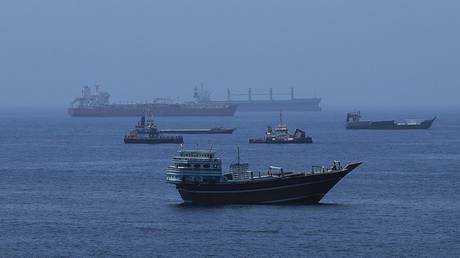
The United Arab Emirates bypassed the wartime blockade of the Strait of Hormuz by deploying a stealth fleet of supertankers to quietly run millions of barrels of crude through the world’s most dangerous chokepoint. This covert logistics pipeline succeeded so thoroughly that Abu Dhabi restored its oil exports close to pre-war volumes before the United States and Iran finalized their recent interim peace agreement. The operational backbone of this multi-billion-dollar gamble was not a state entity or a traditional Western oil major. Instead, the UAE relied on a massive, newly acquired fleet belonging to Sinokor Group, a South Korean shipping company led by the reclusive tycoon Chung Ga-hyun.
By leasing Very Large Crude Carriers (VLCCs) to the Abu Dhabi National Oil Company (ADNOC), Sinokor effectively built a marine conveyor belt that insulated the UAE from the catastrophic supply shocks affecting its regional neighbors.
The Logistics of a Dark Shuttle
When the outbreak of hostilities between the US, Israel, and Iran effectively closed the Strait of Hormuz, global energy markets prepared for prolonged shortages. Traditional shipowners refused to send their assets into a combat zone where insurance premiums surged to prohibitive levels. Abu Dhabi, however, could not afford to lock down its production facilities.
To break the deadlock, ADNOC and Sinokor engineered a high-stakes "shuttle run" strategy. Instead of booking traditional direct voyages from Emirati oil terminals to buyers in Europe or East Asia, Sinokor vessels performed short, rapid loops. They loaded crude at ports inside the Persian Gulf, disabled their automated identification system (AIS) transponders to avoid detection, and slipped through the strait under the cover of night. Once outside the chokepoint in the safer waters of the Gulf of Oman, these "dark" tankers transferred their cargo via ship-to-ship transfers onto conventional vessels bound for global markets.
Data from maritime tracking firms Vortexa and Kpler reveal the sheer scale of the operation. From mid-April, Sinokor-controlled tankers moved an average of 680,000 barrels per day out of the UAE. By June, that figure accelerated to 1.4 million barrels per day. This meant Sinokor single-handedly carried nearly half of all Emirati crude exports during the peak of the regional crisis.
The Seven Billion Dollar Gamble
Chung Ga-hyun’s ability to provide these crucial vessels was the result of a massive, contrarian investment completed just before the conflict began. Throughout late 2025 and early 2026, Sinokor embarked on an unprecedented purchasing spree, spending roughly $7 billion to assemble a private fleet of over 160 tankers. This rapid expansion placed roughly 10 percent of the world's functional VLCC fleet under Sinokor's direct control.
The shipping industry initially viewed the buying binge with deep skepticism. Many analysts questioned why a company rooted historically in intra-Asia container shipping would take on such immense debt to acquire used supertankers. The answer lay in a quiet partnership with Gianluigi Aponte, the founder of Mediterranean Shipping Company (MSC). Backed by MSC’s pandemic-era cash reserves, Sinokor built an immediate supply-side monopoly on uncommitted tonnage.
When the geopolitical crisis struck, Chung did not pull back. He pushed his newly acquired assets directly into the eye of the storm.
The Pure Mathematics of Risk
Operating in a war zone commands a premium that alters standard corporate math. In early 2026, standard spot rates for supertankers hovered around normal historical baselines. As the blockade intensified, Sinokor began commanding daily charter rates as high as $500,000 per day for vessels used as floating storage or combat-zone transport.
To put the revenue into perspective, shipbrokers estimate that just three Sinokor tankers operating on the short UAE shuttle loop since April generated between $60 million and $120 million in pure revenue in under three months. A single vessel purchased second-hand for $88 million in January could effectively pay for itself in less than half a year under these conditions.
| Metric | Pre-War Baseline (2025) | Peak Wartime Chokepoint Rate (2026) |
|---|---|---|
| VLCC Daily Charter Rate | $50,000 - $60,000 | $385,000 - $500,000 |
| Hormuz Transit Freight Cost (per barrel) | $2.50 | $20.00 |
| Sinokor UAE Export Share (June) | < 5% | ~ 50% |
While sovereign states parsed diplomatic cables, Sinokor exploited the structural mechanics of freight derivatives and physical scarcity. The strategy was brutal, transactional, and wildly profitable.
Why the Strategy Outlives the Peace Treaty
The signing of the interim peace deal between Washington and Tehran caused an immediate drop from peak wartime freight rates, but the logistical reality on the water remains highly volatile. The Strait of Hormuz has not simply reverted to its peaceful status quo. Iran retains significant tactical leverage over the waterway, and multiple commercial vessels have been forced to turn back by regional security forces.
Knowing that international buyers remain anxious, Sinokor is aggressively solidifying its dominance. In the final week of June alone, the company dispatched 18 supertankers into the Persian Gulf, positioning enough immediate capacity to move 36 million barrels of crude. Sinokor managers even sent direct notices to international shipbrokers, openly advertising their willingness to pass the Strait of Hormuz for Iraqi and Emirati loadings while other traditional fleets hesitantly waited for further security guarantees.
Sovereign states realized during this conflict that holding oil in the ground is worthless if you lose control of the plumbing. By aligning with an aggressive private operator willing to bypass standard maritime transparency, the UAE protected its market share while its regional competitors faced structural gridlock. The secret pipeline through Hormuz proved that in modern energy warfare, the actor who controls the gray-market tonnage dictates the flow of global capital.