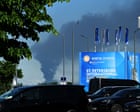
Ukrainian long-range drones struck major energy and military infrastructure in St. Petersburg just as the St. Petersburg International Economic Forum (SPIEF) opened, puncturing the Kremlin’s narrative of economic stability and wartime insulation. The carefully timed strikes ignited a massive fire at the St. Petersburg Oil Terminal and battered the Kronstadt naval base just ten miles from where Vladimir Putin is scheduled to deliver a keynote address. For an event designed to project global confidence and court alternative economic alliances, the thick column of black smoke rising over the Gulf of Finland served as an unscripted, highly visible counter-narrative.
The attack forced a temporary closure of Pulkovo Airport and triggered localized mobile internet blackouts, directly disrupting the arrival of international delegations. Coming hours after a Russian missile barrage killed 23 people across Ukraine, the operation demonstrates Kyiv’s growing capacity to execute deep-penetration strikes that carry substantial economic and psychological leverage.
The Anatomy of an 1,100 Kilometer Strike
Achieving an aerial detonation deep within Russian territory requires sophisticated flight path planning and electronic warfare mitigation. The standard narrative often treats long-range drone strikes as simple asymmetric operations, but hitting St. Petersburg involves navigating some of the densest air defense networks in Eurasia. To reach the Baltic coast from the Ukrainian border, low-flying loitering munitions must cross hundreds of miles of heavily monitored airspace, evading active radar installations and mobile surface-to-air missile batteries.
[Ukrainian Border] ───► (~1,100 km transit via low-altitude path) ───► [St. Petersburg Core]
                                                                            │
                       ┌────────────────────────────────────────────────────┴───────────────────────────────────────┐
                       ▼                                                                                            ▼
         [St. Petersburg Oil Terminal]                                                                        [Kronstadt Naval Base]
   - Major Baltic trans-shipment hub                                                                     - Fleet headquarters & shipyards
   - Sustained critical thermal damage                                                                   - Surface combatant (Boikiy) ignited
Ukraine’s tactical approach relies on a saturation method. By launching mixed swarms of decoy drones alongside armed units, Kyiv forces local Pantsir-S1 and S-400 missile systems to deplete their immediate magazines on false targets. This creates temporary operational blind spots.
The target selection reflects an understanding of Russia’s logistical vulnerabilities. The St. Petersburg Oil Terminal is not merely a regional fuel depot; it serves as a critical trans-shipment hub for maritime petroleum exports that fuel the Kremlin’s federal budget. Simultaneously, the strike on the Kronstadt naval base—which reportedly ignited the Boikiy corvette—challenges the security of Russia’s Baltic Fleet inside its primary home port.
This dual-track targeting confirms that Ukrainian planners are moving away from purely symbolic strikes toward systematic asset degradation.
The Illusion of Normalcy at SPIEF
The Kremlin has long used the forum to project an image of an unshakeable economy that remains integrated with the global financial system. Local administrators went to great lengths to ensure the conference venue appeared isolated from the conflict, implementing strict security cordons and digital restrictions. The physical reality of a burning oil infrastructure visible from the convention center windows destroyed that curation.
The guest list itself highlights the shifting alignment of Moscow's economic focus. The western corporate executives who once dominated the pavilion floors have been replaced by delegations from the Global South, regional partners, and fringe political figures.
Shift in Delegations
- Past Forums: Fortune 500 CEOs, Western European prime ministers, major American investment bankers.
- Current Forum: Official delegations from Saudi Arabia, Cuba, Uzbekistan, and Tanzania; localized business representatives from China and Belarus.
The presence of Saudi Energy Minister Abdulaziz bin Salman Al Saud as a guest of honor underlines the importance of OPEC+ coordination to Russian state revenues. Yet, the parallel attendance of isolated political influencers, former actors, and minor figures reveals the difficulty the Kremlin faces in maintaining the event's historical prestige. While Moscow’s economic envoys attempt to frame the gathering as a assembly of sovereign nations rejecting Western economic hegemony, the physical infrastructure supporting that market is finding itself increasingly vulnerable to long-range interdiction.
The Friction of Long-Range Sanctions
Ukrainian President Volodymyr Zelenskyy has explicitly labeled these operations as a form of kinetic sanctions. The strategic goal is to impose direct financial and logistical friction on the Russian state machinery where diplomatic or economic sanctions fall short. By damaging port infrastructure, refining capabilities, and naval security, Ukraine forces Moscow to reallocate scarce air defense assets from the front lines to protect industrial hubs deep within the interior.
This strategy carries inherent structural risks. Guarding every critical economic node across Russia’s vast geography is mathematically impossible for the Russian Aerospace Forces. When air defense batteries are pulled back to protect oil terminals in the Baltic or manufacturing plants in the Tambov region, defensive coverage over active combat zones in eastern and southern Ukraine thins out.
The broader implication for global energy markets remains complex. While the St. Petersburg terminal is vital for Russian export logistics, sustained disruption to Baltic shipping lanes introduces volatility into broader oil supply chains. This reality complicates relations with Western allies who remain sensitive to global energy price spikes, forcing Kyiv to calibrate its targeting parameters to maximize domestic disruption within Russia while minimizing systemic international shocks.
The Real Air Defense Deficit
The primary takeaway from the St. Petersburg strikes is the widening gap between Russia’s domestic propaganda and its technical capabilities. For years, domestic defense manufacturers marketed automated intercept networks as impenetrable blankets capable of neutralizing any low-altitude threat. The reality on the ground shows that sustained, low-profile drone swarms can consistently exploit gaps in civilian and commercial airspace monitoring.
This structural vulnerability cannot be resolved by simply manufacturing more missiles. It requires integrated electronic warfare coverage and radar systems capable of distinguishing small, composite-material drones from avian activity or commercial traffic in real time. As long as Ukraine maintains production capacity for low-cost, long-range automated munitions, Russia's secondary cities and critical maritime infrastructure will remain within an active combat envelope. The economic consequence is a permanent increase in operational risk premiums for businesses operating within European Russia, changing the long-term calculations for the state's economic survival.