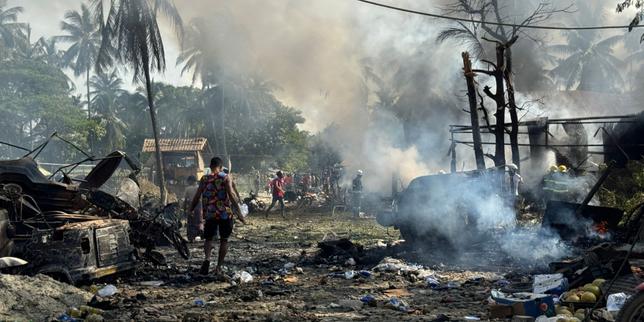
Burma’s western frontier has long served as a laboratory for state-engineered cruelty, but the current escalation in Rakhine State represents a darker mutation of military doctrine. As the ruling junta loses territorial grip across the country, its armed forces have doubled down on a scorched-earth strategy designed to punish civilian populations suspected of supporting insurgent advances. The Myanmar military, cornered by losses against ethnic armed organizations, now relies on systematic massacres, arbitrary executions, and deliberate displacement as tools of survival rather than instruments of conventional warfare. Documented atrocities across townships like Kyauktaw and Mrauk-U reveal a calculated pattern where non-combatants bear the ultimate cost of a crumbling regime's desperation.
For decades, observers watched the Tatmadaw operate with institutionalized impunity. Today, that impunity has transformed into open predation. When frontlines collapse and battalions retreat, military commanders abandon tactical engagement in favor of collective punishment. Entire villages are reduced to ash not because they harbor armed combatants, but because military leadership views the civilian population as an expandable resource of the resistance. This is not collateral damage. It is a deliberate architecture of violence aimed at depopulating strategic corridors and terrorizing communities into submission.
The Anatomy of State-Sanctioned Terror
To understand how Rakhine State descended into its current humanitarian catastrophe, one must examine the mechanics of military deployment. When the Arakan Army launched coordinated offensives seizing vast tracts of territory, the central command in Naypyidaw responded with indiscriminate aerial bombardment and heavy artillery barrages targeting population centers. Schools, religious sites, and makeshift shelters offer no immunity. Survivors recount incidents where troops enter settlements, separate men and boys from their families, and execute them under the pretext of counter-terrorism investigations.
Consider the documented assault on Byain Phyu village, where soldiers rounded up hundreds of residents, subjecting them to severe torture before executing dozens in cold blood. Such operations follow a rigid playbook refined over decades of internal conflict. First comes the intelligence vacuum, filled by blanket suspicion. Then arrives the cordoning of settlements, marked by communications blackouts and restricted humanitarian access. Finally, the violence peaks in public executions and mass arson, sending a chilling message across neighboring districts.
The strategy relies heavily on local militias and proxy networks designed to fracture communities from within. By arming specific factions and stoking historical communal tensions between ethnic Rakhine populations and Rohingya minorities, the regime creates horizontal violence that obscures vertical state responsibility. Analysts tracking the conflict note that this divide-and-rule tactic serves a dual purpose. It weakens local resistance solidarity while providing plausible deniability for military leadership sitting miles away in fortified compounds.
A Two-Sided Squeeze on Vulnerable Populations
Civilians trapped in Rakhine State face an agonizing dilemma as they are caught between a cornered national army and an expanding insurgent administration. While the military remains the primary perpetrator of mass-casualty airstrikes, the Arakan Army has also committed grave violations of international humanitarian law as its territorial control expands. Reports from human rights monitors detail instances of forced labor, arbitrary detention, and targeted abuses against the Rohingya minority residing in newly captured zones.
This dual pressure leaves vulnerable communities with zero safe havens. The Rohingya, who survived the devastating military clearances of 2017, now find themselves navigating a fresh cycle of displacement and systemic marginalization. Restrictions on movement remain crippling, and humanitarian corridors are routinely blocked by both state security forces and insurgent checkpoints. When local populations are treated as tactical threats by both sides, survival becomes an exercise in calculated invisibility. Families ration food in silent cellars while artillery shells whistle overhead, knowing that stepping outside risks immediate detention or worse.
The economic collapse accompanying the conflict compounds these horrors. Hyperinflation, soaring food prices, and the destruction of agricultural infrastructure have pushed hundreds of thousands to the brink of starvation. Fishermen cannot venture out without risking interception; farmers cannot tend fields mined with explosives left by retreating forces. The humanitarian crisis is entirely man-made, sustained by actors who view civilian suffering as an acceptable byproduct of territorial control.
The Economic Engine of Atrocity Financing
Sustaining a multi-front civil war requires immense financial liquidity, and the junta has proven remarkably adept at maintaining cash flows despite international trade restrictions. Natural gas revenues, state-controlled banking channels, and offshore accounts form the lifeblood of military procurement. Foreign currency earnings from energy exports bypass formal transparency standards, flowing directly into the accounts used to purchase aviation fuel, artillery shells, and surveillance hardware from foreign suppliers.
At the same time, the broader regional economy has adapted to the conflict economy. Smuggling rings, illicit resource extraction, and narcotics trafficking networks operating in borderlands provide off-the-books financing for armed actors across the spectrum. The junta relies on these informal channels to circumvent banking blocks, trading timber, gems, and rare earth minerals for military hardware. As long as regional buyers continue purchasing commodities without rigorous supply chain vetting, the financial machinery powering the violence remains fully operational.
This commercial resilience exposes the hollow nature of many diplomatic sanctions. When enforcement mechanisms contain gaping loopholes and neighboring jurisdictions prioritize trade over human rights, economic pressure fails to alter military calculus. Commanders in the field understand that supply lines will remain open regardless of civilian casualties, reinforcing their belief that brute force is a viable long-term governance model.
The Structural Failure of International Deterrence
Diplomatic efforts to halt the bloodshed have repeatedly crashed against the wall of geopolitical indifference and institutional paralysis. The United Nations Security Council remains hobbled by veto dynamics and competing regional interests, leaving local populations to conclude that no international cavalry is coming to their rescue. While international judicial bodies examine state responsibility for historic atrocities, the ongoing violence on the ground continues unabated, outpacing the glacial speed of accountability.
Sanctions targeting the junta's financial lifelines have leaked through porous borders and cooperative regional trade networks, allowing the military to procure aviation fuel, weaponry, and dual-use technology. Neighboring states, prioritizing short-term security and economic arrangements over human rights obligations, frequently engage with the junta as a legitimate governing authority despite its pariah status. This diplomatic hedging breathes life into a regime that should otherwise be isolated into collapse.
Accountability mechanisms face severe evidentiary hurdles. Documenting war crimes in active conflict zones requires immense resources, hazardous fieldwork, and rigorous witness protection protocols that are nearly impossible to maintain when communications are severed. Investigative journalists and human rights monitors rely on fragmented digital footprints, satellite imagery analysis, and hazardous testimonies smuggled across borders. Each verified incident represents a fraction of the actual suffering occurring behind the military's iron curtain.
Behind the Lines of Strategic Impunity
The institutional culture of the Myanmar military ensures that junior officers and foot soldiers anticipate zero consequences for human rights abuses. Promotions depend on battlefield compliance and ruthless enforcement of internal security directives rather than adherence to international conventions. When commanding officers face domestic tribunals or international arrest warrants, the military apparatus circles the wagons, shielding perpetrators behind walls of official denial and fabricated narratives.
This institutional insulation creates an echo chamber of brutality. Soldiers indoctrinated with ultra-nationalist ideology view ethnic minorities and civilian dissenters as existential threats to the state's integrity. Consequently, acts of extreme violence are normalized, celebrated within military ranks as necessary acts of defense. Breaking this cycle requires more than temporary ceasefares or humanitarian aid tranches; it demands the complete dismantling of military supremacy over state governance and the establishment of independent judicial structures capable of trying senior commanders.
Until that structural reckoning occurs, the villages of Rakhine State will continue to burn under the weight of an unyielding campaign. The international community watches from a distance, issuing statements of deep concern while the daily body count climbs. For the families living through this nightmare, history is repeating itself with terrifying precision, driven by a regime determined to rule over ashes rather than surrender power.


