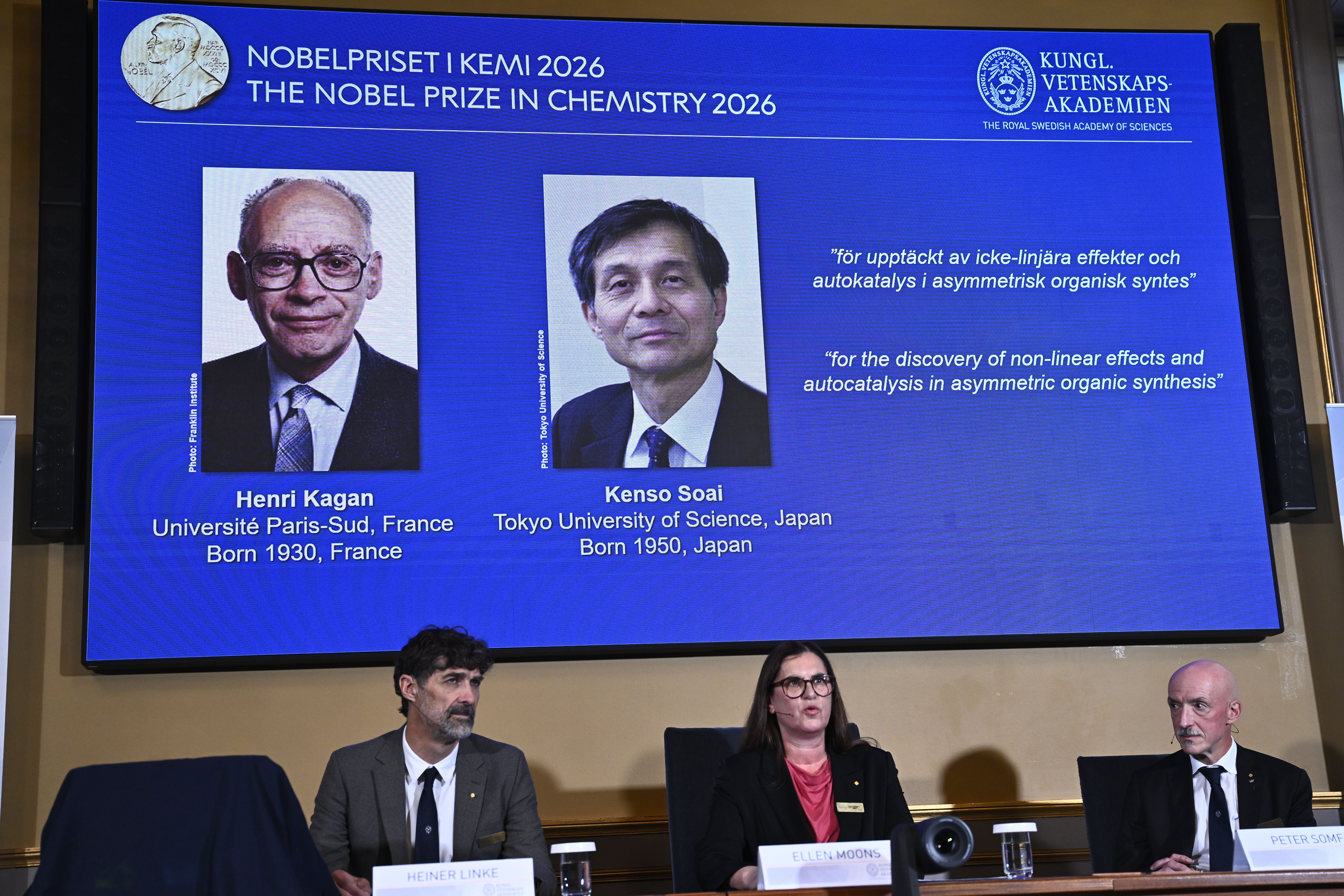
The 2026 Nobel Prize in Chemistry, awarded to Henri B. Kagan and Kenso Soai, marks the official closure of a century-old scientific detective story about why biological life chose a single "handedness" over symmetry. At its core, the recognition honors their work on non-linear effects and autocatalysis in asymmetric organic synthesis. For decades, synthetic chemists struggled with a frustrating reality: when you build molecules in a beaker, nature typically yields a fifty-fifty split of left-handed and right-handed mirror images, known as enantiomers. Biology does not tolerate this ambiguity. Every protein in your body, every strand of DNA, relies exclusively on one mirror-image configuration. Kagan and Soai did not just figure out how to force chemistry to pick a hand; they uncovered the fundamental mechanisms that allowed life to emerge from a chaotic prebiotic soup.
The Tyranny of Chirality in the Molecular World
To understand why this breakthrough matters, look down at your hands. They are mirror images of each other. No matter how you rotate them, your left thumb will never comfortably align on top of the right if both palms face the same direction. Molecules share this exact geometric property, which chemists call chirality.
When a pharmaceutical chemist synthesizes a new drug candidate, the molecular structure often dictates two distinct spatial orientations. Historically, this presented a massive industrial hurdle. As a hypothetical example, imagine a pain relief medication where the left-handed version blocks inflammation, while the right-handed version binds to an unintended cellular receptor, triggering toxic side effects. Separating these mirror images after synthesis is notoriously difficult, expensive, and wasteful.
Before Kagan and Soai altered the trajectory of organic chemistry, laboratories relied on brute-force separation techniques. The underlying assumption in most synthesis was linear: put in a catalyst with a certain optical purity, and you get a proportional optical purity out. That linear worldview collapsed under the weight of empirical evidence supplied by the new laureates.
Henri Kagan and the Power of Non-Linearity
French chemist Henri B. Kagan, working at Paris-Sud University, fundamentally shifted how scientists view catalytic reactions through his discoveries in the 1970s and subsequent decades. Kagan demonstrated that the relationship between the optical purity of a catalyst and the optical purity of the resulting product is frequently non-linear.
This phenomenon, often described mathematically using graphical curves rather than straight lines, revealed that a catalyst with a modest imbalance could be manipulated to generate products with a dramatically higher enantiomeric excess.
To picture this mechanistically, consider a relay race where runners pass a baton. In a linear system, every slow runner slows down the overall team by a fixed amount. In Kagan's non-linear systems, molecular aggregates form dimers or higher-order complexes. If the preferred active species teams up preferentially with itself, it effectively locks out the incorrect mirror image from participating in the catalytic cycle. The bad actors are sidelined, leaving the dominant species to drive the reaction forward with extreme prejudice. This discovery gave industrial chemists an unprecedented diagnostic tool. By observing non-linear effects, researchers could peer directly into the molecular machinery of a reaction vessel and understand precisely how catalysts cooperated or interfered with one another.
Kenso Soai and the Phenomenon of Amplification
While Kagan mapped out the systemic behavior of non-linear catalysts, Japanese chemist Kenso Soai achieved what many thought impossible in a landmark 1995 publication. He discovered an autocatalytic reaction where the product of the reaction acts as the catalyst for its own formation.
In the famous Soai reaction, the asymmetry of the system is not just preserved; it is aggressively amplified. If a reaction starts with even a minuscule initial excess—say, an imperceptible imbalance of one part in a thousand favoring the left-handed product—the autocatalytic feedback loop multiplies that microscopic nudge until the final batch consists almost entirely of a single hand.
This reaction serves as the closest laboratory analog to the origin of life's homochirality ever recorded. For generations, evolutionary biologists and chemists argued over how prebiotic Earth managed to break the symmetry. Did a meteorite strike introduce a slight chiral bias from outer space? Did quartz crystals on early shores filter one form over the other? Soai’s work proved that you do not need a massive external force to maintain purity once a tiny spark of asymmetry exists. The chemistry itself takes over, amplifying the signal and eradicating the noise through self-replication.
Industrial Realities and Modern Synthesis
The transition from academic curiosity to commercial application has reshaped modern manufacturing. Modern chemical synthesis, particularly in the development of complex active pharmaceutical ingredients, agrochemicals, and advanced functional materials, relies entirely on the principles established by Kagan and Soai.
When a modern plant synthesizes an intricate antiviral compound, they cannot afford a 50% yield of inert or dangerous molecular waste. By engineering catalytic systems that exploit non-linear amplification, chemical engineers reduce solvent waste, lower energy consumption, and ensure that human therapeutics interact with biological targets safely and predictably.
Yet, challenges remain on the factory floor. These catalytic cycles are exquisitely sensitive. Minute fluctuations in temperature, trace impurities in solvents, or minor shifts in reagent concentrations can disrupt the delicate balance required to maintain high enantiomeric excess. Scaling these reactions from a university test tube to a multi-ton industrial reactor requires rigorous process control and an acute understanding of the kinetic pathways the laureates spent their lives charting.
The scientific community often waits decades to fully grasp the weight of foundational physical chemistry. With this joint honor, the committee has codified what practitioners in synthesis laboratories have known for years: our ability to control the three-dimensional architecture of matter dictates the boundaries of modern science.
The mirror is no longer neutral, and chemistry bends entirely to our design.
This video provides a helpful overview of the discoveries made by Henri B. Kagan and Kenso Soai regarding asymmetric synthesis and non-linear effects.