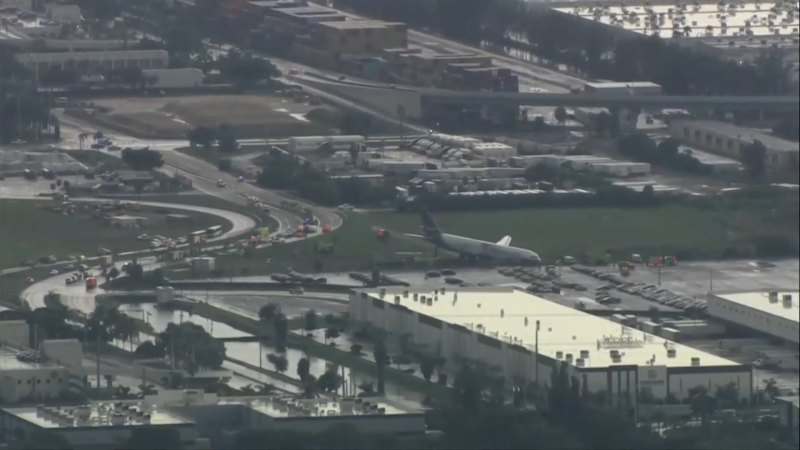
Five people lost their lives when an Amazon Air cargo flight operated by 21 Air overran a runway at Miami International Airport, plowed through perimeter infrastructure, and struck vehicles on a nearby perimeter road. The aircraft, a 32-year-old Boeing 767-300 freighter arriving from San Juan, Puerto Rico, failed to stop within the designated pavement boundaries. It erupted into flames, trapping flight crew in the cockpit and civilians in ground vehicles, exposing deep-seated questions about the intersection of surging e-commerce logistics, aging commercial aircraft conversions, and airport safety margins.
The accident brings immediate scrutiny to the physical risks posed by high-tempo cargo operations operating adjacent to dense urban perimeters. More than sixty emergency response units converged on the site as thick black smoke blanketed the southern sector of the airfield. While investigators from the National Transportation Safety Board and the Federal Aviation Administration sift through flight data recorders and wreckage, aviation safety veterans are looking past the immediate mechanics of the overrun to examine structural pressures within the supply chain network.
The Anatomy of an Overrun
Commercial aviation data indicates that the Boeing 767 freighter was travelling at approximately 112 knots as it exited the usable portion of the runway. Aviation analysts reviewing initial flight tracking parameters point toward a phenomenon known as floating. When a heavy aircraft fails to establish immediate contact within the touchdown zone, it consumes precious linear footage of the runway while remaining airborne on ground effect cushions.
Weather conditions at the time included gusting winds and nearby thunderstorm activity, standard meteorological hazards for South Florida operations, yet variables that demand precise pilot execution. A converted freighter behaves differently than its pristine passenger counterparts. Decades of heavy cargo hauling alter weight distributions, brake system wear patterns, and structural inertia. The aircraft involved had spent over two decades carrying passengers before its conversion to cargo configuration in 2015.
Infrastructure Deficits at Critical Hubs
Runway safety areas come under intense scrutiny following incidents where commercial transport vehicles breach airport perimeters. Miami International Airport lacks engineered materials arresting systems on the specific runway involved. These crushable concrete beds, deployed at more than one hundred airports nationwide under Federal Aviation Administration guidelines, are explicitly designed to deform under the weight of an errant aircraft, safely decelerating it before it breaches perimeter fences.
Without these systems, an aircraft exiting the asphalt retains its forward momentum until it collides with natural terrain, perimeter barriers, or external roadways. Public records show that many legacy major hub airports constructed decades ago struggle to integrate modern runway safety zones without massive capital expenditure or land acquisition plans that disrupt surrounding municipal infrastructure.
The Cost of Same-Day Delivery Pressure
Behind the technical parameters of the flight lies the sprawling infrastructure of modern consumer logistics. Amazon Air has scaled its dedicated cargo network aggressively, relying on contracted carriers like 21 Air to maintain tight delivery windows across domestic and territorial routes. Contract carriers operate under demanding scheduling pressures to feed sorting hubs, maintaining high asset utilization rates that leave narrow margins for maintenance delays or crew scheduling adjustments.
Outsourcing flight operations to regional or specialized carriers allows major tech and retail giants to insulate themselves from direct operational liability while enjoying the fruits of a dedicated logistics grid. When an incident occurs, corporate statements express deep condolences while highlighting that the flight was operated by a third party. This structural buffer between the retailer and the cockpit has become a defining characteristic of contemporary supply chain economics.
Federal investigators will spend months analyzing maintenance logs, weather radar feeds, cockpit voice recordings, and air traffic control transcripts. Yet the broader systemic reality remains untouched. As regional airports shoulder increasing volumes of heavy cargo traffic to satisfy an unyielding appetite for rapid transit, the physical buffers separating commercial flight paths from public roadways continue to face severe operational stress.