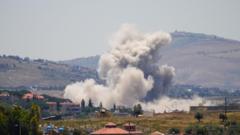
The United States-brokered ceasefire agreement announced between the governments of Israel and Lebanon on June 3 is functionally dead on arrival. Within twenty-four hours of Washington celebrating the diplomatic breakthrough, Hezbollah leader Naim Qassem officially rejected the framework on June 4, labeling the terms a "roadmap for the annihilation" of his constituency. The fundamental reason this truce failed before the ink could dry is structural. The Western mediators attempted to negotiate a peace deal with a sovereign Lebanese government that possesses no actual authority or military leverage over the non-state actor doing the fighting.
By conducting direct talks in Washington with Lebanese Prime Minister Nawaf Salam and President Joseph Aoun, regional diplomats created a phantom accord. Hezbollah, heavily armed and directed by Tehran, was entirely excluded from the negotiating table. The resulting framework demanded that Hezbollah completely halt its operations and evacuate all fighters south of the Litani River, transferring exclusive territorial control to the Lebanese Armed Forces. In similar developments, read about: Why South African Envoys Won't Fix the Xenophobia Crisis.
To the veteran observer, this is a recurring geopolitical delusion. Expecting the regular Lebanese army to forcibly disarm or evict Hezbollah from its southern strongholds is a logistical and political impossibility. The group views such conditions not as diplomacy, but as a demand for unilateral surrender while Israeli troops occupy roughly a fifth of southern Lebanese territory.
The Sovereignty Illusion in Beirut
The international community routinely treats Lebanon as a conventional nation-state where executive decisions in the capital translate to compliance on the ground. This approach ignores the reality of a fractured state. The Lebanese Armed Forces are vastly outgunned by Hezbollah, which operates as a state within a state. When the Trump administration pushed for the implementation of "pilot zones" where non-state actors would be barred, it ignored the lack of domestic enforcement mechanisms. NPR has provided coverage on this fascinating topic in great detail.
Prime Minister Nawaf Salam warned that those rejecting the truce would bear the consequences of ongoing destruction. Yet, his administration holds no cards. Hezbollah’s legitimacy among its base is rooted in its identity as a resistance force against foreign occupation. Asking the group to pack up and retreat while the Israeli military establishes a self-declared buffer zone inside Lebanon contradicts the very core of the militia's doctrine.
The Shadow of the Wider Iran War
The current conflict in Lebanon cannot be separated from the broader regional escalation that erupted on March 2. Following joint Western and Israeli strikes on Iran, Hezbollah entered the fray to relieve pressure on its primary benefactor. Consequently, any local truce in southern Lebanon is intimately tied to the geopolitical objectives of Tehran.
Iran’s foreign ministry quickly backed Hezbollah’s rejection, asserting that Lebanon is an integral part of any final comprehensive regional agreement. Esmail Qaani, head of the Islamic Revolutionary Guard Corps' Quds Force, publicly reinforced this stance by demanding a return to pre-war positions. Tehran is using the leverage of Hezbollah's arsenal to force concessions in broader negotiations, notably regarding the shipping blockades in the Strait of Hormuz that have rattled global energy markets.
[March 2] Regional Escalation -> [April 16] Initial 10-Day Truce -> [June 3] US-Brokered Deal -> [June 4] Hezbollah Rejection
The April 16 ceasefire, which managed to temporarily shield Beirut from heavy bombardment in exchange for a reduction in cross-border rocket fire, proved that temporary de-escalation is possible only when tactical benefits align for both combatants. The June 3 framework abandoned that pragmatism in favor of ambitious, unrealistic political demands.
Tactical Realities on the Ground
While diplomats debated in Washington, the reality on the ground remained bloody and unchanged. On June 4, Israeli airstrikes pounded the Nabatieh area and the western Bekaa Valley, resulting in at least four civilian casualties and the death of a United Nations peacekeeper caught in the crossfire. Concurrently, Hezbollah continued targeting Israeli units operating near the village of Qantara.
Israeli Defense Minister Israel Katz made it clear that Israel will maintain its military presence in the south for the foreseeable future, emphasizing that the military retains total freedom of action to strike targets if northern communities are threatened. This creates an unresolvable paradox. Israel will not withdraw until Hezbollah retreats, and Hezbollah will not retreat while Israel occupies its villages.
The diplomatic corps has scheduled another round of talks for the week of June 22, but without a fundamental shift in strategy, these meetings will yield the same results. Peace cannot be negotiated through proxies who lack the power to enforce the terms of the contract. The conflict will continue to grind on, driven not by the dictates of Beirut, but by the strategic calculations of commanders in the field and their patrons in Tehran.