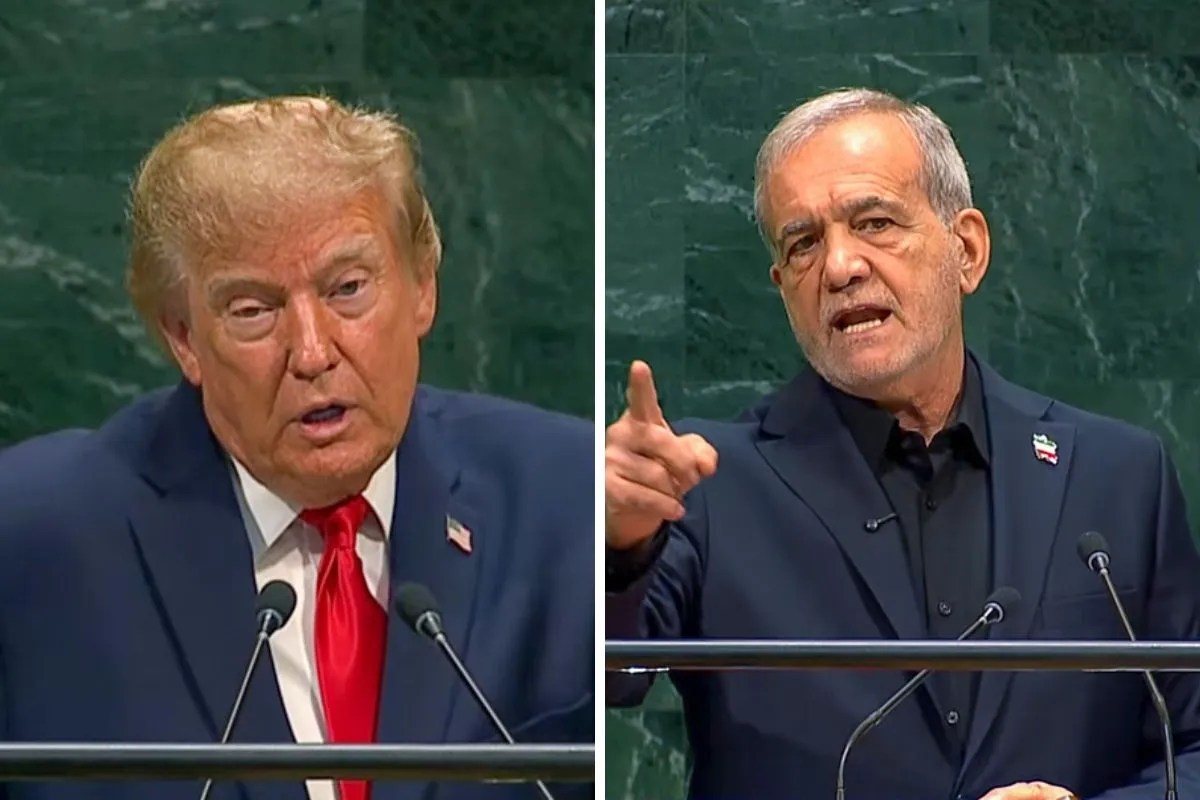
When Iranian President Masoud Pezeshkian touched down in Antalya, Turkiye, in mid-November 2026 for the COP31 climate summit, he did not arrive speaking the language of carbon markets or grid electrification. He arrived with a pointed indictment aimed straight at Washington. Before stepping onto the tarmac, Pezeshkian used social media to ask a blunt question that cut through the diplomatic formalities of the Mediterranean gathering: who threatens global peace and security? Pointing to the conflict that erupted earlier in the year, the deployment of the Precision Strike Missile in Lamerd, and rhetoric invoking the "Mother of All Bombs," he framed American military power and coercive diplomacy as a direct hazard to international order.
Anyone who has covered West Asia for thirty years knows that leaders rarely bring raw battlefield grievances to a climate conference by accident. Pezeshkian was not simply venting in front of a global press corps. He was trying to shift the moral and strategic ledger at a moment when Iran is squeezed militarily, choked economically, and searching for diplomatic traction among neighbors and great powers alike.
The question Pezeshkian posed is simple. The reality behind it is anything but.
What Pezeshkian Put on Trial in Antalya
Look closely at the three pillars of Pezeshkian's accusation. Each one points to a specific flashpoint in the 2026 confrontation between Washington, Tel Aviv, and Tehran.
First came the war itself. Following the brief June 2025 clash, large-scale hostilities reignited in late February 2026. Washington argued the campaign was necessary to stop Iran from acquiring nuclear weapons, while Iranian officials denounced it as unlawful aggression aimed at reshaping the regional balance by force.
Second was the use of the Precision Strike Missile (PrSM) in the southern Iranian city of Lamerd. Developed by Lockheed Martin as a long-range surface-to-surface replacement for older tactical missiles, the PrSM is marketed for speed, range, and precision. Yet investigations by conflict monitor Airwars and the Associated Press into the February 28 strikes in Lamerd raised sharp questions about how the weapon behaved near populated neighborhoods and a sports complex, where dozens of civilians—including children—were killed or injured. U.S. military officials have disputed responsibility or denied targeting civilians, maintaining that American forces do not strike civilian sites deliberately. Still, weapons specialists and former legal advisers warned that dispersing high-density tungsten pellets near residential areas carries severe risks for bystanders outside protective walls.
Third was the looming specter of the GBU-43/B Massive Ordnance Air Blast, widely known as the "Mother of All Bombs". Weighing roughly 21,600 pounds, it is a massive conventional air-burst munition built to create an enormous shockwave rather than penetrate deep subterranean rock. Analysts and former Iranian officials have noted that while such a weapon is poorly suited for deep underground missile complexes, invoking it signals an appetite for overwhelming shock against surface targets, energy nodes, or major infrastructure if talks stall.
Pezeshkian framed American escalation as proof that Washington treats diplomacy as an extension of coercion. Critics of Tehran see the exact same sequence—missile strikes, nuclear brinkmanship, and regional proxies—as proof that Iran's own behavior forced the crisis onto the table.
That clash of interpretations is why global security feels so brittle right now. Neither side views its own actions as the spark. Each sees the other as the arsonist.
Why This Message Landed in Turkiye
Choosing Turkiye as the stage for this broadside was deliberate. Antalya was hosting COP31 under Ankara's presidency, drawing heads of state, energy ministers, and international media into one place. By tying environmental devastation to modern warfare—asking how world leaders could debate Earth's future while ignoring the physical destruction of conflict—Pezeshkian tried to link Iran's security plight to a broader Global South audience.
At the same time, Pezeshkian used the margins of the summit to mend fences and test diplomatic openings. He held meetings with Turkish President Recep Tayyip Erdogan, Iraqi President Nizar Amedi, Norwegian Prime Minister Jonas Gahr Store, and other regional and international figures.
Ankara occupies an awkward, vital middle ground. As a NATO member bordering Iran and managing complex ties with both Washington and Moscow, Turkiye has an obvious interest in preventing a wider war on its doorstep. Trade corridors, refugee flows, and energy transit all sit in the line of fire if hostilities spiral. Hosting Pezeshkian while keeping channels open to Western capitals allows Ankara to project indispensable centrality, even as the summit itself struggled through bruising divisions over fossil fuels and climate finance.
Still, sympathy for Pezeshkian's rhetoric at a climate summit has limits. Many diplomats in Europe and the Middle East view Tehran's grievances selectively. They point out that Iran has fired on regional bases, backed armed groups across the region, and faced repeated warnings from Western governments over military cooperation with Moscow. When a government cites civilian harm while its own security apparatus threatens bases across West Asia and even Europe, its moral argument runs straight into credibility hurdles.
The Hidden Mechanics of Pressure and Escalation
To understand why tensions remain near boiling point even amid diplomatic chatter, you have to look past speeches and trace the twin engines driving the standoff: economic strangulation and horizontal escalation.
Economic Strangulation and Task Force Iron Gate
Military strikes grab headlines, but economic pressure is doing quiet, grinding damage inside Iran. U.S. naval enforcement in the Persian Gulf and Gulf of Oman has sharply curtailed Tehran's seaborne crude exports, with U.S. Central Command estimating more than $25 billion in lost oil export revenue over recent months.
To plug the leaks that usually save sanctioned states, Washington moved overland and maritime. On November 7, 2026, CENTCOM announced Task Force Iron Gate, a joint military and civilian effort aimed at monitoring and disrupting smuggling routes across Iran's land borders and the Caspian Sea. The goal is straightforward: choke off illicit revenue streams along with flows of dual-use technology and weapons components.
Inside Iran, the strain is visible everywhere. Officials have warned of potential winter gas shortages, inflation and currency distress have hammered households, and public frustration has flared over visible investments in underground military infrastructure alongside everyday economic hardship and concerns over civilian shelters. For Pezeshkian, who ran on pragmatism and economic relief, governing under a tightening economic vise leaves almost no room for error.
Threats Stretching Beyond the Region
Cornered states rarely fold quietly; often, they try to raise the cost of pressure until the other side blinks. In the days surrounding Pezeshkian's trip to Turkiye, senior Iranian security and military figures warned that any renewed American attack would not stay confined to nearby bases. Officials and hardline outlets pointed to U.S. and allied facilities in Europe and the Indian Ocean.
That threat is not purely rhetorical noise. Weeks earlier, the U.S. military adjusted aircraft and tanker deployments at British bases amid intelligence concerns over Iran-linked threats, while Washington also heightened security measures for senior officials at home.
At the same time, Tehran has leaned heavily on diplomatic backing from Moscow and Beijing. Russian officials have signaled readiness to help mediate while insisting disputes cannot be settled by force alone, giving Iran political cover even as both countries navigate their own strategic calculations.
What the Competitor Missed and What Comes Next
Most fast-turn news reports treat Pezeshkian's arrival in Turkiye as a simple soundbite war: Iranian president blames America, Washington fires back. That framing misses the real friction underneath.
First, authority inside Tehran is divided by design. Even when Pezeshkian speaks in measured or diplomatic tones—or hints at conditions for talks—final strategic control over nuclear policy, armed forces, and retaliatory doctrine rests with the supreme leader and security establishment, not the presidency. Treating Pezeshkian's words as a standalone policy pivot overstates what his office can deliver on its own.
Second, Washington and its allies face their own strategic dilemma. Maximum pressure and military deterrence can degrade capabilities and squeeze revenues, yet coercive threats alone rarely produce a durable settlement. If talks fail and another round of strikes begins, capitals do not necessarily share the exact same end-state—whether that is containment, regime concession, or a frozen standoff that keeps flaring up every few months.
Consider a hypothetical scenario to see how fragile this balance is: suppose an accidental maritime clash or a misread drone intercept near the Gulf triggers limited retaliatory fire. Neither Washington nor Tehran might want a full-scale war of attrition, yet domestic political pressures, alliance commitments, and fear of looking weak could push both sides up the escalatory ladder faster than diplomats can catch up.
That is the real danger Pezeshkian's outburst exposed in Antalya—not just a war of words between two capitals, but a security architecture where every move carries unintended blowback for ordinary people far from the command rooms. Watch the border transit corridors targeted by Task Force Iron Gate, track any quiet backchannel movement through regional mediators like Turkiye and Qatar, and pay close attention to whether words in Antalya translate into restraint or merely buy time before the next shock.