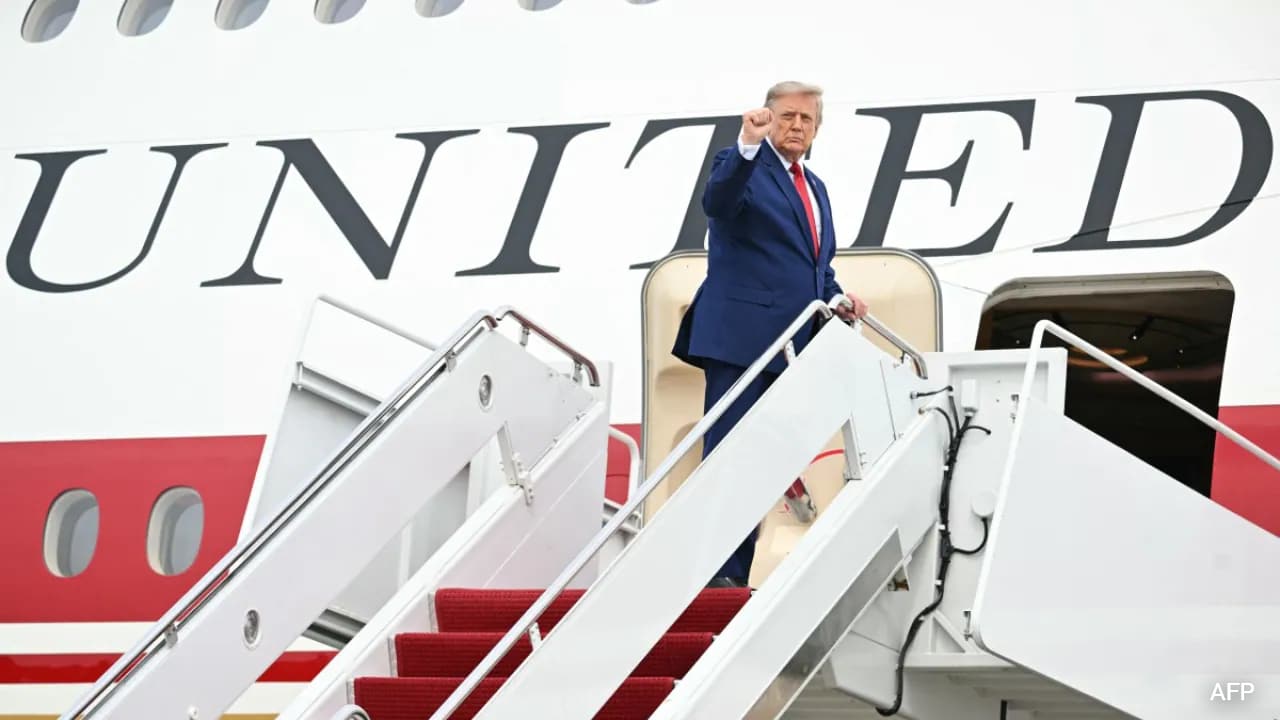
When an American president boards a signature blue-and-white aircraft in full view of the international press corps, the expected choreography is absolute. The stairs pull away, the engines scream to life, and a global superpower projects unmitigated mobility across international airspace. But on a scorching tarmac in Ankara following the NATO summit, that choreography was deliberately shattered.
Faced with an urgent, high-consequence intelligence warning regarding a potential surface-to-air missile threat linked to regional hostilities with Iran, the United States Secret Service executed a clandestine extraction. President Donald Trump did not fly out of Turkey on the aircraft he publicly boarded. Instead, hidden inside the claustrophobic confines of an airport catering truck, the commander-in-chief was covertly transferred across the flight line to an unmarked military jet while the larger presidential plane functioned as an airborne decoy.
The operation sheds harsh light on the fragile margins of modern executive protection, where the omnipresent proliferation of advanced tactical weaponry forces security details into desperate, last-minute deception maneuvers.
The Anatomy of an Emergency Departure
The sequence of events on that July evening unfolded with the terrifying speed typical of actionable counter-terrorism intelligence. According to officials briefed on the operation, intelligence streams picked up a specific, credible plot aimed at targeting the presidential flight with a shoulder-fired missile upon departure from the Turkish capital.
The tactical reality of a shoulder-fired system—often designated as a Man-Portable Air-Defense System or MANPADS—presents a nightmare scenario for aviation security. These weapons are notoriously difficult to track because they do not emit the continuous radar-guidance signatures that standard military countermeasures are engineered to deflect. Modern iterations frequently incorporate advanced heat-seeking or laser-guided optics capable of locking onto high-temperature engine exhausts during the critical, low-altitude vulnerability window of takeoff.
With limited time to construct a completely alternative routing schedule, security leadership opted for immediate physical deception. Trump initially walked up the mobile staircase into the main cabin of an older Air Force One variant—a choice he had publicly attributed to nostalgia—while cameras recorded the moment for public consumption.
Once inside the privacy of the cabin, the reality shifted. A high-lift catering vehicle was positioned flush against the service doors on the opposite side of the fuselage. Under the cover of the elevated food container, Trump and a tight circle of close aides slipped out of public view, dropped down to the tarmac level, and were ferried across the military apron to a smaller Boeing C-32A jet.
Minutes later, the primary aircraft taxied down the runway and departed carrying senior cabinet officials—including Secretary of State Marco Rubio and Treasury Secretary Scott Bessent—alongside the traveling press pool. The press corps, instructed to keep their window shades drawn, remained entirely unaware that the president was flying thousands of feet away on an entirely different flight path.
The Strategic Fallout of Intelligence Leaks
While the immediate operational deception succeeded in moving the president out of harm's way, the subsequent revelation of the maneuver triggered intense friction within the administration. Classified methodologies regarding executive transport, decoy routing, and emergency transfer protocols spilled into public view, sparking frustration among security officials.
When protective details are forced to rely on public exposure of their contingency protocols, their long-term effectiveness degrades. Adversaries study these accounts to map out the exact thresholds required to trigger a disruption of American command-and-control logistics. The incident underscores a wider systemic vulnerability: the intersection of high-end state-level conflict and the porous security environments of foreign host nations.
Turkey sits at a volatile geopolitical crossroads, sharing borders and deep intelligence exposure with actors deeply hostile to Washington. The granular precision of the reported threats—reaching down to knowledge of local schedules and physical movements—demonstrates that traditional diplomatic airfields can rapidly transform into high-risk battlegrounds.
Redefining Presidential Vulnerability
President Trump later downplayed the logistical disruption, noting to reporters that he simply follows the directives of the military and the Secret Service, while wryly suggesting that the smaller alternative jet may have carried an even higher statistical risk profile due to its lower profile. Yet, the psychological weight of the Ankara evacuation lingers.
Decoys and catering truck transfers belong in the playbook of active war zones, not standard diplomatic missions to NATO allies. As regional missile proliferation accelerates and non-state proxies acquire advanced anti-aircraft capabilities, the physical sanctity of the American presidency faces an era of unprecedented atmospheric hazard. The blue-and-white symbol of executive power is no longer an absolute shield, and the margin between routine diplomacy and airborne ambush grows thinner by the hour.
Inside the Secret Air Force One Switch After Iranian Missile Threat
This video provides additional context and visual breakdown regarding the security protocols and intelligence assessments surrounding the secret aircraft switch in Turkey.
http://googleusercontent.com/youtube_content/1