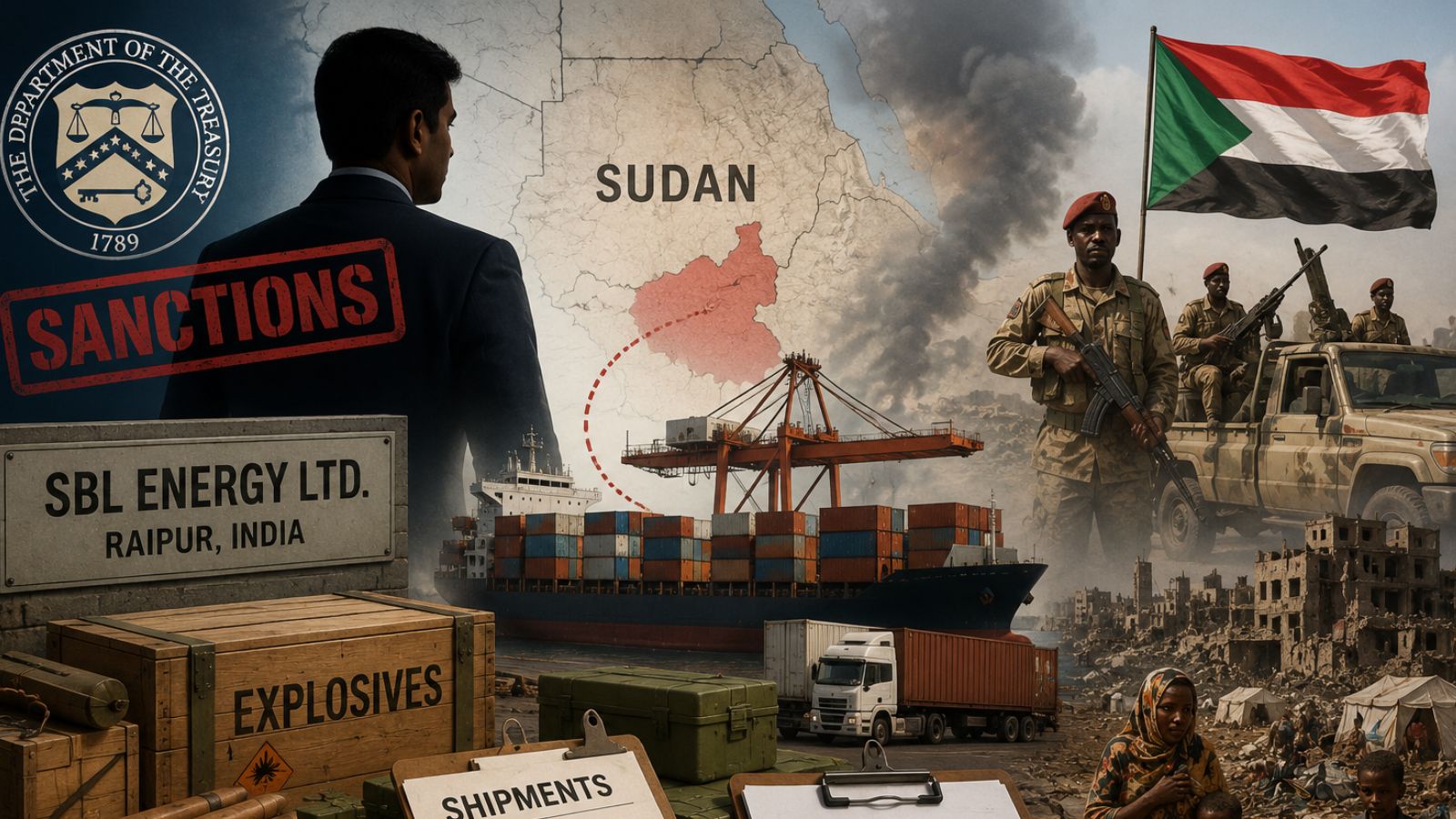
The United States government moved to choke off the shadow supply chains keeping the catastrophic civil war in Sudan alive. In a coordinated action, the US Treasury Department Office of Foreign Assets Control blacklisted eight individuals and entities spanning India, Sudan, Egypt, and Panama. At the center of the crackdown is Alok Choudhari, an Indian corporate executive accused of funneling over 200 secret shipments of industrial explosives to a front company feeding the Sudanese military bomb-making factories.
The enforcement action exposes the terrifying reality of modern proxy conflicts. War is rarely just an internal affair. It relies on a sprawling, highly specialized global network of commercial suppliers, shell corporations, and mercenary recruitment operations willing to profit from state collapse. By tracing the flow of commercial explosives from central India to the frontlines of Khartoum, Western intelligence agencies have revealed how easily standard international trade channels can be repurposed for mass destruction.
The Raipur Pipeline
SBL Energy Limited operates far from the geopolitical friction points of Northeast Africa. Based in the industrial hub of Raipur in Chhattisgarh, India, the company is also known in commercial registries as Amin Explosive Private Limited. Under the leadership of Chief Executive Officer Alok Choudhari, the firm specialized in manufacturing industrial explosives, the kind typically used in mining, quarrying, and infrastructure development.
The industrial capability to move mountains for mining is identical to the capability required to blast civilian infrastructure.
According to federal tracking data released by Washington, SBL Energy systematically bypassed international scrutiny to deliver massive quantities of these volatile materials directly into the hands of the Sudanese Armed Forces. The intermediary was a Sudan-based entity named Target Multiactivities Company. On paper, it appeared to be a standard commercial enterprise. In reality, US investigators established that it functioned as a key procurement arm for the military logistics apparatus in Sudan.
The sheer volume of the trade highlights a prolonged logistics operation rather than an accidental diversion. Over 200 distinct shipments of explosives and related materials moved through this pipeline. Once the cargo cleared the ports and reached its destination, Target Multiactivities Company transferred the materials to the Sudanese military ordnance networks. The explosives were immediately packed into aviation bombs and artillery shells, deployed by the air force in its sweeping bombing campaigns across populated urban zones and rural strongholds alike.
The Military Industrial Complex of Khartoum
To understand how a commercial explosives manufacturer in India ends up fueling an African civil war, one must look closely at the architecture of the Sudanese defense sector. The primary recipient of the Indian shipments was the Defense Industries System, the massive state-owned conglomerate that controls Sudan's domestic arms manufacturing.
The Defense Industries System is not a traditional military branch. It is a multi-billion-dollar corporate empire.
For decades, this conglomerate has maintained total control over the Sudanese economy, operating factories, assembly plants, and import networks through an opaque web of subsidiaries. One of its primary arms is the Giad Industrial Group, an enterprise previously blacklisted by Washington that builds everything from military vehicles to heavy artillery components. When international arms blockades made it difficult for Sudan to purchase factory-ready munitions, the military leadership shifted its strategy toward domestic assembly. They imported the raw components, the chemicals, and the industrial explosives needed to manufacture their own ordnance on-site.
This strategy relies heavily on international civilian partners who look the other way. The Treasury Department explicitly noted that the Defense Industries System has consistently used these complex corporate structures to acquire technology, specialized materiel, and logistics support from external backers, including state actors like Iran. By inserting companies like Target Multiactivities Company and its general manager, Tariq Hussain Muhammad Madani, into the paperwork, the Sudanese military created a buffer that allowed foreign suppliers to claim ignorance of the final destination of their goods.
Port Sudan and the Maritime Network
The Indian pipeline was not the only logistics corridor targeted in the latest round of sanctions. Maritime trade routes through the Red Sea remain the primary artery for keeping the Sudanese military operational. The blacklisting of Ports Engineering Company Limited, a state-owned civil engineering and construction firm based in Port Sudan, underscores this systemic vulnerability.
Established in 1998, Ports Engineering Company was ostensibly tasked with infrastructure development and harbor maintenance. However, intelligence tracking revealed the firm was operating as a cover for specialized military procurement. Since the current conflict erupted in April 2023, the firm used its maritime access to bring in specialized equipment for Sudanese state intelligence.
The manifests of these shipments reveal a highly organized supply chain. The firm imported military uniforms and specialized footwear sourced from companies located in the United Arab Emirates. Simultaneously, it managed the intake of ammunition belts and weapon storage cases manufactured by suppliers in Turkey. By utilizing a state-owned port authority to process these imports, the Sudanese military ensured that shipments cleared customs without standard international inspections, blending war supplies into the daily flow of commercial maritime traffic.
The Mercenary Pipeline
While the Sudanese Armed Forces relied on Indian explosives and Turkish hardware to maintain their conventional superiority, their rivals, the Rapid Support Forces, turned to a completely different type of globalized supply chain. The paramilitary group has consistently looked across borders to solve its personnel deficit, relying heavily on foreign fighters to sustain its operations.
The US treasury enforcement exposed a highly sophisticated transnational recruitment network operating out of Latin America.
At the center of this human trafficking operation for combat is a retired Colombian military officer, Alvaro Andres Quijano Becerra, and his wife, Claudia Viviana Oliveros Forero. Working through a Panama-based shell corporation named Talent Bridge SA, the network systematically recruited combat-hardened former Colombian soldiers to fight as mercenaries alongside paramilitary units in Sudan.
The operation utilized the corporate structure of Talent Bridge to mask the movement of funds and personnel. Panamanian nationals Enrique Daniel Palacios Quintanilla and Jack Peter Derman Guzman, alongside Colombian executive Fredy Alejandro Lopez Ocampo, managed the corporate filings, bank accounts, and international travel logistics that allowed these fighters to transit from South America to the battlefields of East Africa. This cross-continental pipeline highlights how specialized corporate entities can be weaponized to traffic military labor into active war zones under the guise of private security consulting.
The Reality of Sanctions Enforcement
The immediate consequence of these designations is the absolute freezing of all assets, bank accounts, and property held by these individuals and companies within the jurisdiction of the United States. Furthermore, it prohibits any US citizen or global financial institution utilizing the US dollar clearing system from conducting any business with them. For a corporate executive like Alok Choudhari or an international enterprise like SBL Energy, this is an existential commercial blow. It cuts them off from the global banking system entirely.
Yet, seasoned analysts recognize that unilateral financial restrictions are a game of whack-a-mole. The profit margins available in illicit arms and explosives procurement are high enough to incentivize continuous adaptation. When one front company is blacklisted, another is registered under a different name in a separate jurisdiction within weeks.
The underlying problem is the structural weakness of export control enforcement in manufacturing nations. Industrial explosives are dual-use items. They are required for legitimate economic activity worldwide. Without rigorous, continuous end-user verification by domestic authorities in exporting countries like India, the burden of detection falls entirely on foreign intelligence agencies monitoring the back-end of the supply chain.
The conflict in Sudan has caused unparalleled devastation, displacing millions and inducing widespread famine. The battlefield is kept active not by domestic resourcefulness, but by a steady stream of foreign inputs. Tracing the trajectory of an explosive charge from a factory floor in Raipur to a cratered neighborhood in Khartoum reveals that stopping the violence requires confronting the corporate boardrooms and logistics coordinators who treat human catastrophe as a market opportunity.