Georgia is running out of time to figure out how it will count votes for the upcoming elections. Under a law passed two years ago, the state will ban the use of Quick Response (QR) codes for official vote tabulation on July 1. This leaves local election offices with a catastrophic mandate: stop using the core software mechanism of their existing voting machines, but with no funded, certified alternative in place to actually count the ballots. Republican Governor Brian Kemp has called a special legislative session to address the crisis, forcing lawmakers to confront an election administration trainwreck of their own design.
The immediate emergency stems from Senate Bill 189, passed in 2024 by a Republican-led legislature eager to appease a vocal base convinced that electronic voting machines are inherently compromised. The law dictates that the official tally from any ballot scanner must rely strictly on human-readable text or visible marks, explicitly outlawing the machine-readable barcodes that Georgia’s Dominion voting systems use to register selections. It was a classic piece of performative legislation. Lawmakers passed the ban, took credit for securing the ballot box, and then walked away for two straight legislative sessions without appropriating a single dollar or approving a single alternative system to replace the outlawed technology.
Now, the state’s 159 counties find themselves trapped in a bureaucratic nightmare. They are caught between a hard statutory deadline and the terrifying reality that democracy cannot function without an operational mechanism to count votes.
The Illusion of the Paper Trail
To understand how Georgia ended up on the brink of an election meltdown, one must understand how the state actually votes. In 2019, following a federal court order that declared Georgia’s old, paperless touchscreen machines unconstitutional, the state spent more than $100 million on a sweeping modernization effort. They purchased a uniform, statewide system of electronic ballot-marking devices (BMDs).
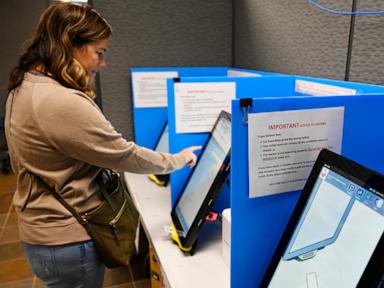
When a voter goes to the polls in Georgia, they do not use a pen to mark a ballot. They sit at a touchscreen kiosk, make their selections electronically, and hit print. The machine spits out a paper card. To the human eye, this card lists the names of the chosen candidates in plain text. But in the corner of that same paper card sits a small, square QR code.
+------------------------------------+
|  GEORGIA OFFICIAL BALLOT           |
|                                    |
|  PRESIDENT: Jane Doe      [QR CODE]|
|  SENATE: John Smith       [QR CODE]|
|                           [QR CODE]|
|  [Human-Readable Text]             |
+------------------------------------+
                  |
                  v
         [TABULATION SCANNER]
                  |
       Reads ONLY the QR Code
 (Human text is ignored during count)
When the voter drops that paper into the scanner, the scanner does not read the English text. It reads the QR code. The code is the actual vote; the text is merely a receipt for the voter.
This hybrid architecture has infuriated a bizarre coalition of election security experts, progressive voting rights advocates, and conservative conspiracy theorists. The fundamental critique is simple: a voter cannot verify what a QR code actually says. If a machine were compromised, it could theoretically print "Candidate A" in text for the voter to see, while encoding "Candidate B" within the black-and-white matrix for the scanner to count.
While there is no evidence that such manipulation has ever occurred in a Georgia election, the psychological friction of the unreadable code proved too politically toxic to sustain. Senate Bill 189 sought to kill the code entirely. The problem is that the state's entire infrastructure is built to read it.
The Half Million Dollar Loophole
Faced with a complete lack of legislative funding to buy entirely new voting machines—a process that state officials estimate would cost upward of $300 million—Secretary of State Brad Raffensperger has proposed a highly controversial, technical workaround.
The plan involves a multi-step patch. Under this guidance, voters will still use the existing touchscreen kiosks, and those kiosks will still print ballots containing QR codes. When those ballots are inserted into precinct scanners on election night, the scanners will still read the QR codes to generate an instantaneous, unofficial preliminary count.
The legal acrobatics happen immediately after. Before the county can officially certify the results, the electronic ballot images captured by those scanners will be uploaded to a centralized server. There, proprietary Optical Character Recognition (OCR) software will scan the digital images, read the human-printed text, and tabulate a second, text-based count. This OCR tally will then be declared the "official" tabulation required by law.
Raffensperger pitches this as a masterstroke of fiscal conservatism, claiming it will cost just $300,000 to implement statewide rather than the tens of millions required to overhaul the physical hardware.
But election security experts are horrified. Computer scientists from institutions like Princeton University’s Center for Information Technology Policy have already flagged the plan as a glaring security vulnerability. The core flaw is one of system integrity. If the underlying scanner software or the centralized server running the OCR software is hacked, the digital images themselves can be manipulated or misread.
Furthermore, the legality of this bypass is highly suspect. Senate Bill 189 explicitly states that the official tabulation count of a ballot scanner must be based on the text portion or machine mark at the time of scanning. Processing digital images on a secondary server after the fact stretches the definition of "scanner tabulation" to a breaking point, practically inviting a wave of post-election lawsuits from whatever faction loses the next vote.
The Chaos of the Hand Count Alternative
With the OCR workaround facing legal headwinds and the QR code ban taking effect, activist groups are pushing aggressively for the nuclear option: discarding the electronic ballot-marking devices altogether and moving to hand-marked paper ballots tallied by hand.
It is an idea that sounds beautifully simple around a kitchen table but collapses under the weight of modern logistical realities. Georgia’s election administrators are unified in their opposition to hand-counting, warning that it is a recipe for human error, massive delays, and astronomical costs.
The data backs them up. Secretary of State office audits of recent primary elections reveal that human beings are remarkably bad at counting paper. In a recent audit of over two million ballots, the state’s automated systems achieved a near-flawless accuracy rate. Out of the tiny handful of discrepancies discovered during the review, more than 90% occurred on hand-marked paper ballots where voter intent was ambiguous, checkmarks strayed outside the bubbles, or human counters simply miscounted.
The sheer scale of a statewide hand count is daunting. During the 2020 election cycle, a hand-count audit of just a single statewide contest required Fulton County to deploy roughly 275 two-person teams working full-time for nearly five days. Scaling that process to encompass an entire ballot—which features dozens of hyper-local races for city councils, school boards, judicial seats, and congressional districts—would require an army of temporary workers that rural counties do not have and cannot afford.
Local election supervisors are already operating on shoestring budgets. They are currently tasked with printing ballots, programming equipment, and training poll workers under a set of rules that change by the week. Forcing them onto a manual system without training or infrastructure would guarantee that results would not be known for weeks, creating a toxic information vacuum ripe for exploitation by bad actors.
A Crisis of Authority
The underlying rot in Georgia’s election ecosystem is not technological. It is institutional. The state is currently locked in a three-way power struggle between a legislature that passes laws without funding them, a Secretary of State attempting to engineer technical loopholes, and a State Election Board that has repeatedly overstepped its administrative bounds to issue conflicting rules.
Consider the timing. A special election to fill the seat of the late U.S. Representative David Scott is scheduled for late July, with early voting beginning mere days after the July 1 QR code ban takes effect. The six counties involved in that congressional district are effectively serving as guinea pigs for an untested, legally dubious counting methodology. They have received preliminary, subject-to-change guidance from the state, but no finality.
This is the hidden cost of weaponizing election administration for short-term political points. When a governing body outlaws the operational framework of its own voting infrastructure without providing a replacement, it abdicates its primary responsibility to the public. It leaves the machinery of democracy running on a wing, a prayer, and a patch of uncertified software.
The special session called by Governor Kemp offers a brief window to avert a systemic failure. Lawmakers could swallow their pride and pass a clean extension of the deadline, pushing the QR code ban out to 2028 to allow for a responsible, funded transition to a text-scanning infrastructure. They could explicitly legalize and appropriate funds for a secure OCR system that meets federal voting system standards. Or they could do nothing, letting the clock run out and leaving the state’s upcoming elections to be decided not by clear statutory mandates, but by the inevitable rulings of emergency court judges.