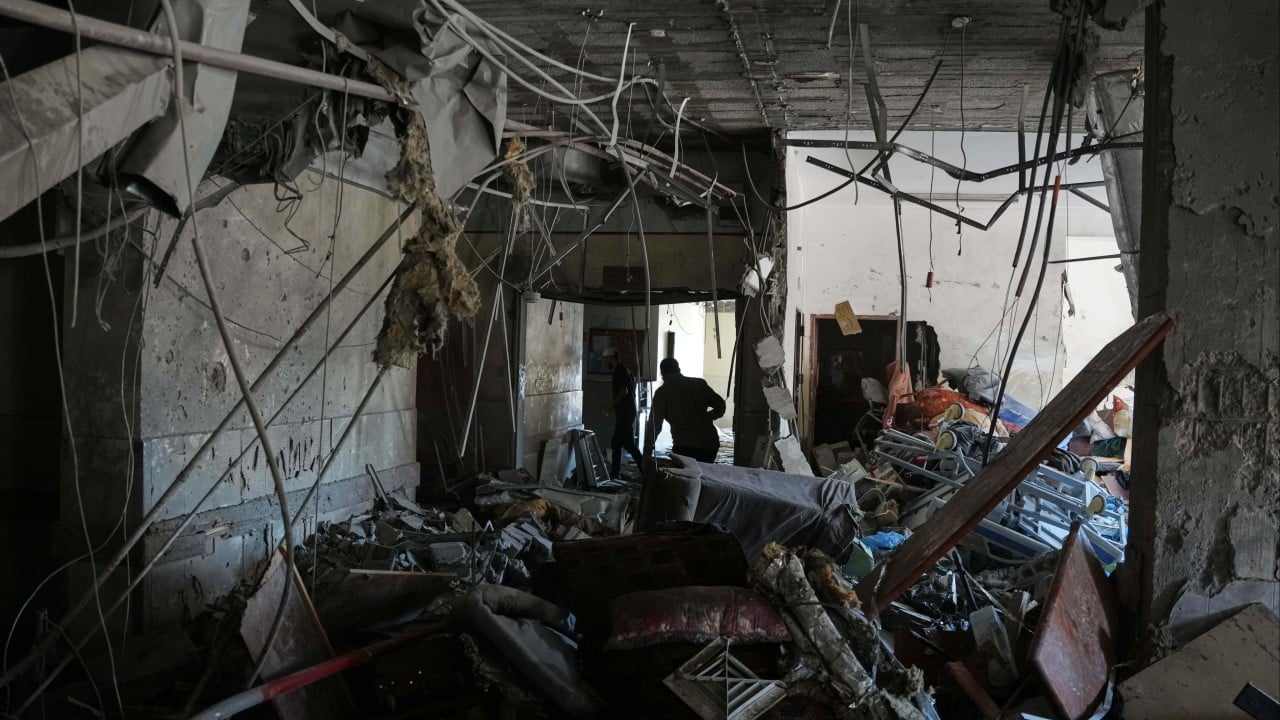
An Israeli airstrike on a Gaza hospital complex killed 11 people in the deadliest military escalation since recent political elections reshaped the diplomatic calculus across the Middle East. The strike hit a medical compound already straining under chronic supply shortages, killing displaced civilians and medical staff while destroying critical trauma infrastructure. While Israeli military officials maintain that militants use medical facilities for command and staging operations, international humanitarian law strictly protects hospitals unless specific, verifiable thresholds of active military use are met—a legal and operational fault line that continues to define the conflict.
News cycles move fast, and wire reports routinely reduce these events to grim arithmetic. Eleven dead. Dozens wounded. One hospital damaged. Yet focusing exclusively on the immediate casualty count misses the structural mechanics driving these strikes, the timing relative to electoral shifts, and the legal deterioration occurring inside modern urban warfare.
The Anatomy of a Protected Zone Under Fire
Hospitals in conflict zones occupy a unique, fragile status under the Geneva Conventions. Specifically, Article 18 of the Fourth Geneva Convention establishes that civilian hospitals organized to give care to the wounded and sick may under no circumstances be the object of attack. They must at all times be respected and protected by the parties to the conflict.
That protection is not absolute, though the bar to revoke it sits extraordinarily high. Under Article 19, protection ceases only if the hospital is used to commit, outside its humanitarian duties, "acts harmful to the enemy." Even when a military force claims a medical facility has been compromised, international law mandates a strict sequence of obligations before a single munition can be released.
- The Warning Requirement: An attacking force must issue a due warning naming a reasonable time limit, and that warning must go unheeded.
- Proportionality Assessments: Commanders must weigh the anticipated concrete and direct military advantage against the expected incidental loss of civilian life and damage to civilian objects.
- Precautionary Measures: The attacker must choose means and methods of attack that avoid, or at minimum minimize, civilian casualties.
In Gaza, those three legal pillars collide daily with the realities of dense urban combat. Over the course of the war, the Israel Defense Forces (IDF) have repeatedly asserted that Hamas embeds tunnel shafts, weapons caches, and operational nodes beneath or adjacent to hospitals, schools, and shelters. Medical directors, international doctors on the ground, and United Nations monitors have consistently countered that they see no evidence of active militant operations inside patient wards, pointing out that strikes frequently hit tents housing displaced families in hospital courtyards rather than fortified military bunkers.
Without independent forensic access to blast sites immediately following an impact, the public is left navigating competing narratives. One side points to intelligence assessments; the other points to shattered emergency rooms and dead paramedics. Both realities exist simultaneously in the fog of asymmetric warfare, leaving accountability perpetually out of reach.
Why Timing Matters After an Election
Political calendars dictate military tempo more often than generals care to admit. When an election concludes—whether in Washington, Jerusalem, or across key regional capitals—a transitional vacuum opens. Incumbent administrations lose domestic political incentives to restrain allied military actions, while incoming governments have not yet consolidated the diplomatic personnel or policy frameworks required to enforce red lines.
History bears this out repeatedly. During the 2008–2009 Gaza war, Operation Cast Lead launched in late December, squarely inside the American presidential transition between George W. Bush and Barack Obama. Diplomatic pressure stalled because neither administration held full operational leverage at that exact moment.
A strike killing 11 people at a Gaza hospital immediately following an election tests the boundaries of that transitional tolerance. Militarily, it signals that operational tempo will not pause for diplomatic recalibration. Politically, it probes how much international pushback an action will generate when foreign ministries are preoccupied with domestic transition briefings.
Consider how deterrence signaling operates in these windows. Military planners view post-election periods as moments when adversaries attempt to regroup, rearm, or exploit perceived hesitation. By executing high-profile strikes on contested targets during a political transition, an army demonstrates continuity of force. The cost, however, is borne by the civilian population sheltering inside facilities that have become the last functioning lifelines in an exhausted territory.
The Collapse of Gaza's Medical Infrastructure
To understand why a strike killing 11 people inside a hospital compound reverberates far beyond the immediate casualties, you have to look at the baseline condition of Gaza's healthcare system. Before the latest escalation, the World Health Organization (WHO) documented hundreds of attacks on healthcare facilities, ambulances, and medical personnel across the enclave.
A modern hospital is not merely a building with beds. It is an interdependent industrial ecosystem.
Power and Water Dependencies
Trauma surgery, neonatal incubators, dialysis machines, and blood banks require uninterrupted electricity. With Gaza's central power grid offline, hospitals rely entirely on backup diesel generators. When an airstrike damages fuel storage tanks, electrical switchgear, or solar arrays on a hospital roof, the secondary mortality rate spikes silently over the following days as life-support systems fail.
The Compounding Effect of Displacement
In Gaza, hospitals stopped functioning solely as medical centers months ago. They became de facto refugee camps. Tens of thousands of displaced Palestinians pitched tents in hospital courtyards, parking lots, and corridors under the assumption that international law still offered a perimeter of safety.
When a munition strikes a hospital courtyard, it does not hit an empty buffer zone. It hits an area packed with hundreds of people per square meter. Shrapnel from even a relatively small precision-guided munition—such as a 250-pound Small Diameter Bomb—carries a lethal radius that turns crowded tent encampments into mass-casualty scenes instantly.
Attrition of Specialist Staff
You can airlift bandages, antibiotics, and surgical kits into a conflict zone within 48 hours. You cannot replace a vascular surgeon, an anesthesiologist, or an ICU nurse in a decade. Every strike that kills or injures medical workers permanently degrades the survival odds of every future trauma patient brought through the emergency doors. When 11 people die at a hospital, the loss of two or three veteran clinicians represents a strategic collapse in local medical capacity.
Precision Munitions and the Illusion of Clean Strikes
Modern militaries frequently invoke precision-guided munitions (PGMs) as proof of adherence to humanitarian standards. GPS-guided kits and laser-designated warheads allow aircraft to strike a specific room on a specific floor of a concrete structure with circular error probable measurements under three meters.
Yet technical accuracy does not guarantee moral or legal precision.
- Blast Overpressure: Inside enclosed concrete structures, a warhead's detonation creates an amplified pressure wave that ruptures internal organs and collapses adjacent load-bearing walls, even if the explosive charge is relatively small.
- Secondary Fragmentation: Concrete, glass, and medical oxygen canisters inside a hospital become lethal projectiles upon impact. Oxygen lines running through hospital walls can rupture and feed flash fires that consume entire wings.
- Intelligence Latency: Precision guidance puts a bomb exactly where the coordinates say to put it. It cannot verify whether the target moved ten minutes earlier, or whether fifty displaced civilians walked into the blast radius while the aircraft was inbound.
In hypothetical terms, imagine an intelligence unit identifies a high-value target entering a room adjacent to an outpatient clinic at 14:00. By the time the strike package is cleared through legal review, approved by command, and executed at 14:25, the target may have exited through a basement corridor while nurses moved pediatric patients into the hallway outside that exact room. The weapon hits the target coordinates with textbook accuracy. The outcome is a civilian catastrophe.
That gap between technological precision and human reality sits at the heart of nearly every disputed strike on medical infrastructure.
Competing Legal Interpretations in Asymmetric Warfare
Ask a military legal advisor and a human rights investigator to examine the same strike on a Gaza hospital, and they will cite the exact same treaties to reach opposite conclusions. Understanding that divergence is essential to cutting through diplomatic rhetoric.
Military lawyers emphasize the concept of dual-use infrastructure and the prohibition against human shields. Under customary international humanitarian law, armed groups are strictly forbidden from using the presence of civilians or protected medical sites to shield military operations from attack. From the military perspective, if an adversary operates from a hospital and international law effectively grants them permanent immunity because civilians are present, every militant group on earth will immediately move its headquarters into pediatric wards. Allowing that precedent, military planners argue, incentivizes the weaponization of hospitals globally.
Human rights investigators and legal scholars at organizations like Amnesty International and Human Rights Watch view the equation from the opposite end. They argue that an adversary's violation of international law—such as operating near civilians—never absolves the attacking force of its own independent legal obligations. Even if a militant fires a rocket from a hospital parking lot, the responding army remains bound by proportionality and precaution. If an airstrike kills 11 civilians and destroys a trauma ward to eliminate a low-level operative or a small weapons cache, the military advantage gained is disproportionate to the civilian harm inflicted.
Both arguments carry internal logic. Neither resolves the crisis on the ground. Instead, the friction between these two legal frameworks has produced a steady erosion of the normative taboo against attacking hospitals—a shift with dangerous implications far beyond Gaza, from Sudan to Ukraine.
The Verification Deficit
One of the defining features of the Gaza conflict is the near-total absence of independent international journalists inside the territory. Foreign correspondents have been largely barred from entering Gaza independently since the war began, leaving the world dependent on local Palestinian journalists—who face extreme personal peril—alongside official statements from the IDF and Gaza's Ministry of Health.
When a strike hits a hospital and kills 11 people, the information ecosystem fractures immediately along predictable lines:
- Initial Casualty Reports: Local medical officials and civil defense crews release raw figures from the emergency room floor within minutes, often accompanied by graphic video footage of the immediate aftermath.
- Military Denials or Justifications: Hours later, military spokespeople issue statements either denying involvement, attributing the blast to a misfired militant projectile, or asserting that a precise strike targeted an embedded militant cell while taking steps to mitigate civilian harm.
- Satellite and Open-Source Analysis: Days or weeks later, open-source intelligence (OSINT) analysts examine commercial satellite imagery, crater geometry, and munition fragments to reconstruct the angle of impact and weapon type.
By the time forensic verification emerges, media attention has already rotated to the next crisis. Accountability requires timely, unimpeded access for independent war crimes investigators and weapons experts—access that neither warring party has consistently granted.
What Happens When Medical Neutrality Dies
The principle of medical neutrality—the agreement that doctors, ambulances, and hospitals remain off-limits during war—was forged in the nineteenth century after Henry Dunant witnessed wounded soldiers left to die on the battlefield of Solferino. For over 160 years, that consensus held imperfectly across world wars, civil conflicts, and insurgencies.
Every uninvestigated strike on a medical facility chips away at that foundational norm. When hospitals become regular battlegrounds, three irreversible shifts occur inside a war zone.
First, civilians stop seeking medical care until injuries become fatal, terrified that approaching a hospital puts a target on their backs. Second, international humanitarian organizations pull out their surgical teams because insurance, security protocols, and basic survival make deployment impossible. Third, other militaries and non-state armed groups around the world watch closely, noting that attacking or militarizing medical infrastructure carries minimal diplomatic consequence.
Eleven people died in the latest strike on a Gaza hospital, marking the bloodiest single incident since the recent election cycle altered the political backdrop. The names of the dead will be recorded on hospital ledgers that are running out of paper, inside wards running out of anesthetic, under skies where the legal boundary between a battlefield and a sanctuary has effectively ceased to exist.


