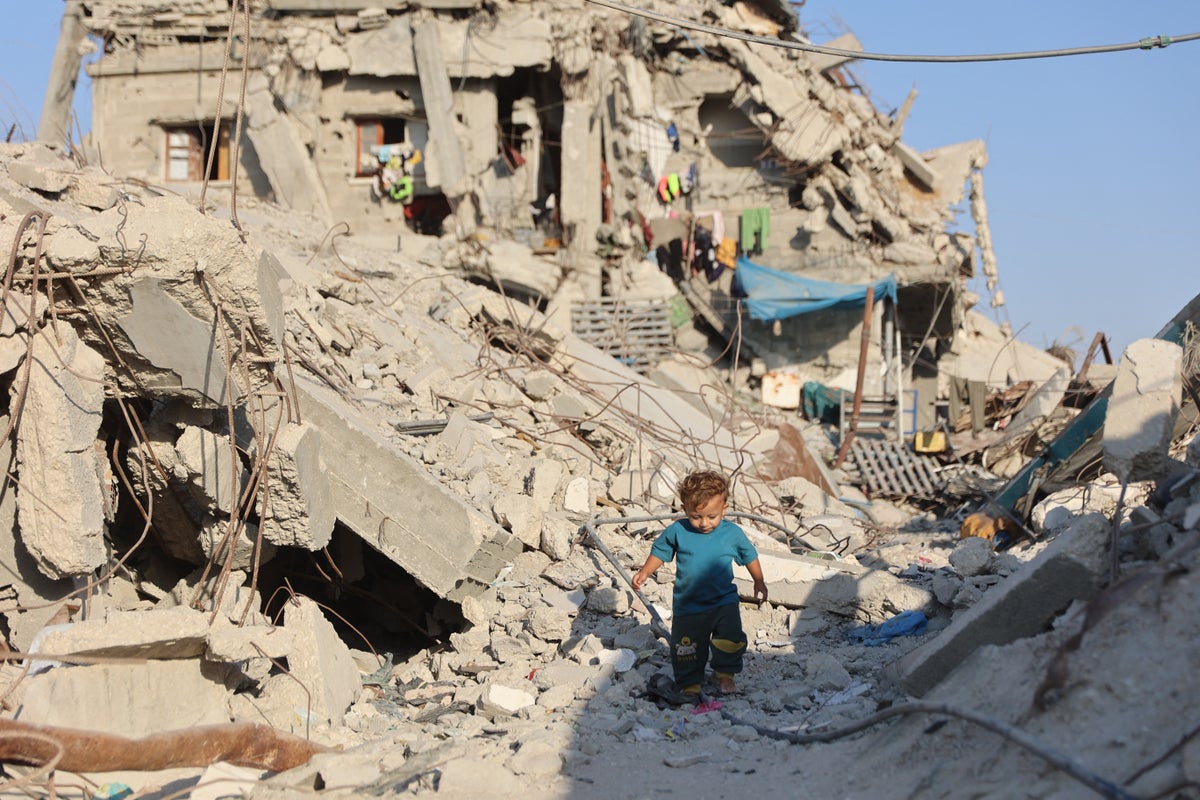
The announcement of a comprehensive disarmament framework for Gaza arrived with the familiar, high-gloss packaging of modern diplomatic theater. Yet beneath the White House declarations and structured phases lies an immediate, bloody contradiction: Israeli airstrikes continue to pound the enclave, killing civilians even as negotiators praise a breakthrough.
This friction exposes the core fracture of the current peace architecture. The gap between theoretical roadmaps and the kinetic reality on the ground is wide enough to swallow entire cities.
The Mechanics of an Illusory Breakthrough
To understand why a proclaimed disarmament agreement has failed to quiet the guns, one must examine the precise architecture of the text itself. The arrangement brokered through international channels relies on a sequential logic that both sides interpret through entirely hostile lenses.
Under the framework, weapons held by civil administrative bodies are slated for transfer to a U.S.-backed Palestinian technocratic committee. Heavy armaments, underground networks, and production sites are meant to undergo decommissioning and storage only after international stabilization forces deploy and a phased Israeli withdrawal begins.
Herein rests the operational paralysis. Jerusalem’s security apparatus views any timeline that separates military redeployment from immediate, total physical surrender of weaponry as an existential hazard.
Israeli intelligence assessments argue that an incomplete handover allows militant networks to preserve their command structures under civilian cover.
- The verification dilemma: Disagreement over who monitors the compliance process.
- The territorial footprint: Israeli forces currently retain operational control over roughly sixty percent of the Gaza Strip.
- The sequencing trap: Israel demands absolute demilitarization as a strict precondition, while militant factions condition their compliance on a permanent end to military operations and complete withdrawal.
The Ground Truth Behind the White Papers
Diplomats in foreign capitals talk in terms of transparent milestones and multinational oversight boards. Inside Gaza, the metric of survival is measured in concrete dust and hospital admissions.
The continuation of kinetic operations during high-level negotiations is not an accident of timing; it is a calculated feature of a strategy built on maximum pressure. The Israeli military maintains that strikes are strictly targeted at active militant cells attempting to exploit the lull.
Meanwhile, local medical infrastructure—already pushed past the brink of collapse over years of continuous bombardment—absorbs the daily human toll. A residential strike in southern Gaza reducing a family to statistical data points does more than extinguish lives; it hardens the psychological barrier against voluntary disarmament. When survival depends on the possession of a deterrent, the theoretical promise of international protection forces rings hollow to those huddled in tent camps.
The Structural Impasse of Regional Guarantors
External mediators face an environment where their leverage is inversely proportional to the stakes involved for local actors. The involvement of multiple regional players introduces competing spheres of influence rather than a unified front.
Disputes over which nations can participate in verification protocols reveal a profound lack of trust that extends far beyond the immediate combatants. The insistence by Jerusalem that certain regional actors be excluded from oversight creates immediate diplomatic roadblocks, turning procedural details into permanent vetoes.
A disarmament process cannot function when the guarantors themselves are subjects of intense geopolitical contention. Every clause regarding tunnel clearance and weapons confiscation is scrutinized not for its technical merit, but for how it alters the ultimate balance of power once the cameras leave.
Until the fundamental contradiction between absolute security demands and phased diplomatic timelines is resolved, the text of any agreement remains mere paper, easily shredded by the next incoming strike.