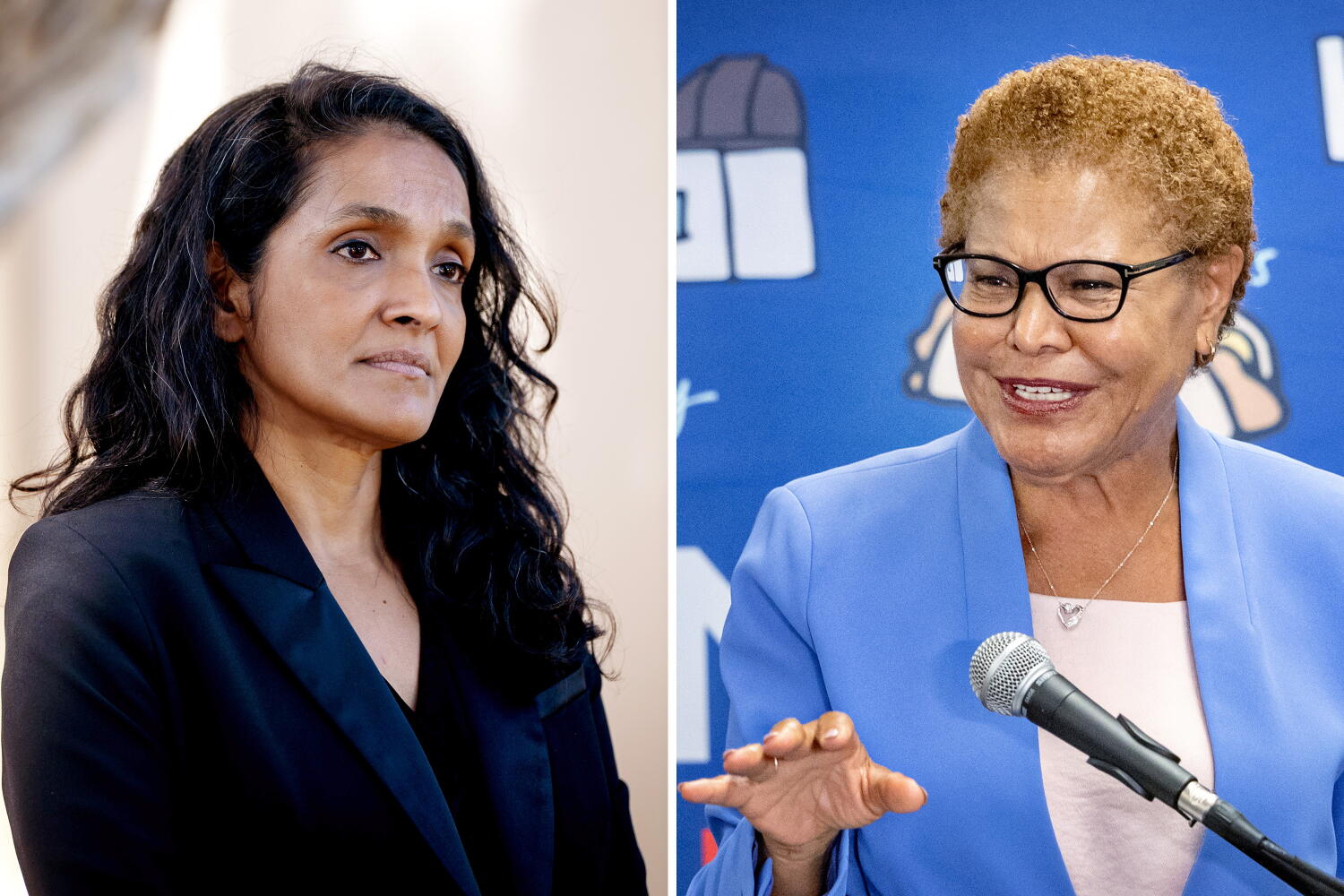
When Los Angeles Mayor Karen Bass and City Councilmember Nithya Raman spent the final weekend before the November 3, 2026 election racing from sanctuary pews to union halls, surface-level dispatches framed it as standard retail politics. It was anything but. Beneath the choreography of Sunday morning church visits and last-minute neighborhood rallies lay a structural collapse of the coalition that had governed America's second-largest city for decades.
The final 72 hours of the 2026 Los Angeles mayoral race exposed a bitter ideological civil war between an entrenched Democratic establishment and an insurgent progressive wing. Both women had once been political allies, with Raman having previously endorsed Bass. Yet as the clock ran down toward Tuesday's runoff, their frantic itineraries across the city revealed two fundamentally incompatible theories of municipal power—and set the stage for Raman's historic upset over an incumbent mayor.
The Anatomy of a 72-Hour Scramble
Standard campaign coverage treats final-weekend appearances as mere photo opportunities. In a sprawling metropolis of roughly four million residents, however, where a candidate stands on the Sunday before an election is a precise diagnostic of where their internal polling shows bleed.
By November 1, 2026, the race had tightened into a statistical dead heat. A late UC Berkeley Institute of Governmental Studies poll showed Bass and Raman locked at 40% each among likely voters, with 19% still undecided. Bass had spent the autumn clawing back a double-digit deficit, forcing both campaigns into an exhaustive geographic sprint across Los Angeles.
Sacred Ground and Institutional Muscle
For Karen Bass, the final weekend was an exercise in institutional defense. Historically, winning a citywide runoff in Los Angeles required locking down two pillars—organized labor and the Black church network—while holding onto moderate Westside and San Fernando Valley voters who prioritized stability.
Bass leaned heavily into that traditional playbook. On Sunday morning, she worked the sanctuary circuit, appealing to congregations where her decades of community organizing and congressional seniority carried deep personal loyalty. By Tuesday morning, she was in Westlake rallying with union workers, leaning on the institutional backing of the city's major labor federations. Her pitch was built on executive continuity and crisis management, bolstered by last-minute backing from an unlikely source. Billionaire developer Rick Caruso, whom Bass had defeated in 2022, publicly endorsed her over Raman, arguing that his reservations about the challenger were less about ideology and more about executive competence.
The Grassroots Counter-Offensive
Nithya Raman's weekend route mapped an entirely different city. A 45-year-old urban planner and Democratic Socialists of America member who had entered the race only hours before the February filing deadline, Raman had initially jumped in to ensure progressive voters had an alternative to reality television personality Spencer Pratt in the June primary.
By the final weekend of the general election, her campaign had morphed into a disciplined, volunteer-heavy turnout machine. Rather than relying solely on traditional power brokers, Raman paired her own Sunday church visits and community events with aggressive tenant and youth outreach. While most major unions lined up behind Bass, Raman had secured key pockets of progressive labor support and built a field operation designed to reach renters who felt priced out of the city.
Why the Old Coalition Fractured
To understand why an incumbent mayor with overwhelming institutional advantages found herself fighting for survival on the final weekend, you have to look past the campaign trail rhetoric and examine the twin pressures that hollowed out Bass's first term—housing costs and disaster response.
Los Angeles politics has long operated on a delicate truce. Establishment Democrats promised incremental progress on homelessness and infrastructure while reassuring business owners and homeowners that City Hall would protect property values and public safety. That truce broke down between 2025 and 2026.
| Strategic Dimension | Karen Bass Campaign | Nithya Raman Campaign |
|---|---|---|
| Core Institutional Base | Major labor unions, Black churches, establishment Democrats | Democratic Socialists of America, tenant unions, progressive activists |
| Primary Campaign Pitch | Experienced executive leadership, public safety, steady recovery | Structural housing reform, renter protections, systemic City Hall change |
| Key Vulnerability | Criticism over the 2025 Palisades fire response and rising homelessness | Questions from moderates and business leaders over executive readiness |
| Late-Stage Validation | Endorsement from 2022 rival Rick Caruso and state Democratic leaders | Grassroots surge among cost-burdened renters and younger voters |
The 2025 Palisades fire left lasting political scar tissue on Bass's administration. Critics seized on the city's preparedness and recovery coordination, turning what was once Bass's greatest strength—her reputation as a steady, unifying coalition builder—into a liability among frustrated voters. During their sole televised head-to-head debate before the runoff, Raman hammered Bass on City Hall records, public safety leadership, and the aftermath of the fire.
At the same time, the city's affordability crisis had reached a breaking point. According to the 2026 Homeless Count, the number of people experiencing homelessness in Los Angeles rose by 3.3% that year, undercutting the administration's narrative that its signature shelter programs were turning the tide. For working-class families and public school teachers watching students leave mid-year because their parents could no longer afford rent, incrementalism looked indistinguishable from stagnation.
Raman capitalized on that frustration with concrete legislative receipts. In 2025, she had spearheaded a motion capping maximum annual rent increases for tenants in rent-stabilized apartments built before 1978, a measure that passed the City Council 13-2. On the final weekend, that single policy record gave her an unmistakable contrast against an incumbent backed by real estate titans like Caruso.
The Financial Asymmetry Nobody Noticed
One of the most overlooked factors in the final stretch of the 2026 race was how money functioned—and failed to function—in a city with generous public matching funds.
Campaign finance filings through mid-October 2026 showed a massive spending gap. Bass had raised over $3.25 million and spent more than $4.5 million when factoring in $1.257 million in public matching funds. Raman, by contrast, raised just over $1.01 million in private contributions, supplemented by the same $1.257 million in matching funds, bringing her total expenditure to roughly $2.35 million.
In a traditional media market as expensive as Los Angeles, a two-to-one spending disadvantage usually dooms a challenger in the final week. Television airtime is prohibitively expensive, and direct mail drops require deep cash reserves.
Yet the 2026 electorate proved remarkably resistant to paid media saturation. Because the mayor's race shared the November 3 ballot with high-turnout federal midterm elections—a cycle that saw Democrats retake control of Congress nationally and Xavier Becerra win the California governorship—the electorate was larger and more engaged than in typical off-cycle municipal contests.
Voters were already tuned into politics. Paid television spots touting establishment endorsements struggled to break through the noise of national midterm coverage, while Raman's volunteer-driven ground game converted renter frustration directly into mail-in and early ballots. By the time both candidates hit the pavement on November 1, a substantial share of the electorate had already locked in their choices, leaving the final weekend scramble to decide a razor-thin slice of late-deciding voters.
What the Result Means for Urban Governance
The consequences of that final weekend became clear within 48 hours of polls closing. Despite early Tuesday night returns showing Bass holding a narrow edge, late-counted mail ballots swung decisively toward Raman. By Thursday morning, November 5, Bass called Raman to concede, with updated tallies showing Raman leading 52% to 48%—a margin that ultimately settled at 54.9% (616,858 votes) to 45.1% (505,871 votes) with 99% of votes counted.
Raman became the first challenger to unseat a sitting Los Angeles mayor in more than two decades, as well as the first Asian-American, Indian-American, and Hindu mayor in the city's history.
Yet winning an ideological insurgency is far easier than governing a fractured bureaucracy. When Raman takes the oath of office on December 14, 2026, she will inherit a strong-mayor system constrained by a 15-member City Council where a majority of members had endorsed her opponent. She will also face immediate skepticism from the business community, downtown developers, and police leadership—including LAPD Chief Jim McDonnell, whose tenure became a flashpoint during the campaign.
Her coalition delivered a historic rebuke to City Hall's old guard. Now, the same renters and working families who powered her past Karen Bass in those final, frantic days will expect her to solve the exact housing and homelessness crises that toppled her predecessor.