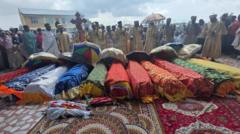
When the morning mist cleared over the Amhara region on a fateful Monday at seven o'clock, the Tsadqane Debre Mitmaq St. Mary Monastery was already alive with motion. Hundreds of worshippers had climbed the rugged mountain terrain, drawn by the enduring promise of a holy water cleansing ritual meant to cure chronic, untreatable ailments. They stood shoulder to shoulder in communal faith. They did not hear the massive rocks breaking loose from the saturated heights above until it was entirely too late.
Within seconds, a catastrophic landslide obliterated the gathering space, leaving at least 14 people dead, seven severely injured, and an untold number of missing souls trapped beneath tons of mud and stone. While initial dispatches frame this tragedy as an unpreventable act of nature born from seasonal downpours, a closer examination of Ethiopia's escalating environmental crisis reveals a different story. This was not a bolt from the blue. It was a predictable collision between climate vulnerability, crumbling infrastructure, and a desperate population with nowhere else to turn for salvation.
The Anatomy of a Mountain Tragedy
To understand why fourteen lives were snuffed out during a sacred morning ritual, one must look closely at the geography and timing. The disaster struck during the height of Kiremt, the local rainy season that traditionally spans from June through September. During these months, the Horn of Africa experiences relentless precipitation that turns fragile mountain slopes into ticking time bombs.
According to regional church administrators, including Megabe Hadis Neka Tibeb Ababu, the general manager of the local diocese, the sheer velocity of the slide left zero margin for escape. Massive boulders tore loose from the mountain face, crashing directly into the dense crowds gathered around the holy water site. Eleven victims were buried hastily at the monastery itself, a testament to the overwhelming local grief and the immediate logistical collapse that follows such isolated events. The wounded had to be transported more than forty miles away to Debre Birhan because closer medical facilities lacked the capacity to handle multi-trauma crush injuries.
Yet, focusing solely on the heavy rain misses the systemic rot underneath. Ethiopia is currently locked in a brutal cycle of extreme weather anomalies driven by global climate shifts. From the catastrophic mudslides in the southern Gamo zones to recurring droughts that starve agrarian communities, the nation's ecological stability is fracturing. When the environment breaks down, the poorest citizens bear the brunt.
Faith, Desperation, and Structural Neglect
Why do hundreds of people continue to crowd beneath unstable mountain overhangs during peak rainy seasons? The answer lies in the deep intersection of spiritual tradition and systemic healthcare failure. For millions of rural Ethiopians, specialized medical care for chronic illnesses is an impossible luxury. Hospitals are hours away, underfunded, and underequipped.
Monasteries like Tsadqane Debre Mitmaq serve a dual purpose. They are houses of God and sanctuaries of last resort. The holy water springs are viewed with absolute reverence, believed to possess miraculous healing properties for physical afflictions that secular medicine cannot or will not cure. When you are poor, chronically ill, and systematically underserved, the risk of a mountain slope feels secondary to the absolute necessity of spiritual intervention.
This creates a harrowing sociological reality. The very institutions that offer psychological and spiritual comfort to the marginalized are often situated in geographically precarious terrain—carved into mountain sides, nestled in river valleys, or clinging to escarpments. Decades of deforestation, overgrazing, and lack of basic civil engineering interventions have stripped these slopes of their natural anchors. When the Kiremt rains arrive, these holy sites transform into hazard zones.
The Failure of Early Warning Systems
Disaster prevention offices in Ethiopia are chronically under-resourced. While local communications offices routinely issue broad warnings about seasonal flooding, actionable, localized early warning systems for rural religious sites are virtually nonexistent. There were no sirens on the cliffs above Tsadqane Debre Mitmaq. There were no geotechnical engineers surveying the stability of the rock faces prior to the holy water ceremonies.
Instead, rescue operations remain reactive rather than proactive. Teams of local volunteers and regional defense personnel rush to dig through the mud only after the screams have stopped. By the time heavy excavation machinery reaches remote mountainous pockets, the window for saving trapped victims has slammed shut.
This reactive loop repeats itself year after year. In July 2024, a massive double landslide in southern Ethiopia swallowed hundreds of lives in a single night, sparking temporary international outcry and papal prayers. Months later, the pattern repeated itself in Gamo. Now, the Amhara region joins the grim ledger. Each event is treated as an isolated tragedy by mainstream feeds, divorced from the broader narrative of institutional inertia.
Confronting the Uncomfortable Future
The hard truth is that climate adaptation in rural East Africa cannot remain an abstract debate held in international conference rooms. It requires heavy investment in local infrastructure, soil stabilization, and public safety education that respects religious traditions without ignoring physical danger.
Relocating centuries-old monasteries is culturally and spiritually impossible. The identity of these sacred spaces is tied directly to their geography, their springs, and their isolation. However, reinforcing the surrounding topography, building physical diversion barriers, and establishing strict occupancy limits during peak meteorological danger windows are baseline modern necessities.
Until regional authorities bridge the gap between faith-based tourism, rural healthcare, and climate resilience, mountainsides across the Horn of Africa will continue to give way under the weight of water and human hope. The survivors at Tsadqane Debre Mitmaq are currently mourning their dead and trying to piece together a shattered community. Behind them, the rain continues to fall on the hills, and the soil remains unanchored.
Pope prays for victims of Ethiopia landslides, condemns global weapons sales
This video provides important context regarding the broader pattern of deadly landslides in Ethiopia and international responses to the country's recurring climate disasters.
http://googleusercontent.com/youtube_content/1

.png?itok=1mb05mKJ)

