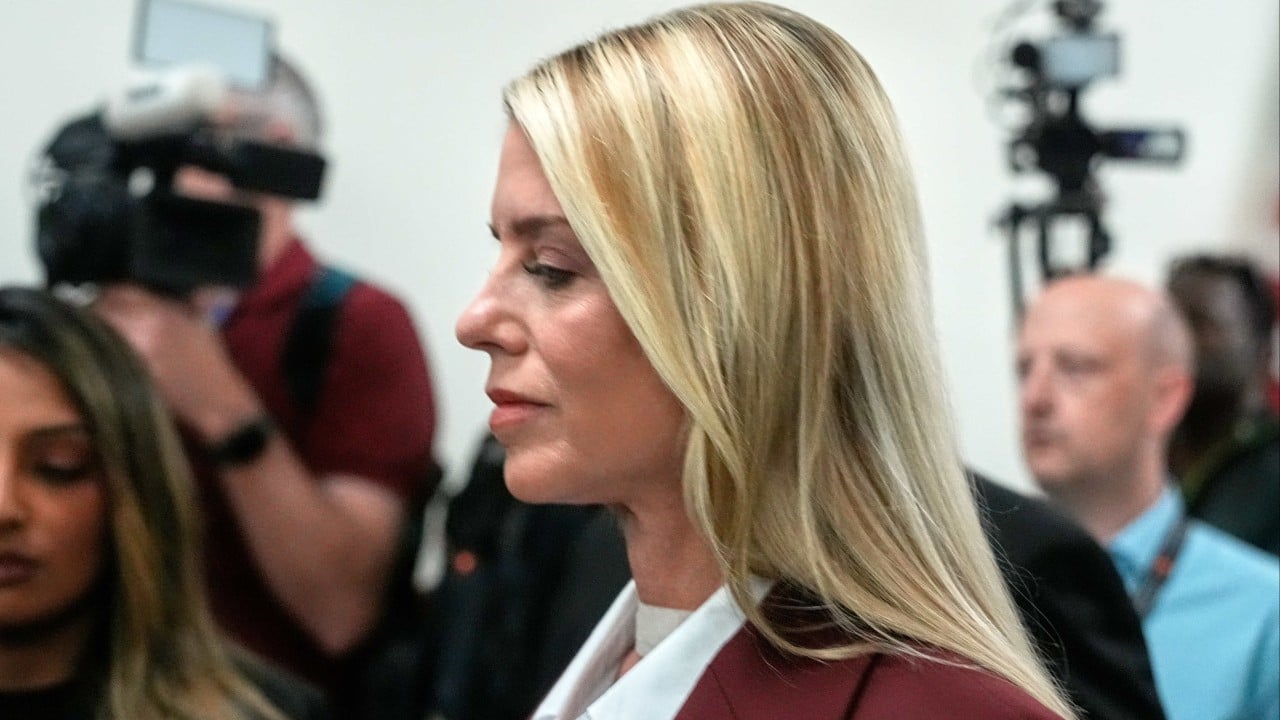
Former Attorney General Pam Bondi’s closed-door testimony before the House Oversight Committee on Friday exposed a coordinated breakdown in accountability regarding the release of the Jeffrey Epstein investigative files. While Bondi publicly claimed the Justice Department achieved unprecedented transparency, her refusal to answer specific questions regarding Donald Trump’s knowledge of the file contents or the systematic exposure of victims' identities confirms that the agency prioritized political shield-building over public disclosure. Active Department of Justice attorneys sat beside Bondi during the non-sworn, transcribed interview, explicitly instructing her to withhold answers regarding presidential directives and the mechanics behind a highly criticized redaction process.
The institutional failure did not happen by accident. It is the result of a deliberate strategy to control the narrative of a three-million-page archive that has plagued the administration since early last year.
The Deflection Strategy and the Missing Client List
When Bondi took over the Justice Department in early 2025, she built public anticipation by declaring that a definitive list of Epstein’s clients was sitting on her desk, promising that a "truckload" of files would be exposed. That reality dissolved by July 2025, when the department reversed course, stating no such master client list existed and that further document drops would be halted.
The political calculus shifted permanently in late 2025 with the passage of the Epstein Files Transparency Act, which mandated a hard deadline for the public release of the records. What followed was not a clean archival disclosure, but a rushed, chaotic data dump that appeared engineered to distract and insulate rather than inform.
During Friday’s testimony, Bondi attempted to shift responsibility downward.
"As the head of a large Department with broad responsibilities, I did not lead every aspect of this effort or conduct that document review myself," Bondi stated in her prepared opening remarks.
She noted that direct management of the document review had been delegated to Todd Blanche, her former deputy who now serves as acting attorney general. This bureaucratic shielding allows leadership to claim credit for the existence of the release while claiming ignorance regarding its massive structural failures.
Weaponized Competence and the Victim Doxxing Crisis
The most damaging aspect of the department's handling is the asymmetric nature of the redactions. While powerful political figures and corporate elites received extensive institutional protection through heavily blacked-out text blocks, the actual survivors of Epstein’s trafficking network were systematically exposed.
The document dumps contained unredacted phone numbers, home addresses, passport details, and explicit descriptions of minors. Some victims were named or identifiable more than 500 times across the files.
During the closed-door session, Democratic lawmakers pressed Bondi on why the agency displayed meticulous precision when screening out references to high-level political associates, but demonstrated total carelessness regarding the safety of Jane Does. Internal FBI directives previously revealed that agents reviewing the archive were explicitly instructed to flag every mention of Donald Trump, whose name appears over 1,000 times in the raw files.
When Representative James Walkinshaw asked Bondi if Trump possessed prior knowledge of Epstein's criminal operation before it became public, Bondi declined to clear the president. Instead, she stated, "I’m not certain of the extent of his knowledge."
The presence of a sitting DOJ attorney during Friday's interview provided a legal wall, blocking lawmakers from establishing whether the instructions to prioritize presidential insulation came directly from the White House.
The Legal Shell Game
The decision by House Committee Chairman James Comer to allow a closed-door, transcribed interview rather than a public, videotaped deposition under oath fundamentally altered the stakes. In a standard deposition, evasive answers carry the immediate threat of perjury and are preserved on camera for public evaluation. A transcribed interview behind locked doors allows a witness to manage their temper, consult extensively with handlers, and rely on standard administrative non-answers without facing immediate legal jeopardy.
Outside the hearing room, survivors gathered to witness yet another administrative deflection. The standard defense offered by the department—that they did the best they could under a tight statutory timeline—fails to explain why the errors consistently favored the powerful at the expense of the vulnerable.
The Justice Department claims that when redaction errors are discovered, files are temporarily pulled down and corrected. This is an empty remedy in the internet age. Once a database of this magnitude is scraped and mirrored by external entities, the damage is permanent. The survivors whose private information was compromised cannot claw back their privacy from public servers.
The House Oversight Committee’s investigation will continue to parse the transcripts, but the structural reality is already clear. The long-promised release of the Epstein archive was transformed from an exercise in judicial accountability into an exercise in reputational damage control, leaving the institutional mechanisms that protected Epstein for decades completely intact.