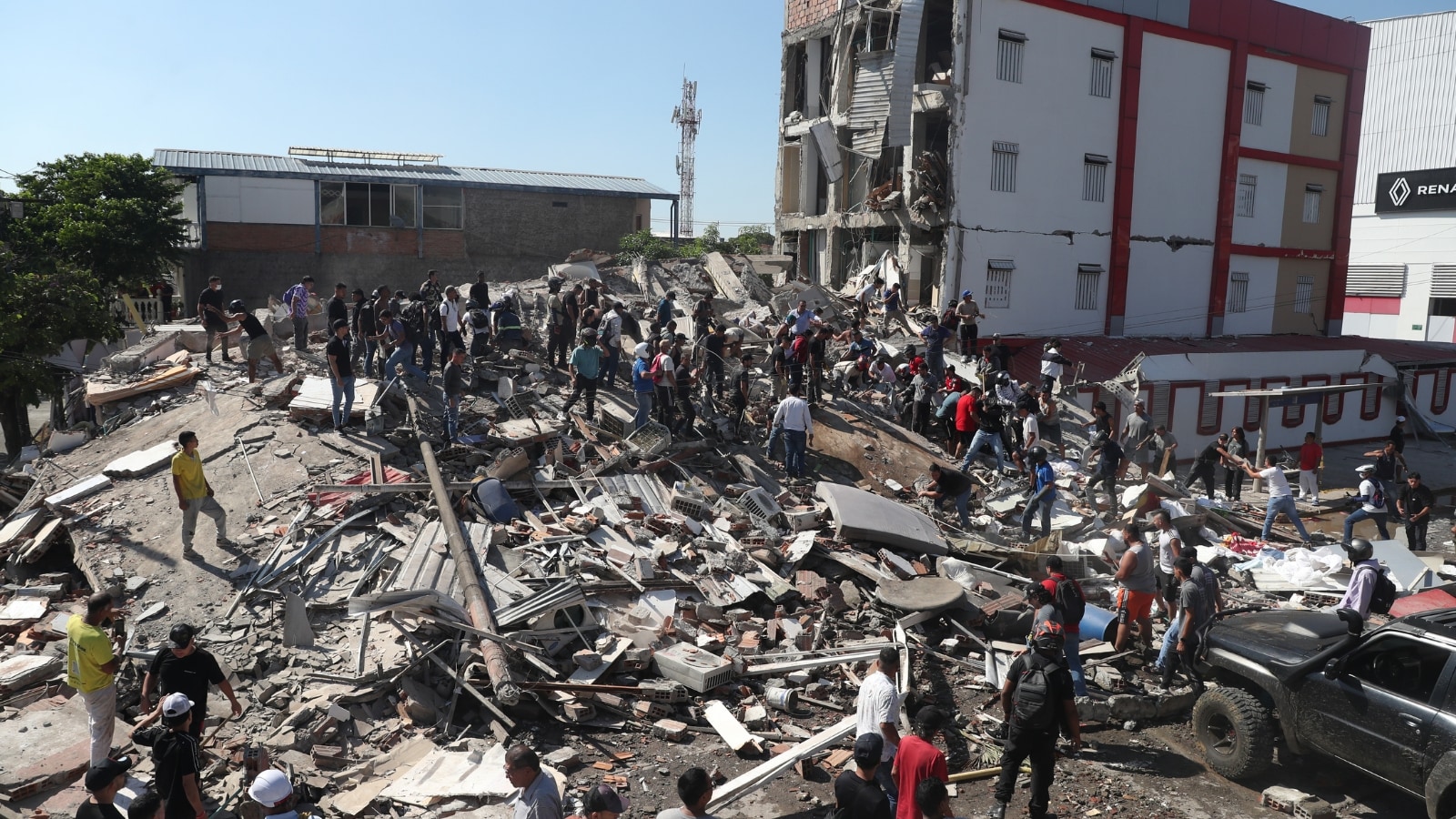
A massive 7.4-magnitude earthquake struck western Colombia, leaving over 100 people dead, collapsing commercial towers and residential blocks, and shattering infrastructure across the coffee region and the Pacific coast. This disaster marks the strongest seismic event recorded in the country this century. It struck with terrifying force on a Monday morning, centered near the remote Chocó region at a depth of roughly 110 kilometers.
For newly inaugurated President Abelardo De La Espriella, the catastrophe represents a baptism by fire. Taking office only days prior, the administration was instantly forced to declare a national state of emergency, pivoting all state apparatuses toward search and rescue operations. Yet, behind the official casualty counts of over 110 dead—with some regional estimates climbing past 130—lies a deeper vulnerability exposed by the violent ground motion.
The Mechanics of an Intermediate-Depth Shock
Seismologists point out a distinct anomaly regarding this event. The U.S. Geological Survey registered the hypocenter at an intermediate depth of roughly 107 kilometers. Standard seismological doctrine dictates that intermediate-depth earthquakes are typically less destructive than shallow quakes of identical magnitude because the primary energy release occurs far below the surface crust.
Theory clashed with raw physics on Monday.
Despite the depth, the seismic energy traveled through complex geological formations along the Pacific Ring of Fire, erupting in high-frequency waves that rattled basins and destabilized urban centers hundreds of kilometers apart. Cities like Pereira and Cali experienced severe intensity shaking, where older masonry structures and high-rises crumpled like paper. In Manizales, a side tower of the historic neo-Gothic cathedral fractured, casting tons of stone onto empty streets below.
Infrastructure Failures and Communication Blackouts
The human cost mounted rapidly due to structural failure and geographical isolation. In Quibdo, the capital of the heavily rural Chocó department near the epicenter, communications went dark immediately following the main shock. Cell towers failed, power lines snapped, and local authorities were left blind for hours, unable to gauge whether outlying indigenous and rural communities remained intact.
When information finally trickled out, the picture grew grim. Hospitals reported overflowing emergency wards filled with trauma cases, while medical staff treated patients outside on pavements out of fear of lingering aftershocks. Civil aviation authorities suspended operations at regional airports across Pereira, Manizales, and Quibdo, grounding crucial logistics support while engineers scrambled to inspect cracked runways and buckling control towers.
Heroism filled the immediate vacuum left by institutional delay. In Cali and Pereira, ordinary citizens formed human chains, clawing through piles of shattered concrete and twisted rebar with bare hands and household buckets. Firefighters and urban rescue units worked through the night under floodlights, racing against time to reach muffled voices trapped in air pockets beneath collapsed multi-story apartments.
Political Fallout and Regional Echoes
The timing compounds the geopolitical and social friction. Coming on the heels of catastrophic twin earthquakes in neighboring Venezuela just weeks prior—which claimed thousands of lives—the Andean region is gripped by collective trauma over structural safety.
President De La Espriella rushed to the worst-hit zones, promising emergency rent subsidies and pledging an immediate influx of security forces. In cities like Cali, municipal leaders imposed strict curfews and deployed military personnel to streets rattled by rumors of looting. Emergency funds pledged by international partners, including a multi-million-dollar aid package from the United States, will offer temporary relief, but long-term structural remediation remains an uphill battle.
As aftershocks continue to test the endurance of weary populations, the focus shifts from immediate extraction to the grueling assessment of millions of citizens living under high-risk construction standards. The ground has settled for the moment, but the political and economic tremors are only beginning to surface