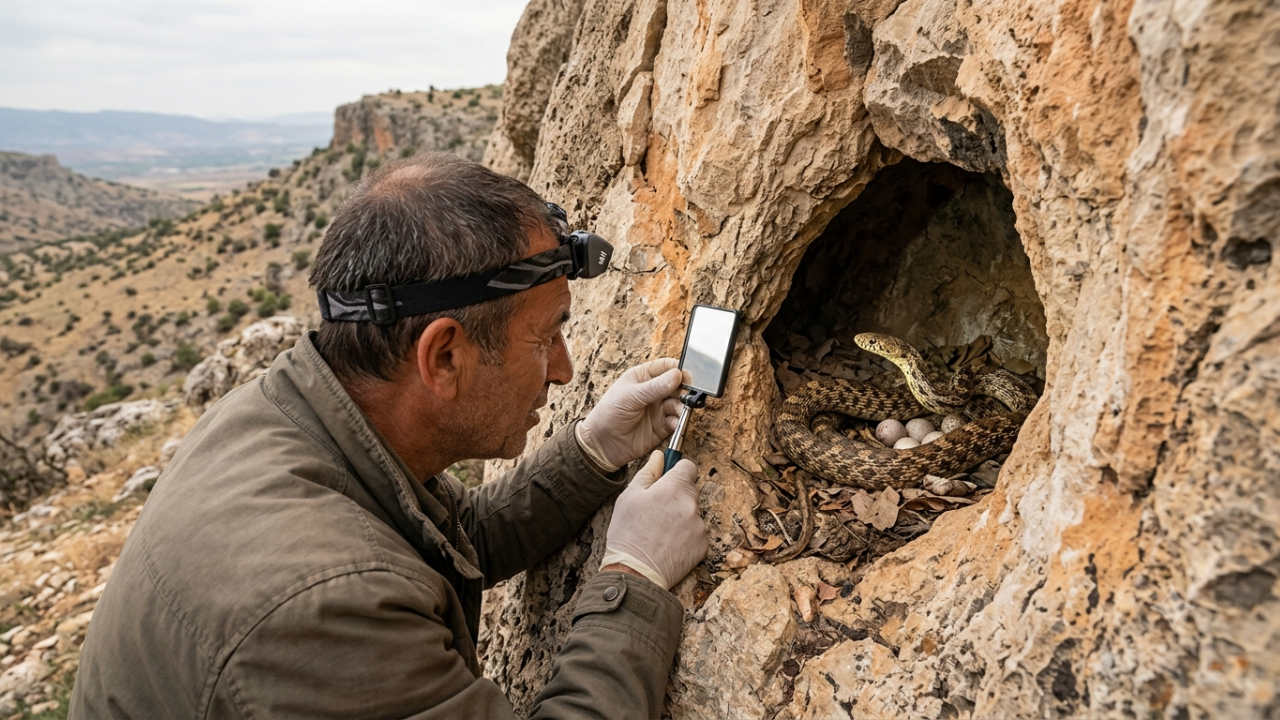
When field biologists checked 109 Eurasian scops owl nests across central Turkey over six breeding seasons, they discovered a startling biological anomaly. In 44% of the occupied nests, researchers found live, writhing worm snakes (Xerotyphlops vermicularis) sharing close quarters with developing chicks.
These subterranean reptiles were not dead items brought home for a late-night snack, nor were they accidental intruders that happened to tunnel into a tree cavity. The owls were deliberately capturing the live blind snakes, transporting them through the night air, and dropping them straight into their nest boxes.
Mainstream headlines have treated this discovery as a quirky animal oddity, a cute case of unusual roommates in the avian world. That interpretation misses the sharper evolutionary mechanics at play. This behavior points toward a calculated, cross-species arrangement that fundamentally challenges how we view avian parenting and the rigid boundaries of predator-prey dynamics.
The Architecture of an Unlikely Partnership
To understand why a nocturnal raptor would invite a venomless, blind burrower into its nursery, you have to look closely at the interior environment of an active bird nest. Organic debris accumulates rapidly inside these confined spaces. Uneaten food scraps, decaying pellets, bird droppings, and shed feathers combine to form a warm, humid incubator for parasitic insects.
Ants, blowfly larvae, and other kleptoparasites swarm these microscopic waste sites. They irritate nestlings, compete for resources, and in severe cases, cause direct physiological harm to vulnerable chicks.
Enter the worm snake. This specialized reptile spends almost its entire life underground hunting tiny invertebrates, insect eggs, and larvae. When an adult scops owl drops a live specimen into the nesting material, the snake does not attempt to attack the owlets. Instead, it burrows directly into the organic debris lining the bottom of the cavity.
The field data tells a compelling story regarding the outcome of this arrangement. While the initial clutch sizes and total number of hatched chicks showed no significant differences between snake-infested nests and sterile ones, the divergence appeared during the critical growth phase. 61% of hatched chicks fledged successfully in nests containing the live snakes. In nests where the reptiles were absent, that survival rate plummeted to 29%.
A more than two-fold increase in survival cannot be dismissed as random noise. The snakes are effectively acting as biological pest control, vacuuming up the parasitic insect larvae that would otherwise slowly drain the health of the growing brood.
Parallels Across Continents
This strange behavior in Turkish forests is not an isolated local glitch. Decades earlier, ornithologists studying eastern screech owls in North America documented an identical phenomenon involving the Texas blind snake.
In those ecosystems, adult owls regularly captured tiny thread snakes and carried them back to their tree cavities alive. The parallels are striking. Different owl genera, different continents, and completely distinct snake species have converged on the exact same functional outcome.
Evolution does not support behaviors that waste energy unless there is a tangible payoff. Raptors operate under strict caloric budgets. Spending time and nocturnal foraging energy to transport a non-nutritive, live animal back to a nest requires an explanation deeper than an accidental error in hunting instinct. If the snakes were meant to be food, the adult owls would dispatch them prior to delivery, as they routinely do with other prey.
Instead, the reptiles are spared the beak and integrated into the ecosystem of the nest. It suggests a form of proto-domestication, where one animal utilizes the specialized foraging habits of another to optimize its own reproductive fitness.
The Evolutionary Gamble
Of course, nature rarely offers pure altruism, and this relationship carries inherent risks. A snake is still an opportunistic carnivore sharing space with helpless, immobile nestlings. If prey availability inside the nest drops, or if stress factors accumulate, the dynamic could theoretically shift.
Furthermore, researchers face a persistent analytical hurdle. Does the presence of the snake actively cause the higher fledging rate by clearing out parasites, or are healthier, more experienced adult owls simply better at both catching snakes and raising chicks due to superior territory quality?
Teasing apart causation from correlation in field biology requires immense caution. The data confirms a strong spatial and temporal correlation, but the cognitive mechanisms driving the adult owls to select and spare these specific reptiles remain opaque.
If this interaction represents a step on the evolutionary pathway toward a true mutualism, it forces us to reconsider the cognitive flexibility of birds. We traditionally categorize animal behaviors into rigid, genetically hardwired programs. Carrying a live pest-control agent into a nursery looks suspiciously like forward-planning, a level of ecological engineering usually reserved for primates or advanced social mammals.
The next time an ecologist peers into a dark tree cavity and finds a startled snake gliding beneath a clutch of owlets, they are not looking at a mistake. They are looking at an ancient, silent collaboration forged in the dark corners of the wild, proving that survival often depends entirely on choosing the right roommate.