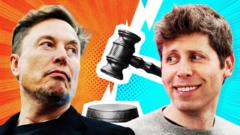
The courtroom in Oakland, California, currently houses the most expensive collision of egos in tech history. On one side sits Sam Altman, the architect of a $850 billion empire that effectively ended the era of "move fast and break things" by moving faster and breaking everything. On the other sits Elon Musk, the man who provided the seed capital and the moral high ground for OpenAI, only to find himself locked out of the house he helped build. This is not a simple contract dispute. It is a fundamental war over whether the most powerful technology in human history should be a public utility or a private ATM.
Musk’s legal team filed a scorched-earth complaint alleging that OpenAI has morphed into a "closed-source de facto subsidiary" of Microsoft. The suit claims Altman and Greg Brockman engaged in a "long con," using Musk’s $44 million in early donations to recruit world-class talent under the guise of a non-profit mission, only to flip the switch to a for-profit model once the technology became viable. Musk is demanding the disgorgement of billions in profits and the removal of Altman from the board.
OpenAI has fired back with a digital paper trail. They released internal emails from 2017 showing that Musk not only knew about the shift toward a for-profit structure but actively encouraged it—provided he could be the one to control it. The rift, it appears, was never about the money itself. It was about whose name would be on the masthead when AGI finally arrives.
The 2018 Pivot That Fractured the Frontier
In the early days, OpenAI was a research laboratory with a quixotic goal. It promised to develop Artificial General Intelligence (AGI) for the benefit of all humanity, unencumbered by the quarterly earnings reports that stifle innovation at Google or Meta. Musk was the primary financier, providing the "oxygen" the startup needed to compete for researchers who were already commandering million-dollar salaries elsewhere.
But by 2017, the math of AI changed. The sheer volume of compute power required to train large-scale models surpassed what any charitable foundation could reasonably sustain. The hardware costs for the "compute" were no longer measured in millions, but in billions.
Altman and Brockman proposed a "capped-profit" entity. This structure allowed them to raise venture capital while maintaining a technical allegiance to the non-profit board. Musk balked. According to OpenAI's internal logs, Musk wanted to merge OpenAI into Tesla, arguing that it was the only way to rival Google's DeepMind. When the board refused to hand him the keys, Musk walked away, cutting off his funding and leaving the lab in a precarious financial position.
What followed was the Microsoft deal. By 2019, Microsoft had injected $1 billion—later growing to $13 billion—into OpenAI. This wasn't just cash; it was credits for Azure, the massive server farm necessary to build GPT-4. To Musk, this was the ultimate betrayal. He saw the "Open" in OpenAI evaporate as the code became proprietary and the mission pivoted toward commercial products like ChatGPT Plus and enterprise API sales.
The Shakespearean Deceit Argument
Musk’s lawsuit leans heavily on the "Founding Agreement," a document that OpenAI lawyers argue does not technically exist as a formal, signed contract. Instead, Musk’s team is piecing together a "contract by conduct," using emails and public statements to prove that the original intent was a binding promise to the public.
The argument is that Altman used Musk’s brand and money as bait. In the legal filings, Musk’s lawyers describe the transition as a "textbook tale of altruism versus greed." They point to the 2025 restructuring, which converted OpenAI’s for-profit subsidiary into a Public Benefit Corporation (PBC), as a smokescreen to prepare for a massive IPO.
There is a deep irony in the timing. While Musk sues OpenAI for being too commercial, his own AI venture, xAI, is currently raising billions at a $40 billion valuation. His chatbot, Grok, is integrated directly into the X platform to drive subscriptions. Critics argue that Musk isn't upset that OpenAI became a business; he is upset that he doesn't own a piece of it.
The Governance Failure that Almost Ended it All
The friction between the non-profit mission and the for-profit reality reached a boiling point in November 2023. The world watched as the OpenAI board fired Sam Altman in a Friday afternoon coup, citing a lack of "candor." Within 72 hours, the company faced a total collapse. Nearly 700 of the 720 employees signed a letter demanding Altman’s return, or they would follow him to a new division at Microsoft.
This was the moment the mask slipped. The non-profit board, designed to be the ultimate check on the technology's safety and commercialization, was rendered powerless by the labor market. The engineers didn't care about the founding charter; they cared about their equity, which was tied to the for-profit subsidiary.
Altman returned with a new, more corporate-friendly board. The "safety-first" researchers, including co-founder Ilya Sutskever, eventually departed. The trial now underway is the delayed explosion from that 2023 meltdown. It is a forensic examination of who actually owns the rights to AGI: the people who dreamt it, or the people who paid for the electricity to run it.
The Compute Trap
The fundamental problem facing both Musk and Altman is the "Compute Trap." As models grow in complexity, the cost of training them increases exponentially.
$$C = P \times T$$
In this simplified view, the cost ($C$) is a product of the hardware price ($P$) and the time ($T$) spent training on massive datasets. When $C$ reaches into the tens of billions, the "charity" model becomes physically impossible. You cannot build a God-like intelligence on bake-sale proceeds.
OpenAI’s CFO, Sarah Friar, has recently expressed concerns that the company's revenue growth—while staggering—might not be enough to sustain the frantic pace of server acquisition. This financial pressure is what drives the push toward an IPO. An IPO would provide the liquidity needed to buy millions of H100 chips, but it would also legally obligate OpenAI to prioritize shareholder value over "humanity."
The Impact of a Musk Victory
If the court sides with Musk, the ramifications for the tech industry would be seismic. A forced return to a pure non-profit status would likely invalidate the Microsoft partnership, effectively stripping OpenAI of its computing power overnight. It would also throw the upcoming IPO into a legal vacuum, potentially wiping out hundreds of billions in paper wealth for employees and investors.
However, a win for Altman isn't a total victory for the industry. It would codify a precedent where "non-profit" is simply a marketing term used to bootstrap a startup before it pivots to a monopoly. It would signal the end of the open-source era for frontier AI, as every major lab retreats behind proprietary walls to protect their "moats."
The trial is expected to last three weeks, featuring testimony from Satya Nadella and perhaps even a rare public cross-examination of Altman himself. But regardless of the verdict, the original vision of OpenAI is dead. The laboratory that was meant to be a neutral arbiter of human progress has become a battlefield for two men who cannot stand to lose.
The outcome won't just decide where the money goes. It will decide who gets to define what "benefit to humanity" actually means in a world where the most valuable resource is no longer oil or gold, but the silicon-based intelligence that both Altman and Musk are desperate to control.