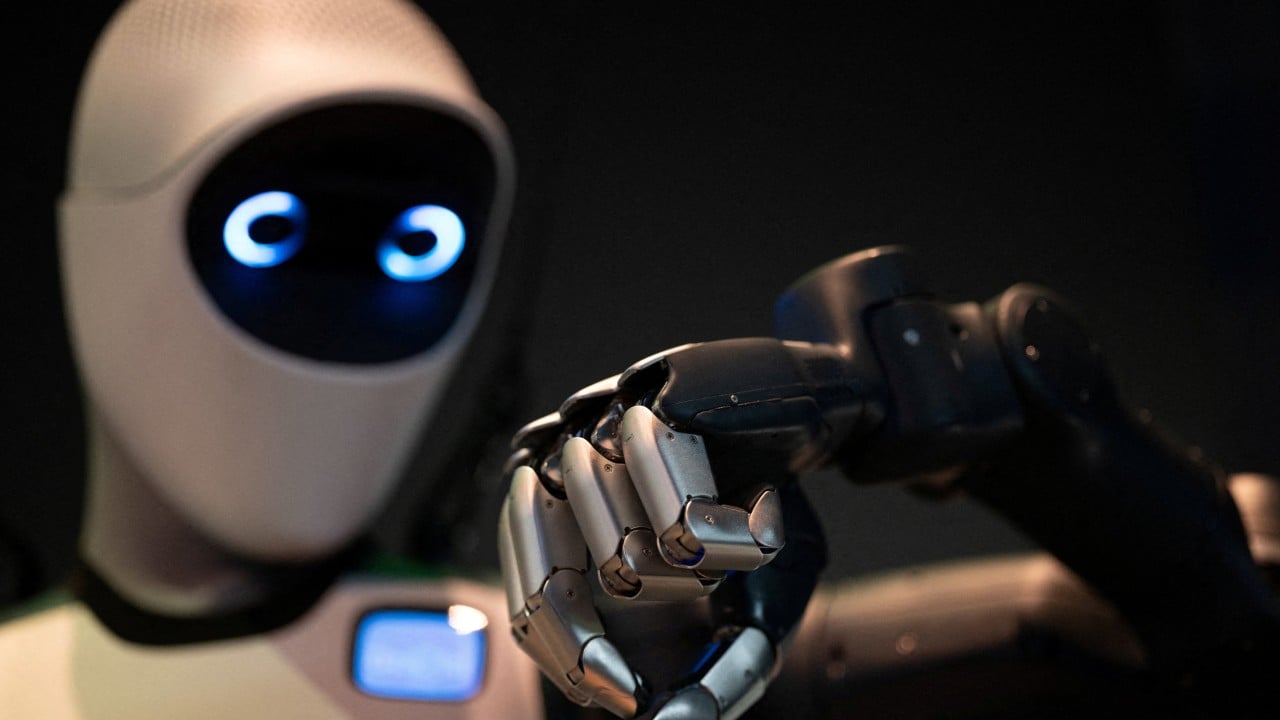
The headlines coming out of Singapore’s Asia Tech x Summit paint a pristine picture of the future. By the end of 2026, the newly built Punggol Digital District will become a living playground for physical artificial intelligence. Eight commercial titans and tech firms, including Grab, DHL, and security giant Certis, are unleashing fleets of autonomous machines to clean streets, deliver Hainanese chicken rice, and patrol public plazas. The government calls it a milestone for efficiency.
The narrative is clean, but the physical reality of robotics never is. Moving AI out of data centers and onto public sidewalks exposes a brutal truth that software engineers routinely ignore. Concrete is a hostile environment for algorithms. You might also find this related coverage insightful: The Engineering Unit Economics of Chandrayaan 3 and the 2026 AIAA Goddard Astronautics Award.
Behind the triumphant press releases lies a high-stakes gamble. Singapore is trying to solve a desperate labor shortage by forcing fundamentally fragile machines to coexist with unpredictable humans. If it fails, it will not be because the software lacked computing power, but because the real world refuse to behave like a simulation.
The Chaos of Multi-Operator Ecosystems
For years, autonomous mobile robot trials have been carefully controlled, single-company affairs. A tech startup deploys three identical rovers inside a private office lobby with uniform flooring and predictable foot traffic. As extensively documented in detailed articles by TechCrunch, the results are worth noting.
Punggol Digital District breaks this protective bubble entirely. The Infocomm Media Development Authority, JTC, and the Singapore Institute of Technology are launching a multi-operator environment.
This means a heavy, treaded Certis security bot, a nimble Grab food delivery container, and an industrial cleaning machine will all share the same public paths simultaneously.
The physics of this arrangement present an immediate technical hurdle.
- Sensor Saturation: When three different robots from three different manufacturers approach the same blind corner, their LiDAR pulses, ultrasonic sensors, and infrared cameras blind each other.
- Gridlock: Without a centralized traffic control system, independent algorithms default to defensive programming. A robot programmed to stop within two meters of an obstacle will simply freeze when confronted by another machine doing the same thing.
- The Sidewalk Standoff: If two delivery rovers face each other on a narrow path bordered by landscaping, neither has the systemic awareness to back up and let the other pass.
To bypass the typical bureaucratic molasses, the Land Transport Authority granted a precinct-level exemption under the Active Mobility Act. Operators do not need individual permits for every single trial. This slashes red tape, but it shifts the burden of safety entirely onto the software.
The initial design partners, which include homegrown startup QuikBot, are essentially flying blind into a shared physical space. Building a machine that avoids hitting a stationary bench is simple. Designing an algorithm that negotiates right-of-way with a rival company's robot, while a distracted pedestrian steps off a curb, is an entirely different class of engineering.
The Myth of Labor Replacement
Politicians love to frame automation as a neat displacement mechanism. The official line is that these machines will handle the low-value, repetitive tasks, freeing human workers to step into managerial or supervisory roles.
The math does not work out so cleanly on the balance sheet.
Replacing a low-wage cleaning or delivery worker with a physical AI platform does not eliminate human labor; it merely trades blue-collar workers for highly paid technicians.
Consider a hypothetical scenario where an autonomous delivery rover encounters a common real-world obstacle, such as a stray trash can blocking a ramp. A human delivery worker moves the can in two seconds. A robot stops, logs an exception error, and waits.
[Robot Detects Obstacle]
       │
       ▼
[Run Internal Re-routing Algorithm] ──(Failure: Path Blocked)──► [Halt Operations]
                                                                        │
                                                                        ▼
                                                             [Alert Remote Supervisor]
                                                                        │
                                                                        ▼
                                                             [Dispatch Human Tech Support]
When a fleet of fifty robots encounters these micro-frictions daily, you quickly require a dedicated operations center staffed by system administrators, remote tele-operators, and hardware mechanics.
The capital expenditure of acquiring the hardware, combined with the operational cost of maintaining a specialized tech support team, frequently eclipses the cost of traditional human labor.
Automation in high-cost, labor-starved economies like Singapore is born out of demographic desperation, not immediate cost savings. The working-age population is shrinking. The workers simply do not exist to fill these roles.
Businesses are forced to accept the immense overhead of robotics because the alternative is not cheap human labor; it is no labor at all.
Hardware is the Ultimate Bottleneck
Silicon Valley has spent the last decade operating under the assumption that software eats the world. In the domain of physical AI, the world fights back.
The entry of hardware heavyweights into the Singapore ecosystem reveals where the true battle lines are drawn. U.S. chipmaker Nvidia is opening a dedicated AI research lab in the city-state, specifically targeting efficient computing and foundation models for machines. They are joined by Chinese hardware manufacturers like Unitree and Slamtec, firms that specialize in building the physical legs, joints, and sensors that allow machines to move.
The software models driving these robots have grown incredibly sophisticated. Large language models and spatial computing allow a machine to theoretically understand its environment.
The physical hardware remains stubborn.
Actuators overheat. Lithium-ion batteries degrade rapidly under the brutal heat and humidity of a tropical climate. Optical cameras get obscured by sudden downpours, and delicate LiDAR lenses scratch over months of exposure to road dust.
If a cloud-based software tool crashes, you restart the server. If a 100-kilogram security patrol robot suffers a mechanical freeze while descending a public ramp, it becomes a dangerous unguided missile.
+-----------------------------------------------------------------+
|               The Physical AI Paradox                            |
+-----------------------------------------------------------------+
| High Software Sophistication  │ High Physical Fragility         |
|                               │                                 |
| - Multimodal perception       │ - Actuator thermal limits       |
| - Real-time path optimization │ - Battery drain from humidity    |
| - Advanced spatial awareness  │ - Sensor degradation from debris|
+-----------------------------------------------------------------+
The industry is learning that scaling a physical fleet is an industrial manufacturing problem, not a code deployment problem.
The software can calculate the optimal route across a mixed-use campus in milliseconds. If the mechanical joints of the robot cannot handle the vibration of crossing thousands of brick pavers day after day, the system breaks.
The Coming Regulatory Collision
Singapore’s Punggol experiment is an attempt to write the global playbook for the governance of physical machines. By legalizing precinct-wide trials, the government is forcing an answer to the legal ambiguities that have stalled autonomous systems everywhere else.
The gray areas are deep. If a delivery robot operated by an algorithm designed by an American tech firm, running on a chassis built by a Chinese manufacturer, hits a cyclist on a public path in Singapore, who is liable?
Is it the food delivery platform that fulfilled the order, the software firm that calibrated the obstacle-avoidance model, or the state agency that certified the district as safe?
Insurance companies have no historical actuarial tables for multi-operator robot environments. They do not know how to price the risk of an ecosystem where machines from competing brands constantly interact without a shared communication protocol.
The Punggol testbed is intended to generate this data, but the collection process will be defined by friction.
Furthermore, the public paths of a university campus or an office district are not neutral spaces. They are social environments.
Children will deliberately block delivery robots to see how they react. Thieves will realize that a rolling cooler full of high-end meals has no defense against a crowbar other than sounding a shrill alarm.
Vandals will spray paint over camera lenses.
The success of physical AI depends entirely on human compliance. The moment the novelty wears off, the public will stop accommodating the machines.
The robots will no longer be viewed as symbols of a high-tech future. They will be seen as rolling obstructions cluttering already crowded urban walkways.
Redefining the Edge
The Punggol Digital District testbed is not a glimpse into a seamless, automated paradise. It is an industrial laboratory where the limits of silicon and steel are being pushed to their breaking points.
The organizations involved are discovering that the true challenge of automation is not teaching a machine to think, but forcing it to survive the relentless wear and tear of the physical world.
Victory will not be declared when a robot successfully delivers a parcel under ideal conditions. It will happen when a fleet can operate for a year in the rain, dust, and human chaos without requiring a team of engineers to constantly rescue it from the curb.