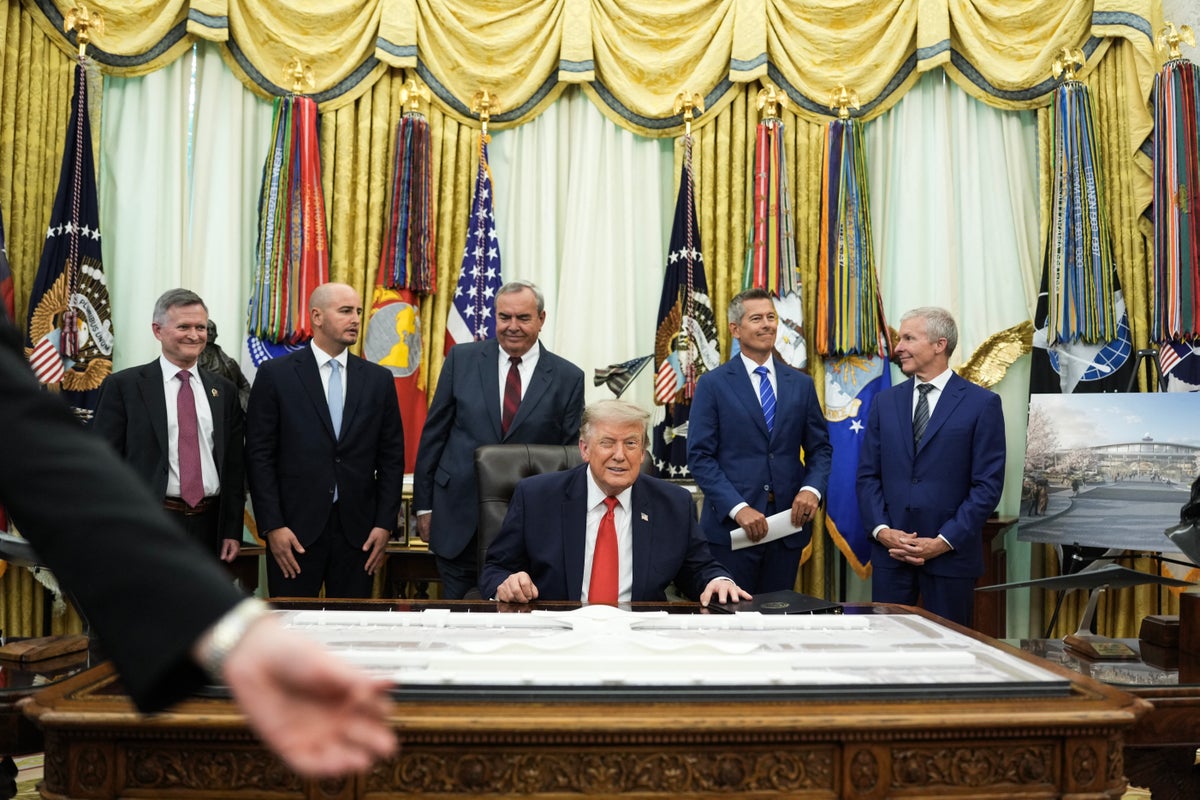
President Donald Trump unveiled a massive $22.5 billion plan to completely rebuild Washington Dulles International Airport, aiming to replace its dated concourses, expand its total footprint by over 5 million square feet, and finally retire the infamous "people mover" mobile lounges. The project, announced in the Oval Office alongside Transportation Secretary Sean Duffy and United Airlines CEO Scott Kirby, targets an airport that handled a record-breaking 29 million passengers in 2025 but has long tortured travelers with fractured logistics, jet-fuel-scented concourses, and absurd transit loops.
Yet beneath the glossy architectural renderings showcasing glass facades and gold-mirrored ceilings, a much more complex financial and structural reality is taking shape. This is not merely an aesthetic makeover. It is a high-stakes stress test of how mega-infrastructure projects are funded, managed, and executed in an era of executive intervention.
The Architectural Tug of War
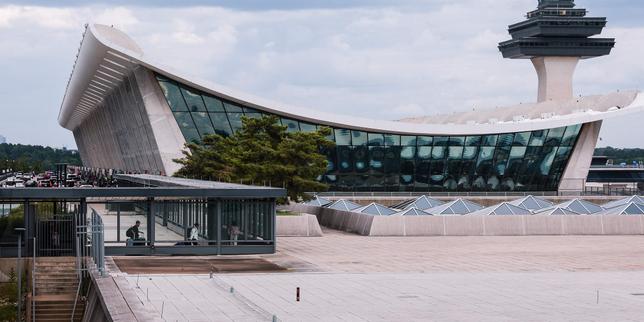
Eero Saarinen's iconic main terminal at Dulles is widely treated as a sacred monument of mid-century modern design. Any intervention there risks destroying the very thing that makes the airport historically significant.
The approved master plan attempts a difficult balancing act. It preserves Saarinen's sweeping, catenary-curve main terminal while completely obliterating the operational guts behind it. Concourses C and D—long criticized as dark, cramped holding pens that smell faintly of aviation exhaust—are slated for total demolition and replacement. Five new terminals will take their place, creating a higher-capacity matrix designed to absorb traffic growth for the next half-century.
Behind closed doors, the design phase was remarkably hands-on. Reports indicate that competing architectural firms brought physical three-dimensional models directly to the White House for executive critique. This level of micro-management is rare in civil aviation planning, where layout logic is typically dictated by runway geometry, taxiway efficiency, and strict Federal Aviation Administration safety clearances rather than presidential preference.
Killing the Mobile Lounge
Few aviation artifacts polarize travelers quite like the Dulles mobile lounges. Introduced in the 1960s as a futuristic way to ferry passengers directly from the terminal to aircraft parked on the remote tarmac, these lumbering, elevator-cab-on-wheels vehicles became a punchline.
They are slow, mechanically fragile, and prone to dramatic operational bottlenecks. The friction points multiplied sharply following recent tarmac accidents, including a collision that injured nearly two dozen passengers.
The new proposal replaces these lumbering giants with a horseshoe-shaped underground train system, expanded pedestrian walking tunnels, and additional moving walkways.
"You get off a bus, you go into a train, from the train you get onto another bus. It's the impossible airport." — President Donald Trump
Eliminating the mobile lounges solves a chronic logistical hemorrhage, but building deep underground transit loops beneath an active, high-volume international airfield without disrupting daily flight operations is an engineering nightmare.
The Tricky Math of Funding
A $22.5 billion price tag demands intense scrutiny. While the administration has emphasized that the project will avoid direct federal funding allocations, the financial mechanism relies heavily on the Metropolitan Washington Airports Authority (MWAA) issuing municipal bonds.
MWAA operates autonomously, but its debt servicing capacity is ultimately tied to revenue streams generated at the airport. Those streams come from two primary sources: airline operating fees and passenger facility charges.
United Airlines, which controls roughly 70 percent of all traffic out of Dulles, has signaled willingness to help foot the bill. A massive investment aligns with their long-term strategy, especially given plans to build one of the largest United Polaris lounges in the world into the new footprint.
However, airlines do not absorb capital expenditures out of corporate charity. Every dollar spent on a gold-accented concourse or a massive 32,000-car parking garage eventually finds its way into ticket prices, landing fees, and passenger ticket taxes. Travelers flying out of the mid-Atlantic region may end up paying for this grand modernization project long after the construction dust settles.
The Shadow of Past Projects
Skepticism surrounding this overhaul is compounded by recent history in the capital region. Federal and local infrastructure initiatives in Washington, D.C., have a frustrating habit of running into public relations and execution roadblocks. Recent high-profile cosmetic projects near the National Mall saw protective coatings peel away and decorative pools turn mucky green shortly after completion, drawing heavy public ridicule.
An airport is infinitely more complicated than a reflecting pool. Managing thousands of construction workers airside, coordinating structural overhauls around strict security perimeters, and avoiding multi-year tarmac gridlock requires precision execution from contractors who have yet to be rigorously tested on a timeline this aggressive.
The ambition is undeniable. The desire to restore American pride in gateway infrastructure after decades of stagnation—the last major greenfield US airport was Denver in 1995—resonates with millions of frequent flyers.
Yet transforming blueprints featuring high ceilings and glass atriums into concrete reality requires navigating decades of bureaucratic inertia, massive debt issuances, and intricate engineering hurdles. Whether Dulles becomes a global benchmark or an expensive cautionary tale depends entirely on what happens when the first shovel hits the tarmac.