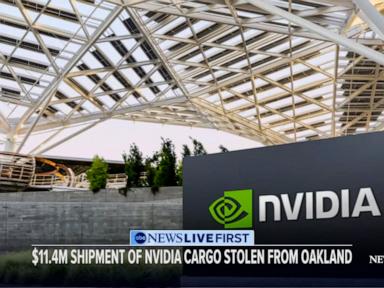
An $11.4 million shipment of Nvidia hardware vanished from a logistics operation in Oakland, California, exposing a massive vulnerability in the artificial intelligence supply chain. While the competitor headline treats this as another local crime blotter story, the reality is far more systemic. High-end graphics processing units (GPUs) have become the modern equivalent of gold bullion, attracting organized freight theft rings that exploit fractured trucking networks, weak yard security, and booming gray-market demand.
When a single tractor-trailer carries more than ten million dollars in silicon, the economics of crime shift overnight. You do not need to crack a bank vault anymore. You just need a stolen carrier identity, a spoofed bill of lading, and a warehouse in an industrial park forty miles down the interstate.
The Anatomy of Modern Silicon Theft
To understand how an $11.4 million load of Nvidia cargo disappears in broad daylight or under the cover of a routine yard transfer, you have to look at how freight actually moves through Northern California. The Port of Oakland and its surrounding logistics corridors sit at the mouth of Silicon Valley. Every day, thousands of containers and dry vans move through a sprawling web of third-party logistics providers (3PLs), freight brokers, and independent owner-operators.
Thieves do not stumble onto an $11.4 million load by accident. These operations rely on targeted reconnaissance and strategic cargo theft, a distinct category from opportunistic smash-and-grab crimes.
Consider a hypothetical example of how a typical strategic heist unfolds in this corridor. A crime ring sets up a shell trucking company or hijacks the Motor Carrier (MC) number of a legitimate, dormant carrier. They monitor digital load boards or compromise the email account of a mid-tier freight broker. Once they identify a high-value electronics shipment originating near the Bay Area, they bid aggressively to haul it—often undercutting market rates just enough to win the contract without raising immediate red flags.
When the driver arrives at the Oakland facility, the paperwork matches. The seal numbers align. The security guard at the gate checks a valid-looking commercial driver's license, waves the rig through, and logs the departure. By the time the legitimate broker realizes the GPS transponder has been disabled or stripped out in a nearby rest stop, the pallets of Nvidia hardware have already been cross-docked into unmarked box trucks and dispersed across multiple storage units.
Even when the theft involves a direct breach of a secured lot or trailer drop yard—a persistent issue across Oakland's industrial zones—the mechanics remain the same. Trailers sit unattended during shift changes or over weekends. A bobtail tractor backs up, hooks onto the kingpin, and drives off in under ninety seconds.
Why Nvidia Hardware Became the Ultimate Target
Ten years ago, cargo thieves in California targeted consumer electronics, pharmaceuticals, and high-end apparel. A truckload of flat-screen televisions might net a few hundred thousand dollars on the black market, requiring dozens of fences and significant physical storage space to liquidate.
Artificial intelligence changed the math.
Enterprise-grade Nvidia hardware—particularly data center accelerators like the H100, H200, and Blackwell architectures, alongside high-tier workstation GPUs—offers an unprecedented value-to-weight ratio. A single server blade or pallet of enterprise GPUs can easily exceed $300,000 in retail and secondary-market value while taking up less space than a residential refrigerator. Fit thirty or forty pallets into a standard 53-foot dry van, and you are suddenly looking at an $11.4 million payload rolling down Interstate 880 without an armed escort.
Three market forces make stolen Nvidia cargo uniquely easy to monetize:
- Severe Supply Bottlenecks: Cloud service providers, sovereign AI initiatives, and mid-sized tech firms routinely face multi-month backlogs when ordering directly through authorized distributors. Desperation breeds lax due diligence.
- Global Gray-Market Liquidity: Export controls and regional restrictions have created massive price premiums for advanced compute hardware overseas. A GPU that retails for $30,000 in California can fetch significantly more in jurisdictions cut off from official supply channels.
- Lack of End-User Serial Verification: Unlike smartphones, which carriers can instantly blacklist via IMEI numbers, discrete GPUs and server components rarely undergo automated ownership verification when plugged into a private data center rack or a cryptocurrency mining farm.
Once the cardboard outer packaging is stripped away and replaced with generic anti-static bags and plain brown boxes, a stolen GPU looks identical to a legitimate surplus unit.
The Structural Failures of the Oakland Corridor
Oakland has long struggled with localized freight crime, sitting at the intersection of major maritime, rail, and highway infrastructure. Yet blaming the $11.4 million Nvidia theft solely on local street crime misses the deeper industry failure. The modern American supply chain was built for speed and cost efficiency, not high-security custody.
Shippers frequently rely on double-brokering—a practice where a freight broker accepts a load from a manufacturer and quietly hands it off to another broker, who then hires a carrier. Each handoff introduces a blind spot. The manufacturer thinks a vetted, insured carrier is hauling their $11.4 million shipment. In reality, the load is sitting in the back of a subcontracted rig whose driver was hired off an encrypted messaging app forty-eight hours earlier.
Yard security practices compound the problem. Many logistics hubs around the East Bay operate with thin margins and high turnover among private security contractors. Physical barriers are often limited to chain-link fences and automated gate arms. When a facility processes hundreds of trucks per shift, guards are pressured to keep traffic from backing up onto public streets. Thorough identity verification—calling the carrier's listed dispatch number on file rather than the number printed on the driver's paperwork—rarely happens under peak volume pressure.
Insurance frameworks also create perverse incentives. Standard motor carrier cargo insurance policies typically cap out at $100,000 to $250,000 per load. Unless the shipper specifically declares the full value and purchases specialized high-value cargo coverage—which requires strict adherence to security protocols like team drivers, continuous GPS monitoring, and no-stop transit rules—someone is left holding a massive financial loss. When corners get cut on transit protocols to save a few thousand dollars in freight charges, the exposure runs into the tens of millions.
Where Does $11.4 Million in Stolen GPUs Actually Go
You cannot sell $11.4 million worth of enterprise Nvidia chips on a street corner or a standard consumer auction site without triggering immediate law enforcement attention. Liquidating a haul of this magnitude requires an established criminal infrastructure that mirrors legitimate distribution networks.
Investigators who track high-value semiconductor thefts generally see stolen inventory split into two distinct channels:
The Domestic Secondary Broker Market
The independent IT hardware brokerage ecosystem operates largely on trust, speed, and wire transfers. Thousands of legitimate resellers buy and sell excess data center inventory, liquidated startup assets, and refurbished servers every day. Criminal syndicates infiltrate this space by setting up seemingly legitimate LLCs, complete with professional websites, tax IDs, and rented office suites.
They approach secondary brokers claiming to have "cancelled data center orders" or "excess enterprise allocation" available at a 15 to 20 percent discount. Because hardware shortages are a daily reality in the AI sector, buyers rarely question why a new vendor has fifty high-end Nvidia units ready to ship immediately. Once the wire clears, the shell company dissolves, and the hardware disappears into legitimate corporate server racks across North America.
Cross-Border Smuggling Pipelines
The second, more lucrative route involves moving the hardware out of the United States entirely. California's proximity to major international ports and southern border crossings makes rapid export relatively straightforward for organized rings.
Stolen GPUs are frequently re-labeled as generic computer parts, power supplies, or low-value electronic scrap on customs manifests. They are consolidated into mixed-freight shipping containers and routed through transshipment hubs in Southeast Asia or the Middle East before reaching their final buyers. By the time federal investigators trace the shipping containers, the chips have already been installed in foreign compute clusters where American law enforcement has zero jurisdiction.
Why Tracking Technology Fails Against Organized Rings
A common misconception outside the logistics industry is that high-value shipments are effortlessly tracked via satellite. If you can track a fifty-dollar parcel from a retail warehouse to your front porch, surely an $11.4 million Nvidia shipment has redundant GPS beacons embedded in every pallet.
It rarely works that way in practice.
Professional cargo thieves treat electronic countermeasures as standard operating procedure. Before a stolen trailer even leaves the Oakland city limits, crews deploy commercial-grade GPS and cellular jammers—devices easily purchased online that flood local radio frequencies with noise, rendering standard trailer-mounted trackers useless.
Once the rig reaches an indoor facility—often a rented warehouse with a metal roof that naturally blocks satellite signals—crews systematically tear open the shrink-wrap on the pallets. They use handheld RF (radio frequency) detectors to sweep every box for hidden battery-powered trackers like AirTags or covert cellular beacons. Any suspicious device is tossed into a microwave or dropped into a storm drain miles away from the stash house.
Even hardware-level telemetry offers limited help in the immediate aftermath of a theft. While modern data center GPUs contain cryptographic hardware identifiers and firmware-level attestation features, those systems only activate when the chip is powered on, connected to a network, and queried by software that reports back to a central server. If the buyer runs an air-gapped cluster or uses custom enterprise management tools that block external telemetry, the manufacturer may never see the stolen serial numbers come online.
The Ripple Effect Across the Tech Supply Chain
The loss of an $11.4 million shipment is a rounding error on Nvidia's quarterly balance sheet, given the company's massive revenue scale. For everyone else in the ecosystem, however, the consequences are immediate and painful.
First, there is the direct hit to the distributors, system integrators, and freight insurers caught in the middle. When a shipment of this size is stolen, the replacement lead time isn't measured in days; it is measured in months. A downstream customer—perhaps a cloud startup or a university research lab—suddenly finds its infrastructure rollout stalled because the exact hardware allocated to their purchase order is sitting in an unmarked warehouse in the Central Valley.
Second, every major heist drives up the cost of moving technology. Cargo insurers respond to eight-figure losses by tightening underwriting standards across the board. Freight forwarders hauling semiconductors are increasingly forced to implement costly security mandates:
- Two-driver teams who are prohibited from leaving the truck unattended for even five minutes within the first 250 miles of origin.
- Covert escort vehicles trailing unmarked box trucks through high-risk metropolitan zones like Oakland and Los Angeles.
- Biometric gate verification and real-time facial recognition at pickup facilities to combat identity theft.
- Mandatory armored transport for loads exceeding specific valuation thresholds, effectively treating server racks like cash shipments from the Federal Reserve.
These expenses do not stay absorbed within the trucking industry. They get baked directly into the hardware pricing passed on to enterprise buyers and, eventually, everyday consumers.
Hardening the Weakest Link
Technology companies spend billions of dollars securing their digital infrastructure against state-sponsored hackers, deploying zero-trust architectures, end-to-end encryption, and biometric authentication. Yet those same companies routinely hand over physical assets worth tens of millions of dollars to a fragmented trucking network held together by PDFs, phone calls, and unlocked padlocks.
Until manufacturers, distributors, and logistics providers treat physical silicon custody with the same paranoia they apply to cybersecurity, Oakland will remain a hunting ground. Thieves will continue to follow the highest-margin cargo on the highway, and as long as a single trailer of Nvidia hardware carries the value of a small bank, the trucks will keep disappearing.


