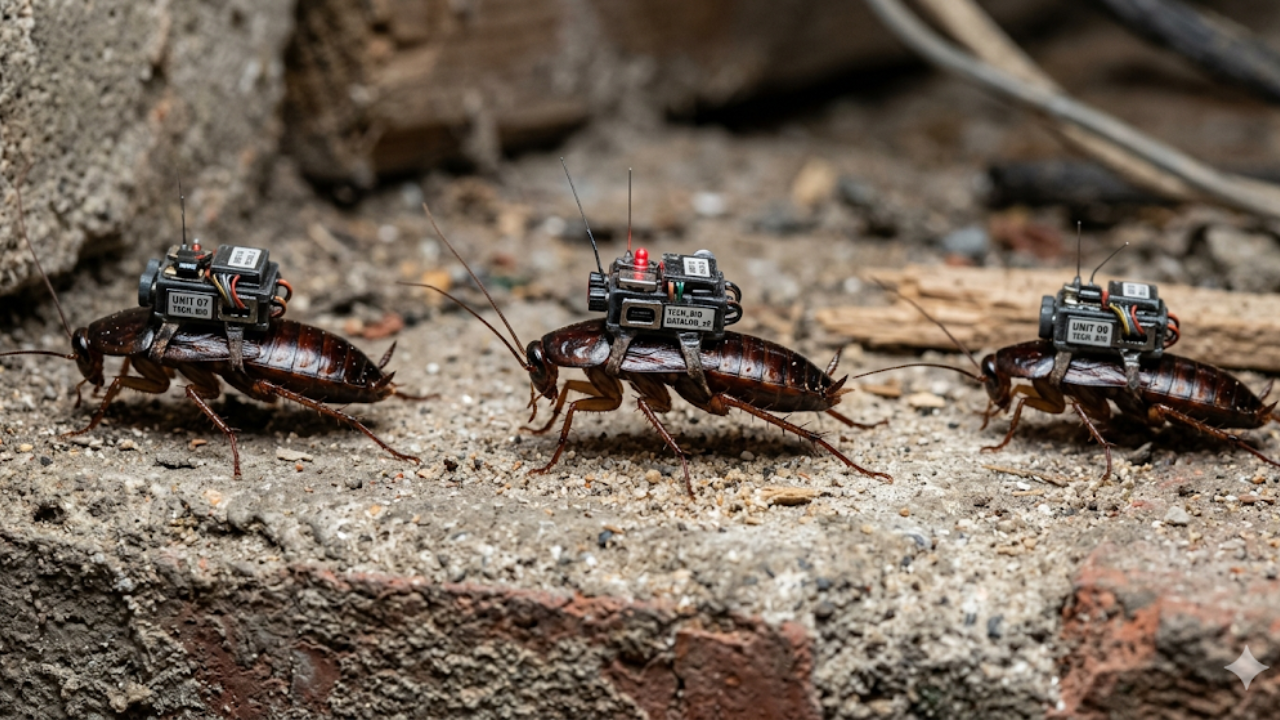
The concept sounds like something pulled from a low-budget science fiction script. Madagascar hissing cockroaches, equipped with miniature electronic "backpacks," scuttling through the dark, damp labyrinths of municipal sewage and gas lines. Yet, this is the reality of modern industrial maintenance. Engineers are no longer looking for bigger, faster machines to solve the problem of crumbling infrastructure. Instead, they are turning to biological machines that have spent 300 million years perfecting the art of survival in tight spaces.
While traditional utility companies have long relied on expensive, bulky robotic crawlers to find leaks, these machines are notoriously prone to failure. They get stuck in debris. Their batteries die. They cannot navigate the 90-degree turns found in older pipe systems. Cyborg insects offer a radical alternative. By merging living nervous systems with low-power microcontrollers, researchers have created a hybrid surveillance force that is cheaper, more resilient, and more effective than anything made of pure silicon and steel.
The Mechanics of the Cyborg Backpack
The hardware is deceptively simple. A small circuit board is mounted to the thorax of the insect, usually a species chosen for its size and hardiness. Thin electrodes are inserted into the cockroach’s cerci—the sensory organs at the rear of the abdomen that usually detect air movements from predators.
By sending small electrical pulses to these organs, researchers can trick the insect into thinking something is approaching from the left or right. The cockroach responds by turning in the opposite direction. This is not autonomous robotics in the traditional sense; it is a bio-hack. The insect provides the power, the locomotive intelligence, and the rugged chassis. The humans provide the GPS coordinates.
Why Mechanical Robots are Failing
The push toward entomological solutions stems from a crisis in mechanical engineering. Our cities are sitting on a ticking time bomb of decaying pipes. In the United States alone, a water main breaks every two minutes. Most of these pipes are too small for human inspection and too complex for standard robots.
A traditional pipe-crawling robot requires a heavy tether for power and data transmission. That tether creates friction. After a few turns, the friction becomes so great that the robot can no longer move forward. Even wireless versions struggle. Wireless signals do not travel well through soil and metal pipes.
The cyborg insect bypasses these hurdles. It is autonomous in its movement. It can climb walls, squeeze through gaps thinner than a coin, and survive drops that would shatter a plastic drone. If a mechanical robot flips over, the mission is over. If a cockroach flips over, it uses its wings or legs to right itself and keeps moving.
Detecting the Invisible Leak
The "backpack" is not just for steering. It is a mobile laboratory. The latest iterations carry tiny chemical sensors capable of detecting trace amounts of methane or hydrogen. When a pipe leaks, it creates a chemical gradient. By programming the insects to follow these specific scent trails, scientists can pinpoint the exact location of a crack before it becomes a catastrophic blowout.
Some setups also include thermal sensors. In a water pipe, a leak often causes a slight change in the temperature of the surrounding soil. The cyborg cockroach, naturally drawn to certain thermal profiles, can be directed to "patrol" these zones. This data is then transmitted back to the surface using low-frequency radio waves or stored locally on a micro-SD card for later retrieval once the insect returns to a collection point.
The Problem of Control and Ethics
There is a significant hurdle that the industry rarely discusses in its press releases: the "battery" of the insect itself. While the electronic backpack might last for several days, the biological component has its own limits. An insect under constant electrical stimulation eventually experiences fatigue. Its nervous system can become desensitized to the pulses, a phenomenon known as habituation.
Furthermore, the ethics of using living creatures as disposable sensors remain a gray area. While most people have little sympathy for cockroaches, the precedent of using neurological overrides on living organisms raises questions for bioethicists. If we do this to insects today, what happens when the tech scales to larger, more complex animals?
Energy Harvesting and Self-Sustaining Swarms
The goal isn't just to steer one bug; it is to deploy a swarm. To make this viable, the backpacks need to be self-sustaining. Some researchers are testing "bio-fuel cells" that generate electricity from the insect’s own internal chemistry. By breaking down the trehalose (a type of sugar) found in the insect's hemolymph, the backpack can theoretically power itself indefinitely.
This creates a self-charging, self-repairing, and self-navigating sensor network. When a sensor "dies," it is a loss of pennies rather than the thousands of dollars lost when a high-end inspection drone is buried in a collapse.
Logistics of the Underground Search
Deploying these insects is not as simple as dumping a bucket of bugs into a manhole. It requires a sophisticated deployment strategy. Usually, a "mother ship" robot—a larger, more traditional wheeled vehicle—carries the insects to the general vicinity of a suspected leak.
The insects are then released like a localized cloud. They fan out, exploring the micro-fissures that the larger robot cannot reach. Once the data is collected, the insects are lured back to the mother ship using pheromone triggers or light signals. It is a coordinated dance of biology and tech.
The Economic Reality
The shift toward cyborg insects is driven by the bottom line. Traditional pipeline inspection costs thousands of dollars per mile. Much of that cost is labor and equipment maintenance. A colony of Madagascar hissing cockroaches costs virtually nothing to maintain. The electronics, thanks to the mass production of smartphone components, are cheaper than ever.
For a municipal water department operating on a razor-thin budget, the choice between a $50,000 robotic snake and a $500 swarm of cyborg insects is becoming an easy one to make. The technology is moving out of the lab and into the field because it is the only solution that scales to the size of the problem.
The Limits of the Tech
We must be clear: this is not a perfect system. These insects are still animals. They are influenced by humidity, temperature, and hunger. A cyborg cockroach might decide that a piece of rotting organic matter in the sewer is more interesting than the methane leak it was sent to find.
Signal transmission remains the biggest technical bottleneck. The earth is an excellent insulator. Getting a high-bandwidth signal from a cockroach 10 feet underground to a technician on the street requires creative engineering, often involving a chain of "repeater" insects that pass the signal along like a bucket brigade.
The Future of Bio-Hybrid Infrastructure
As our cities age, the demand for invisible, low-cost maintenance will only grow. We are entering an era where the infrastructure itself will be monitored by a permanent resident population of bio-hybrids. These aren't just pests anymore; they are the janitors of the digital age.
The next time you walk over a manhole cover, there is a chance that a dozen feet below you, a tiny, six-legged cyborg is checking the integrity of the gas lines that heat your home. It isn't pretty, and it isn't what we imagined the future of robotics would look like, but it is the only thing that works.
Would you like me to analyze the specific types of sensors being integrated into these bio-hybrid systems?