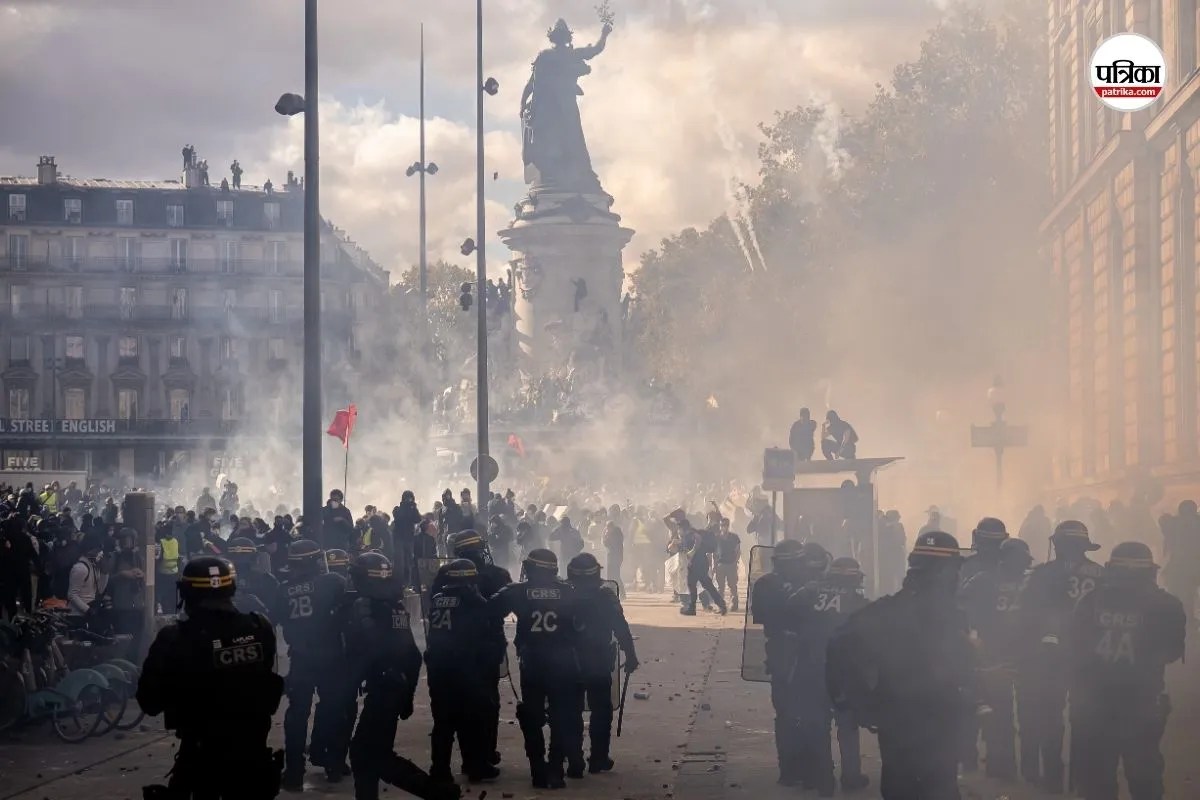
Blaming inflation for French street protests is the laziest habit in political commentary. Prices rise. People march. TV pundits nod solemnly and call it a cost-of-living crisis.
Lazy. Shallow. Wrong.
Look at the headline most outlets love to recycle whenever smoke rises over Paris, Lyon, or Marseille: public anger over inflation turned peaceful opposition into street chaos. That story is comforting because it treats unrest like bad weather—something that happens to a country rather than something baked into its operating system.
It is not.
In France, a hike in fuel prices, grocery bills, or pension rules rarely stays a simple math problem for long. It turns into a constitutional brawl over entitlement, legitimacy, and state power. Inflation is the spark. The French institutional structure is the dry timber stacked ten feet high around every town square.
If you want to understand why protests in France escalate faster, burn hotter, and last longer than protests in countries with similar inflation numbers, stop staring at consumer price indexes. Look at how the French state distributes risk, taxes labor, and manages consent.
The Cost-of-Living Myth That Lets Policymakers Off the Hook
Standard coverage treats inflation as the villain and street violence as an unfortunate side effect. That framing does two things well: it gets clicks fast, and it absolves entrenched political and economic habits of blame.
Prices have risen across Western economies over recent years. Yet the way those price shocks translate into street mobilization looks radically different from one capital to another. Two countries can face comparable grocery or energy pressures and end up with completely different politics. One gets angry letters and election swings; the other gets roundabouts blocked, storefronts smashed, and tear gas drifting down broad boulevards.
Why? Because purchasing power is only half the equation. The other half is institutional trust and perceived fairness.
When citizens feel the state already takes a massive slice of their income in exchange for ironclad security, subsidized services, and predictable rules, a sudden squeeze feels like a breach of contract. Not just an expensive Tuesday. A betrayal.
Think of it like a high-pressure boiler. Heat is heat. If the valves work and the welds hold, the system hums. If rust has eaten through the seams for thirty years, even a modest rise in pressure makes the whole thing rattle.
Competitor articles love to map the timeline: a price jump is announced, unions warn of pushback, marches start peacefully, fringe agitators hijack the crowd, clashes erupt. That timeline describes what happened on camera. It barely touches why the match caught so fast.
Purchasing Power vs. Perceived Betrayal
Economists measure real wages—what your paycheck can actually buy after inflation. Citizens measure relative sacrifice.
A household can absorb a two-percent hit to its grocery budget if it believes everyone is sharing the pain and the system still works for its kids. It will not absorb even a small hit if it believes insiders are protected, bureaucrats are untouchable, and working people are always the first ones asked to tighten their belts.
That distinction explains why technocratic explanations fail in French streets. Telling an exhausted commuter or small-business owner about core inflation, supply-chain bottlenecks, or fiscal consolidation sounds like a landlord explaining why the roof leaks while raising the rent.
Why French Protests Escalate Differently Than Protests Elsewhere
Walk through the mechanics of French contentious politics and the pattern becomes hard to miss. Protest in France is not an emergency brake pulled only when everything else fails. For huge swaths of the population, it is a primary negotiation channel.
I have watched organizations and institutions burn millions trying to communicate their way out of crises like this with slick press kits and polite policy briefs. Those efforts flop almost every time because they assume the conflict is a misunderstanding. It usually isn't. It is a clash of incentives.
In many political systems, street protests are a sign that normal channels are broken. In France, street protests are often how pressure gets registered inside a centralized system that concentrates huge authority at the top while leaving middle-ground compromise thin.
Centralization Turns Local Pain Into National Crisis
France runs on a famously centralized administrative model—often traced back to Napoleonic prefectures and the Fifth Republic's executive power. When decisions are made high up in Paris, grievances don't stay neatly contained in municipal council meetings. They aim straight at the center.
A local dispute over transport costs or regional living expenses quickly scales upward. Every demand becomes a test of presidential authority. Every concession becomes a precedent.
That dynamic creates a nasty feedback loop:
- A policy or price shock hits everyday expenses.
- Groups with strong organizational memory—unions, student networks, local activists—mobilize fast.
- The executive branch either stands firm and looks rigid, or backs down and teaches the public that disruption pays.
- Radical actors use the confusion to settle scores with police and state symbols.
Once clashes begin, the media lens narrows to chaos and property damage. The deeper structural gripe gets buried under broken glass, even as the underlying resentment stays intact.
Answering the Questions People Actually Type Into Search Boxes
When people read about French unrest, they usually type a few predictable questions into search bars. Most answers give you watered-down summaries. Let's strip away the polite phrasing and look at what is really going on.
"Why do peaceful protests in France turn violent so quickly?"
They do not turn violent by accident; they turn violent at predictable friction points.
Large demonstrations in France routinely draw three very different groups into the same space: ordinary families and workers venting real frustration, organized groups using confrontation as leverage, and hardline agitators—often dubbed casseurs—who show up specifically to fight security forces and trash symbols of capitalism and state power.
Once tear gas flies or barricades go up, the crowd splits along tactical lines. Peaceful marchers scatter or get trapped near flashpoints, while confrontational groups stay put and trade blows with riot police (CRS or gendarmes mobiles). Calling the whole thing "a peaceful protest that turned violent" blurs a crucial reality: two different games are often being played on the same street at the exact same time.
"Is inflation really the main reason people are in the streets?"
Inflation is the trigger you can point to on a chart. It is rarely the whole engine.
High living costs hurt hardest when people already feel trapped by housing shortages, sluggish real-wage growth, heavy payroll taxes, and rigid labor rules that make hiring cautious and career mobility sticky. When your margin for error is already razor-thin, a spike in diesel, electricity, or food isn't a minor annoyance. It wipes out your buffer completely.
So yes, people march over prices. What keeps them angry is the sense that the system offers fewer ladders up and fewer safety nets than their parents had—while still demanding heavy contributions upfront.
"Can governments stop riots just by lowering prices or offering subsidies?"
Short-term subsidies buy quiet. They rarely buy stability.
Handing out fuel rebates, energy checks, or targeted price caps can cool tempers for a few weeks. Politicians love them because they look decisive and immediate. Yet blanket subsidies are expensive, distort price signals, often help higher earners who consume more energy or drive more miles, and leave the structural fiscal gap wide open.
Worse, if the government reverses a subsidy later—or raises taxes somewhere else to pay for it—the exact same anger comes roaring back, only with even less trust left in the bank.
What Heavyweight Thinkers Actually Tell Us About This
Serious scholars of political economy and contentious politics have been warning about versions of this trap for decades.
Political economist Albert O. Hirschman gave us the classic framework of exit, voice, and loyalty. When conditions deteriorate, people can leave (exit), complain and protest to force change (voice), or stick around out of attachment or lack of alternatives (loyalty). In high-tax, high-benefit welfare states with strong social ties and high moving friction, voice—often loud, organized, and disruptive—becomes a dominant outlet when people feel loyalty is being abused and clean exit isn't realistic.
Sociologist Charles Tilly spent his career analyzing contentious politics and repertoires of contention—the familiar scripts people use to make claims against authorities. Blockades, strikes, marches, symbolic occupation of public spaces: these aren't random outbursts. They are learned tools passed down across generations.
Meanwhile, institutional economists from Douglass North to Daron Acemoglu and James A. Robinson have hammered home a simple truth: economic stress hits hardest inside extractive or rigid institutional arrangements where ordinary citizens feel they lack responsive day-to-day influence over rules that shape their livelihoods.
None of these thinkers are saying prices don't matter. They are saying prices operate inside institutions. Ignore the institution, and you misread the riot every single time.
The Uncomfortable Blind Spots of This Contrarian View
Any honest contrarian has to admit where their own thesis has sharp edges. Pushing the "structural and institutional" argument too far creates its own blind spots.
First, it can sound overly deterministic. Saying "French institutions breed big protests" should never become an excuse to shrug off real human pain. When a single parent cannot afford groceries or a bakery owner cannot pay the electric bill, that hardship is real regardless of political theory.
Second, over-focusing on big structural dynamics can underplay agency and competence. Bad timing, tone-deaf speeches, clumsy policing tactics, or poorly drafted legislation can turn a manageable dispute into a national crisis overnight. Leadership choices still matter enormously.
Third, there is a real risk of exceptionalism. France has distinct political traditions, yes, but similar frustrations—stagnant middle-class living standards, distrust of distant elites, anger over rising costs—show up in different costumes across Europe, North America, Latin America, and beyond. Treating France as a total alien species misses patterns that repeat elsewhere.
A sharp analysis holds both truths at once: immediate economic pain is real, and deep structural rules shape how explosively that pain comes out.
What Actually Works Instead of Panic and Patchwork
If you are running a business, advising leaders, or simply trying to read events clearly without falling for sensationalism, conventional playbooks fail when the street heats up. Here is what works better in practice.
- Stop treating every protest as a PR problem. A polished statement from a press office does not move people who believe the rules are rigged against them. Clarity, candor about trade-offs, and concrete fixes beat spin every time.
- Separate economic relief from structural reform. If you need temporary help for vulnerable households during a price spike, target it cleanly and put a clear expiration date on it. Do not pretend a stopgap subsidy is a long-term economic strategy.
- Map the real coalitions, not just the loudest voices. Moderate workers, small businesses, union rank-and-file members, and hardline street agitators do not want the same things. Treating them as one monolith guarantees bad policy and worse messaging.
- Fix bottlenecks before prices spike. Housing supply, energy reliability, labor flexibility, and transparent public spending determine how much shock a society can absorb. Resilience is built years before the crisis hits the front page.
- Plan operations around disruption without overreacting. For businesses operating in high-friction environments, build logistics redundancy, flexible schedules, and clear safety protocols early. Overreacting with alarmist moves wastes money; ignoring physical and operational realities invites avoidable losses.
Inflation didn't break France. It exposed the fault lines already running underneath the floorboards. Fix the floorboards, or keep getting shocked every time the ground shakes.