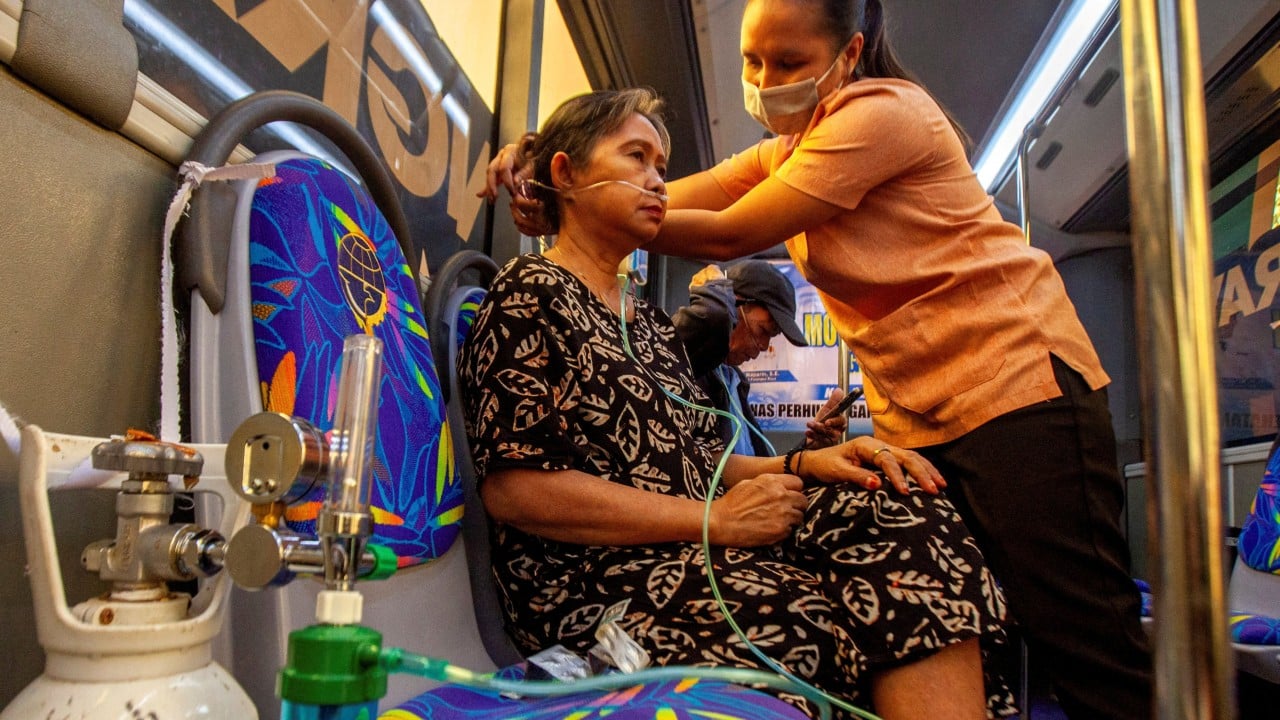
Putting people on a retrofitted bus to breathe filtered air for thirty minutes while their city burns is not a triumph of public health. It is an admission of catastrophic failure disguised as innovation.
Every time toxic haze blankets Sumatra or Kalimantan—driven by the seasonal burning of carbon-rich peatlands for palm oil and pulpwood plantations—international media falls in love with the same heartwarming tech-band-aid story. Local officials park an air-conditioned bus equipped with HEPA filters and oxygen tanks on a smog-choked street. Residents step inside, take a few deep breaths, snap a photo for local press, and step right back out into air that is actively scarring their lungs. Learn more on a connected issue: this related article.
The consensus among feel-good tech blogs and surface-level news outlets is that these "oxygen buses" offer vital, immediate relief to choking communities. That consensus is dangerously naive. By celebrating mobile clean-air lounges, we are applauding a placebo while ignoring the basic physics of respiratory toxicology and the structural economics of land clearing.
If you want to understand why this approach fails—and what actually protects human lungs during a peat fire crisis—you have to strip away the PR gloss and look at the atmospheric science. Additional analysis by USA Today delves into similar perspectives on this issue.
The Physics Of A Thirty-Minute Breather
When peatlands burn, they do not produce standard wood smoke. Peat is partially decayed organic matter accumulated over thousands of years in waterlogged conditions. When drained and ignited, it smolders underground at low temperatures, producing an exceptionally dense, toxic cocktail of carbon monoxide, volatile organic compounds, benzene, and fine particulate matter known as PM2.5—particles smaller than 2.5 micrometers in diameter, roughly one-thirtieth the width of a human hair.
Unlike larger dust particles that get trapped in your nose and throat, PM2.5 bypasses your upper respiratory defenses entirely. It travels deep into the alveoli, the microscopic air sacs where oxygen enters your bloodstream, and crosses directly into your circulatory system. Once there, it triggers systemic inflammation, spikes blood pressure, and accelerates cardiovascular events.
Now, apply basic exposure math to the oxygen bus model.
Air pollution toxicity is a function of concentration multiplied by duration. During severe haze episodes in provinces like Riau or Central Kalimantan, the Air Quality Index routinely blows past 500, with PM2.5 concentrations exceeding 300 to 500 micrograms per cubic meter—more than twenty times the World Health Organization’s 24-hour exposure guideline.
If a resident spends 23.5 hours a day inhaling air at 400 micrograms per cubic meter, stepping onto an oxygen bus for thirty minutes reduces their daily cumulative particulate load by roughly two percent. It does not clear the soot already embedded in their alveolar macrophages. It does not reverse the acute inflammatory cascade already underway in their vascular walls.
Worse, the "oxygen" part of the equation is largely physiological theater for healthy adults. Unless a patient is suffering from acute hypoxemia—abnormally low blood oxygen levels caused by severe underlying lung disease or carbon monoxide poisoning—breathing supplemental oxygen for half an hour does nothing to scrub particulate matter from their lungs. Healthy human hemoglobin is already 95% to 100% saturated with oxygen, even in moderately polluted air. Giving a healthy person extra oxygen in a bus is like pouring water into a glass that is already full. What their body actually needs is the absence of fine particulates, and it needs that absence continuously, not in half-hour novelty doses.
How Band-Aid Tech Kills Real Policy
I have spent over a decade watching municipalities and corporations throw money at visible, photogenic hardware to avoid fixing invisible, politically expensive root causes. In air quality management, this is the oldest trick in the playbook.
Building a mobile oxygen bus costs a fraction of what it takes to enforce zero-burn land clearing laws or rewet drained peat domes. It requires zero confrontation with powerful agribusiness conglomerates. It demands no overhaul of provincial land-use permits. Instead, it gives local officials a ribbon to cut and journalists a tidy narrative of resilience.
Imagine a scenario where a city’s municipal water supply is contaminated with industrial lead. Instead of shutting down the factory dumping the heavy metals or replacing the corroded pipes, the local government parks a sleek, branded "Hydration Van" in the town square. Citizens are invited to line up once a day for a single eight-ounce cup of triple-filtered water before going home to cook and bathe in poisoned tap water. Nobody would call that Hydration Van a breakthrough. They would call it an insult.
Yet when the medium is air instead of water, we lose all sense of proportion. We praise the bus.
This dynamic creates a perverse political incentive. When crisis response is measured by the deployment of temporary relief vehicles, long-term prevention loses urgency. Every dollar and media cycle spent celebrating a mobile clean-air unit is attention diverted from the only metric that actually matters: keeping water tables high enough in Indonesia’s peatlands so the soil cannot catch fire in the first place.
Dismantling The Public’s Wrong Questions
When haze season hits Southeast Asia, public discourse inevitably spirals into a series of predictable questions. Almost every single one is framed around the wrong premise.
Are Oxygen Buses Effective For Smog Relief?
No. They are effective for localized, acute symptom management in vulnerable individuals—such as an asthmatic experiencing an airway constriction or an elderly resident showing signs of respiratory distress—acting essentially as a stationary ambulance. As a broad public health intervention for a city of hundreds of thousands, they are statistically irrelevant. You cannot solve a regional atmospheric crisis one busload of thirty people at a time.
What Is The Best Air Purifier For Haze Season?
People obsess over brand names, smart sensors, and multi-stage carbon filters, often spending hundreds of dollars on sleek appliances that cannot move enough air to matter. The metric you actually need is the Clean Air Delivery Rate (CADR), measured in cubic meters per hour. A fancy purifier with a low CADR in a leaky room is useless during a peat fire. Furthermore, commercial purifiers are priced far beyond the reach of the rural and working-class Indonesians who bear the brunt of agricultural burning.
Do Cloth Or Surgical Masks Protect Against Toxic Haze?
Not even close. Standard surgical masks are designed to block large respiratory droplets from leaving the wearer's mouth; they have massive gaps around the nose and cheeks that allow microscopic PM2.5 particles to rush straight in unfiltered. Cloth masks are worse—they create a false sense of security while letting roughly 80% to 90% of fine smoke particulates pass directly into your lungs. If a mask does not carry an N95, KN95, or FFP2 rating and form an airtight seal against your face, it is doing almost nothing against peat smoke.
Why Doesn’t Indonesia Just Ban Slash-And-Burn Agriculture?
It already did. Burning land to clear it for plantations has been illegal in Indonesia for decades, reinforced by strict laws passed after the catastrophic 2015 fires. Asking why there isn't a ban misses the actual problem: enforcement asymmetry. Smallholder farmers use fire because it is the cheapest way to clear brush and temporarily neutralize acidic peat soil with ash. Meanwhile, larger corporate concessions have historically exploited overlapping land maps, weak local monitoring, and slow judicial prosecution. The law exists on paper; the political and logistical capacity to police millions of hectares of remote swamp does not.
What Actually Works When The Sky Turns Orange
If we abandon the theater of the oxygen bus, what does an evidence-based, high-impact response to severe haze actually look like? It requires shifting from mobile novelty to stationary, scalable, and brutally practical engineering.
1. Decentralized Clean-Air Shelters Over Mobile Buses
Instead of outfitting a vehicle that serves twenty people at a time and burns diesel fuel while idling, municipalities should convert existing public infrastructure—school gymnasiums, community halls, mosques, and clinics—into positive-pressure clean air shelters.
By sealing windows with basic weatherstripping and pumping outside air through industrial-grade HEPA filtration banks, you create slightly higher air pressure inside the building than outside. That positive pressure ensures that clean air leaks out through cracks rather than toxic smoke leaking in. One retrofitted community hall can house 500 vulnerable residents—infants, pregnant women, the elderly, and asthma patients—for twelve hours a day at a fraction of the per-capita cost of a specialized bus.
2. The Corsi-Rosenthal Box For Mass Household Protection
The single most disruptive innovation in indoor air quality over the past few years didn't come from a Silicon Valley startup; it came from open-source engineering. A Corsi-Rosenthal Box—constructed by taping four high-efficiency MERV-13 furnace filters into a cube with a standard box fan on top—delivers a Clean Air Delivery Rate that rivals or beats commercial air purifiers costing eight times as much.
Public health agencies and NGOs should stop handing out surgical masks and start distributing flat-packed MERV-13 filter kits and box fans to low-income households in haze-prone provinces. If a family can create a single "clean room" in their home where they sleep for eight hours a night, their cumulative 24-hour PM2.5 exposure drops by a third. That is real, measurable physiological protection.
3. Hydrological Restoration Before The Dry Season
You do not put out a peat fire with water bombers from the air; once peat ignites, it burns deep beneath the surface where aerial water drops cannot reach. You prevent peat fires by blocking the drainage canals dug by plantation developers.
Organizations like the Peatland Restoration Agency (BRG) and international forestry researchers at CIFOR (Center for International Forestry Research) have demonstrated that building simple wooden or compacted-peat canal blocks raises the groundwater table, keeping the organic soil saturated and fireproof. Every dollar spent blocking a drainage canal in April saves a thousand dollars in emergency healthcare and economic shutdowns in September.
The Hard Truth About The Contrarian Fix
Admitting that the oxygen bus is a failure forces us to confront an uncomfortable reality: the real solutions are deeply unsexy and come with steep trade-offs.
Positive-pressure community shelters require reliable electrical grids in regions that frequently suffer rolling blackouts. Distributing DIY filter boxes demands supply chains capable of moving millions of MERV-13 filters into remote Bornean and Sumatran districts before the smoke arrives. And aggressive peatland rewetting directly threatens the short-term profit margins of palm oil and timber operators, creating fierce local economic resistance and threatening the livelihoods of smallholder farmers who have no affordable mechanical alternative to fire for clearing land.
There are no clean, effortless wins here. Fixing Indonesia’s haze crisis means tackling land tenure reform, subsidizing mechanical land-clearing equipment for small farmers, and holding supply-chain buyers accountable for deforestation-free commodities.
Until governments and media stop rewarding cosmetic interventions, we will keep seeing the same cycle every dry season. The peat will burn. The sky will turn toxic amber. And somewhere on a suffocating street, a freshly painted bus will pull up to the curb, open its doors for thirty minutes, and pretend that a breath of air is the same thing as a cure.
Stop applauding the bus, and start demanding the floodgates that keep the peat underwater.