The metal cool of a steering wheel usually feels like control. For generations, sliding into the driver’s seat meant command over machinery, geography, and destination. But when technology promises to do the thinking for us, that metal wheel changes. It becomes an invitation to drift. Not just across lanes, but out of consciousness entirely.
A quiet street in the middle of the night possesses a fragile peace. Row after row of parked cars sit beneath the amber glow of streetlights, their engines cold, their owners asleep inside homes filled with the soft breathing of children and partners. It is a scene of absolute vulnerability. The people inside those houses trust the geometry of the curb. They trust the unspoken social contract that the asphalt belongs to moving vehicles and the concrete belongs to the stationary.
Then comes the hum.
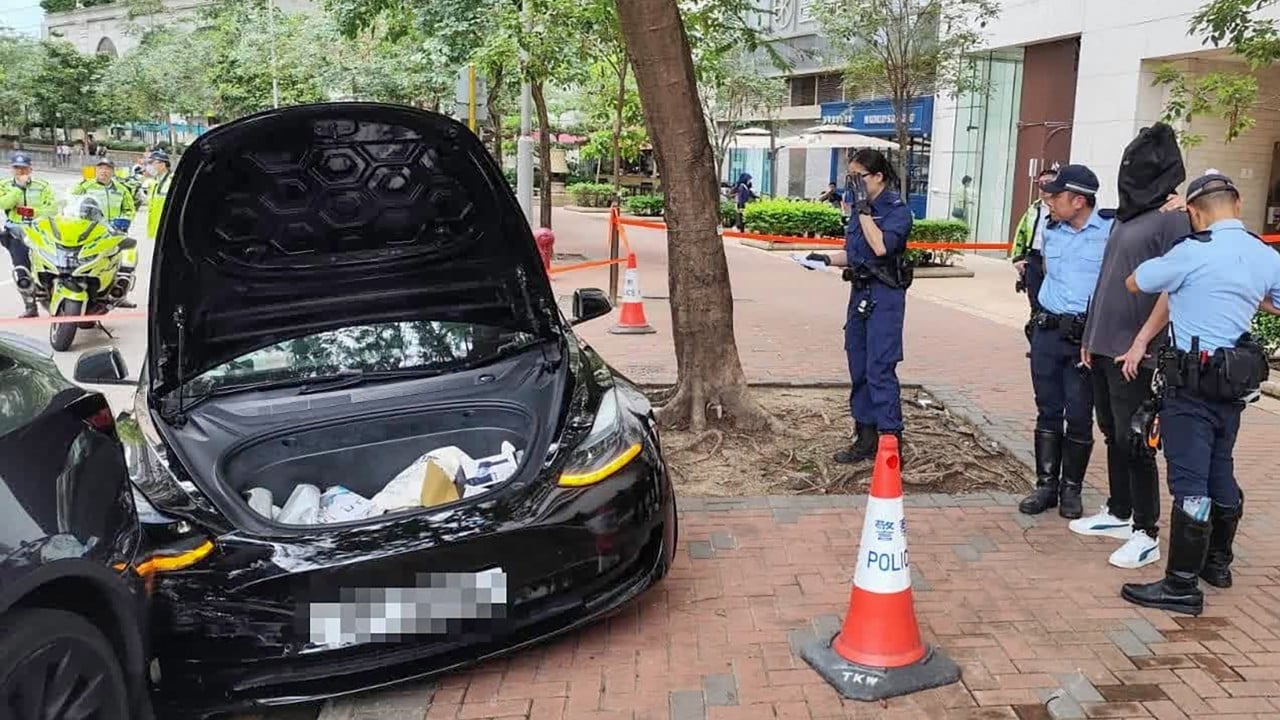
It is not the guttural roar of a modified exhaust or the high-pitched whine of a struggling four-cylinder engine. It is the low, futuristic thrum of a modern electric vehicle. A Tesla. To anyone watching, the car moves with an eerie, detached precision right up until the moment it doesn't.
Crash.
The sound of shattering plastic and crumpling alloy tears through the midnight silence. A heavy luxury sedan, packed with lithium-ion batteries and guided by millions of lines of code, rams squarely into a parked, defenseless vehicle. The violence of the impact shoves the parked car forward, its tires screeching against the pavement, alarms triggering in a discordant symphony of panic.
When the flashing blue lights of the police cruisers finally arrive to paint the neighborhood in rhythmic pulses of color, the narrative takes its darkest turn. The driver is not suffering a medical emergency. He is not swerving to avoid a stray animal.
He is high.
Officers guide the man out of the vehicle. His eyes are glassy, his movements sluggish, his comprehension fractured. The handcuffs click into place with a cold, metallic finality. Another arrest. Another statistic in the growing, alarming trend of drug-driving. But beneath the standard police report lies a deeply unsettling psychological shift in how we interact with modern transportation.
The Digital Cushion and the False Sense of Security
We live in an era of technological insulation. Modern vehicles are designed to isolate us from the harsh realities of the road. Soundproofing dampens the roar of the wind. Advanced suspension turns potholes into minor ripples. And driver-assistance suites monitor blind spots, maintain lane discipline, and brake automatically when obstacles appear.
This is undeniable progress. It saves lives every single day. But it also creates a dangerous psychological byproduct: the illusion of invulnerability.
Consider a hypothetical driver we will call Marcus. Marcus is not a career criminal. He is an ordinary professional who makes a catastrophic choice. After a long night, altered by substances that blur the edges of his perception, Marcus looks at his car. If he drove a twenty-year-old pickup truck with loose steering and a manual transmission, the sheer physical effort required to operate it might terrify him into calling a rideshare. The truck offers no safety net. It demands absolute, sober presence.
But Marcus owns a high-tech electric vehicle.
The car greets him with a glowing screen. It breathes readiness. In his compromised state, Marcus internalizes a fatal lie: The car will protect me from myself. He believes the technology bridges the gap between his impaired reflexes and the demands of the road. He treats the vehicle's autonomous features not as an emergency backup, but as a digital designated driver.
This is the hidden crisis of modern transit. The smarter our cars become, the more some drivers are willing to degrade their own capacity. The technology intended to eradicate human error is instead being used as a cushion for human recklessness.
The Biology of Impairment Meets Artificial Intelligence
To understand why this combination is so volatile, we have to look at what happens inside the brain during drug-induced impairment. Unlike alcohol, which generally acts as a central nervous system depressant with predictable metrics like Blood Alcohol Concentration (BAC), narcotics, synthetics, and illicit substances alter cognitive function in wildly erratic ways.
- Spatial Distortion: A driver's ability to judge the distance between their front bumper and a parked car's rear quarter panel is severely compromised. A gap of three feet can look like thirty.
- Latency in Decision Making: The brain's neural pathways, slowed by chemical interference, experience a lag. By the time the mind registers a hazard, the vehicle has already traveled dozens of yards.
- Overconfidence: Certain substances eliminate the natural biological trigger of fear. A sober driver feels a spike of adrenaline when a vehicle drifts; an impaired driver feels entirely at peace right up to the point of impact.
Now, overlay this fractured human biology onto a system of cameras, radar, and machine learning algorithms.
An advanced driver-assistance system is exceptional at tracking clear lines on a well-lit highway. It excels at maintaining a set distance from a vehicle traveling at a constant speed directly ahead. However, urban and suburban environments are chaotic. They require human intuition. They require the ability to read the body language of a pedestrian stepping off a curb, or to anticipate the erratic movement of a car parking at an odd angle.
When a driver abdicates their responsibility to an automated system while under the influence, they create a terrifying blind spot. The car expects a vigilant human ready to take the wheel in a fraction of a second. The human expects the car to handle everything.
Two systems, both operating on false assumptions, meeting on a dark residential street. The result is inevitably catastrophic.
The Ripples Beyond the Asphalt
It is easy to look at a headline about a drug-driving arrest and view it as an isolated incident. A bad actor caught. Justice served. Move on.
But the true cost of these incidents radiates outward in ways that a police blotter can never capture.
Think of the family sleeping inside the house just yards from that crash. They wake up to a sound like a bomb exploding. For months afterward, every loud noise in the night triggers a spike of cortisol. The street that once felt like a sanctuary now feels like a hazard zone.
Think of the owner of the parked vehicle. Perhaps it was a modest sedan, paid off after years of hard work, used to commute to a job that keeps the family afloat. Suddenly, through no fault of their own, their routine is shattered. Insurance claims, rental car logistics, missed hours at work, the sudden, uninvited stress of financial instability—all because someone thought their car was smart enough to navigate a drug-induced haze.
Then there is the collective cost to our trust in innovation. Every time a high-tech vehicle is involved in a high-profile wreck, it chips away at the public’s faith in autonomous technology. The future of transportation relies on trust. We must believe that the algorithms sharing the road with us are being used to make communities safer, not to facilitate irresponsible escapes from reality.
When people misuse technology to shield themselves from the consequences of intoxication, they stall the progress that could eventually save thousands of lives. They turn a tool of liberation into a weapon of convenience.
Reclaiming the Responsibility of the Wheel
We cannot engineer our way out of accountability.
No amount of code, no array of sensors, and no marketing campaign can replace the fundamental ethical obligation of sitting in the driver’s seat. When we operate a two-ton machine capable of ending a life in an instant, we enter into a covenant with every pedestrian, every cyclist, and every sleeping family we pass.
The solution does not lie solely in harsher penalties or more frequent police checkpoints, though enforcement remains vital. The real shift must happen within our cultural understanding of what a vehicle is.
A car is not a living room. It is not an entertainment center. It is not a sanctuary where we can escape our obligations to the outside world. It is a profound responsibility.
As automotive technology continues to advance toward true autonomy, the temptation to check out will only grow stronger. The temptation to let the machine handle the burden of our poor choices will become more seductive. We must resist this drift with everything we have.
The next time you step into a vehicle, look at the screen, look at the sleek dashboard, and then look at your hands on the wheel. The technology beneath you is a brilliant assistant, but the conscience belongs entirely to you. The peace of the streets we share depends on us remembering that distinction, long before the blue lights start to flash.