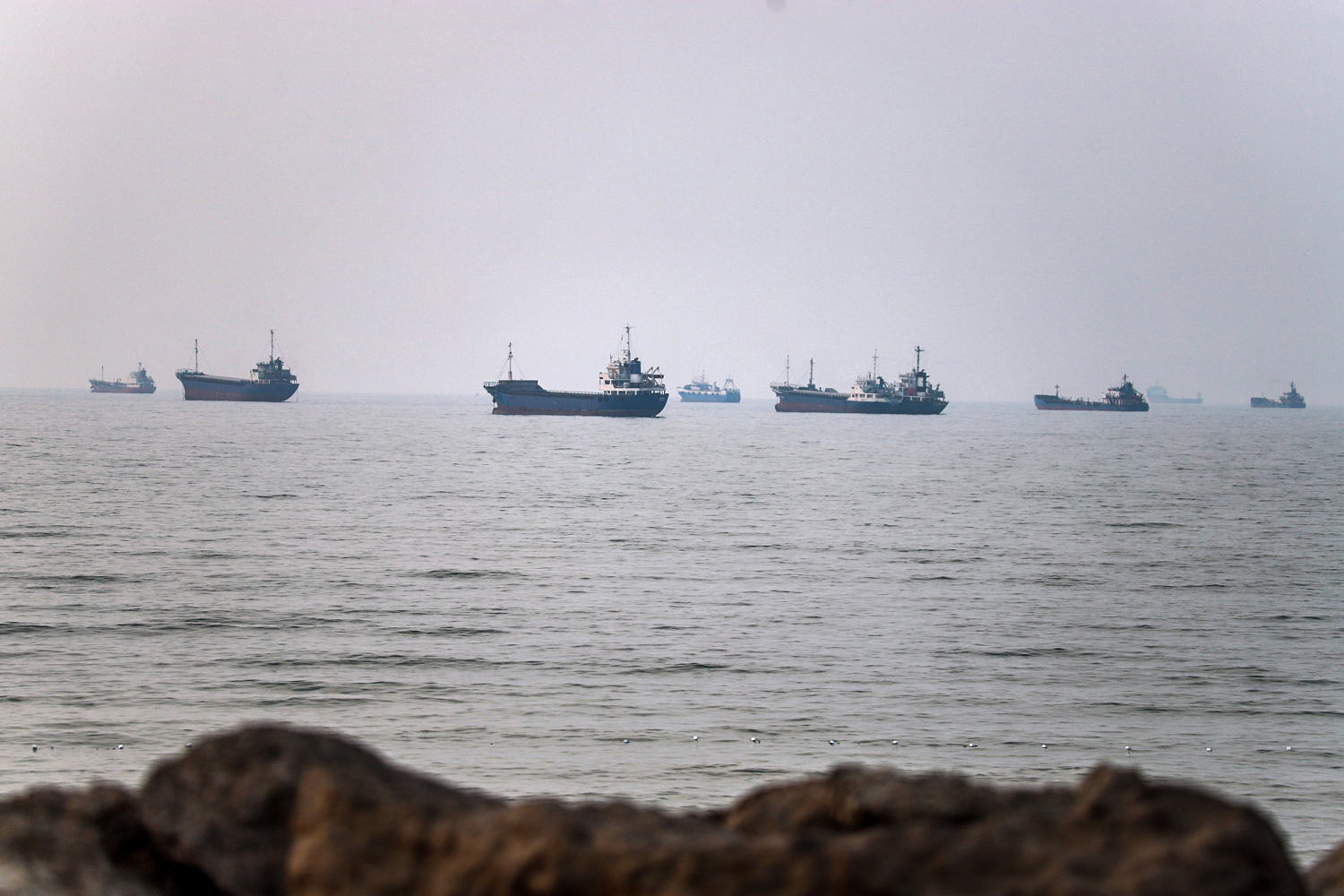
The steel hull of a modern container ship is essentially a floating building, five stories high and hundreds of feet long. When it burns, it smells like scorched rubber, melting insulation, and heavy fuel oil.
On Saturday night, inside the tight maritime throat of the Strait of Hormuz, the Cyprus-flagged M/V GFS Galaxy became a giant torch. A strike by the Islamic Revolutionary Guard Corps left the engine room shattered, the vessel paralyzed, and one civilian crew member missing somewhere in the dark, churning water.
Thousands of miles away, the event registers as a slight spike in the cost of a gallon of gas or a line item on a defense briefing. But for the people on the water, the geography of global trade has shrunk to a terrifyingly thin line.
The Geography of Friction
The Strait of Hormuz is twenty-one miles wide at its narrowest pinch. It is the world’s primary economic jugular, a passage through which a fifth of the planet’s oil and natural gas must squeeze. To look at a satellite map, the water looks infinite and blue. To navigate it right now is to walk a tightrope over an active volcano.
On Sunday morning, the geopolitical reality split into two entirely irreconcilable universes.
In Tehran, the state-run media broadcasted a decree: the Strait of Hormuz is closed until further notice. No ships pass without explicit Iranian permission. The era of uncoordinated transit is over.
In Washington, the message was flatly the opposite. "It's open," President Donald Trump declared on national television, noting that U.S. forces had just launched a massive wave of retaliatory airstrikes—hitting 140 targets across southern Iran, including missile dumps and drone launchpads in Bushehr and Asalouyeh.
So who is telling the truth?
The answer depends entirely on how you define a word. If "open" means that the United States military possesses the raw firepower to escort vessels and blow Iranian assets out of the water, then yes, the strait is open. But if "open" means a predictable, insurable commercial corridor where civilian merchant sailors do not have to worry about a missile melting their quarters, the strait has been functionally dead for months.
Consider the reality on the water this Sunday. Transponders are dark. The normal hum of 140 massive vessels passing through daily has withered to almost nothing. Only two tankers were spotted approaching the chokepoint. One empty supertanker crept along the Omani coast, running blind without its satellite tracking systems, trying to blend into the shadows of the cliffs.
The water is technically there. The passage is physically clear. But the ocean is empty.
The Human Cost of a Standoff
We tend to talk about blockades and maritime corridors in terms of abstract mathematics. We analyze the price of crude oil—which has fluctuated wildly around $100 a barrel—and we map out supply chain delays for European manufacturing.
We forget about the mariners.
Imagine a hypothetical third engineer on a cargo vessel, let’s call him Marcus. He is a contract sailor from Manila or Odessa. He signed up to move steel boxes full of consumer electronics and refrigerated fruit across the ocean. He is not a combatant. Yet, as his ship approaches the Omani coast, he knows that the satellite navigation system on the bridge might suddenly start lying due to Iranian GPS jamming. He knows that if his captain takes a route a few miles too close to the northern shore, a fast-attack speedboat could pull alongside, or a low-flying suicide drone could tear through the superstructure.
This isn't a hypothetical fear. The International Maritime Organization recently noted that thousands of mariners have found themselves effectively trapped in the Persian Gulf, unwilling or unable to run the gauntlet.
When Iran announced its closure, it claimed the GFS Galaxy had used an "unauthorized route" and ignored warnings. The U.S. military countered that the ship was transiting lawfully through international waters. While the two superpowers argue over the legal definitions of maritime boundaries, a crew is left fighting a fire in a crippled engine room, staring out into a gulf that has become a shooting gallery.
The Anatomy of an Escalation
The current crisis did not materialize out of nowhere. It is the unraveling of a fragile, desperate diplomatic experiment.
Just weeks ago, a memorandum of understanding signed on June 17 was supposed to provide a sixty-day breathing room. It was an interim deal meant to pause the shadow war that erupted earlier this year, allowing trade to resume while diplomats argued over nuclear programs and sanctions relief.
But agreements signed in air-conditioned rooms in Europe mean very little when the local commanders on the water are holding matches. The truce began to fray when Iranian forces fired warning shots at commercial ships using a southern route near Oman—a route designed specifically to keep civilian vessels away from Iranian territorial waters. Tehran viewed this route as an illegal determination of shipping lanes by foreign powers; Washington viewed it as the only safe way to keep global trade moving.
The response to the Galaxy attack was swift and heavy. The U.S. Central Command did not just target the specific missile batteries that hit the ship; they launched a sweeping campaign to degrade Iran's coastal infrastructure.
Then came the counter-punch.
Within hours of the American bombardment, the Revolutionary Guard launched ballistic missiles and drones across the region. Sirens wailed in Bahrain, home to the U.S. Navy’s Fifth Fleet. Shrapnel rained down in Qatar, wounding civilians. Explosions rattled Kuwait and Jordan. Oman, traditionally the quiet mediator of the region, took the rare step of summoning the Iranian ambassador to protest strikes near its own waters, calling the escalation utterly irresponsible.
The conflict is no longer contained to a narrow strip of sea. It is bleeding into the soil of half a dozen neighboring countries.
The Broken Dial
There is a specific kind of danger that occurs when neither side can afford to back down because they are playing to entirely different audiences.
For the Trump administration, maintaining the flow of shipping through Hormuz is a test of absolute credibility. To allow Iran to dictate who uses an international waterway would be a catastrophic capitulation, one that would reset the balance of power in the Middle East and send shockwaves through the global economy. The strategy is simple: apply maximum military pressure until Tehran blinks.
For Iran’s leadership, the strait is the ultimate lever. As Mohsen Rezaee, a senior adviser to Iran’s leadership, recently stated, this strategic passage is viewed as more valuable than dozens of atomic bombs. In their view, if Iran cannot normalize its own oil exports due to Western sanctions, then no one else will enjoy a stable energy market either.
The speaker of Iran's parliament, Mohammad Bagher Qalibaf, put it bluntly on social media: "The era of one-sided deals is over... Reality is knocking."
This is the gridlock. One side is using 140-target airstrikes to enforce an open status quo; the other side is using mines, drones, and asymmetric attacks to prove that the status quo is dead.
The Horizon
The true tragedy of the situation is that the global economy is slowly learning to live with the chaos. Traders are adjusting to the volatility. Supply chains are being rerouted around Africa at immense cost, or businesses are simply absorbing the expensive insurance premiums required to sail into the Gulf.
We are becoming numb to the alerts. We read about another round of strikes, another disabled ship, another political statement, and we turn the page.
But the illusion of normalcy disappears the moment you look closely at the water. The Strait of Hormuz is not a line on a map or a data point on a financial terminal. It is a real place, filled with hot wind, the smell of salt water, and the sudden, terrifying roar of incoming missiles.
Right now, the world’s most critical waterway is held in a violent suspension. It is open by force of arms, closed by fear of death, and monitored by sailors who can do nothing but watch the horizon and hope they aren't the next target.