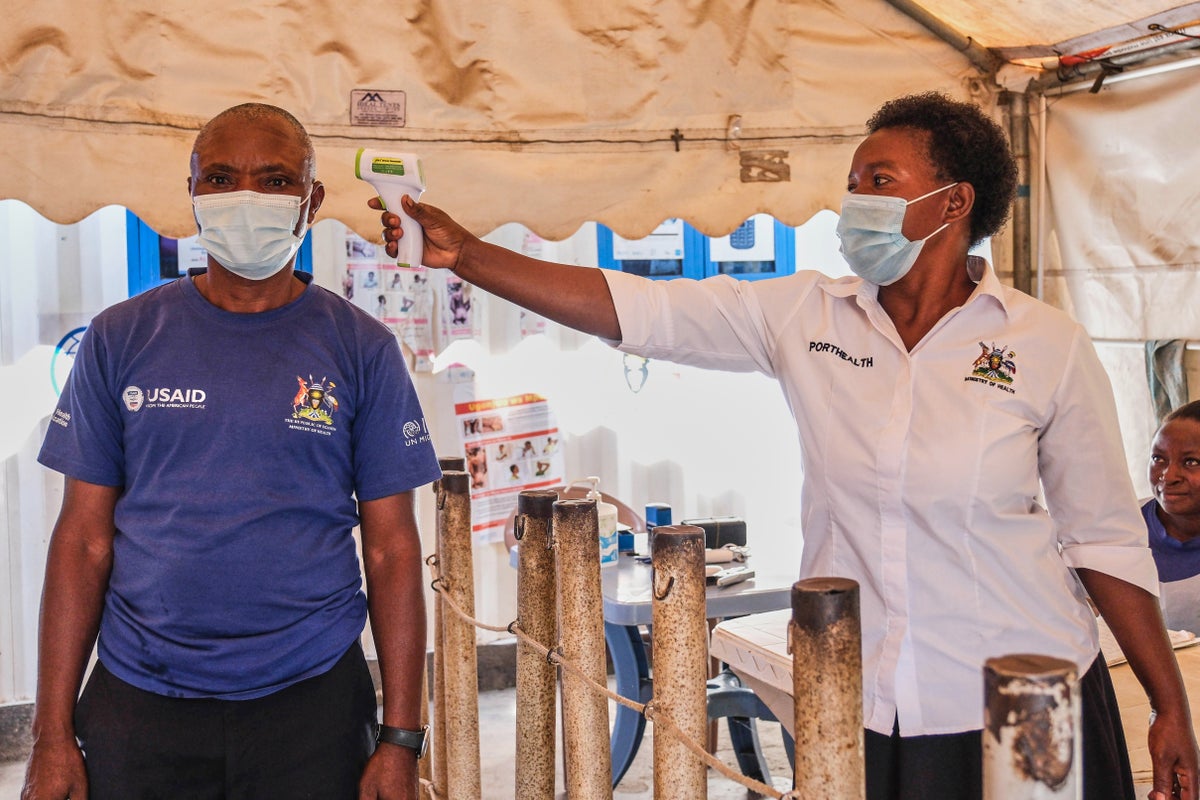
Uganda has closed its border with the Democratic Republic of Congo in a desperate bid to block a surging Ebola outbreak, a move that directly defies World Health Organization guidelines and signals deep panic over a rare, unvaccinable viral strain. The decision, handed down by a local task force led by Vice-President Jesca Alupo and executed by Health Ministry Permanent Secretary Dr. Diana Atwine, institutes an immediate shutdown of formal crossings. Only heavily screened security, cargo, and humanitarian transit are permitted, while anyone else entering from the DRC faces a mandatory 21-day isolation.
The political theater of a sealed border provides a false sense of security. The reality on the ground is far more perilous, as the virus has already breached the frontier, infecting Ugandan healthcare workers before the formal outbreak declaration on May 15. This is not the familiar Ebola of years past. Officials are wrestling with the Bundibugyo strain, a rare variant for which there are no approved vaccines, no specific therapeutic drugs, and a history of evading standard diagnostic tests. By shutting down official channels, Uganda risks driving desperate travelers into the thick brush of unmonitored footpaths, effectively blinding the very surveillance networks required to track the contagion.
The Blind Spot of Bio-Defense
Public health containment relies entirely on visibility. When a government closes an official port of entry, the human traffic does not magically disappear. It merely liquefies, flowing through the hundreds of informal, unmonitored footpaths that lace the dense forests of the hundreds-of-miles-long Uganda-DRC border.
For communities along this frontier, the international boundary is an arbitrary line cutting through families, tribal lands, and daily markets. People cross constantly to trade food, visit relatives, or seek medical attention. By criminalizing or restricting these normal movements, the border closure incentivizes local populations to bypass formal checkpoints entirely. The World Health Organization has repeatedly warned against international travel bans for exactly this reason. Forcing migration underground makes contact tracing—the single most vital weapon against Ebola—completely impossible.
The administrative failure began long before the border order. The virus was already circulating silently in eastern Congo for weeks before its official identification in mid-May. Because the Bundibugyo strain is rare, standard diagnostic kits initially failed to recognize it, allowing transmission chains to multiply completely unnoticed. By the time Ugandan authorities realized Congolese patients crossing the border were carrying Ebola, several frontline Ugandan health workers had already been exposed and infected. The virus did not wait for a passport stamp; it arrived via the standard flow of regional medical migration.
A Virus Without an Arsenal
The global health community has grown complacent about Ebola, largely due to the success of Ervebo and other highly effective vaccines deployed during recent outbreaks in West Africa and the DRC. Those medical tools, however, were engineered exclusively for the Zaire strain of the virus.
Against the Bundibugyo variant, the global medical cabinet is entirely bare.
- No Approved Vaccine: The stockpiles of experimental and approved Ebola vaccines currently held by global health bodies are useless against this strain.
- No Proven Therapeutics: Monoclonal antibody treatments that saved lives in recent epidemics do not possess the binding affinity required to neutralize Bundibugyo.
- Diagnostic Delays: Early symptoms mimic malaria or typhoid, and because standard rapid tests initially misidentified the strain, local clinics inadvertently operated as amplification points for the disease.
The lack of pharmaceutical interventions shifts the entire burden of defense back to primitive public health measures: strict isolation, rigorous contact tracing, and safe burials. These strategies require an extraordinary level of community trust and immense operational funding. Neither is currently present in sufficient quantities.
The WHO and Africa CDC recently launched a $518 million emergency response plan to combat what has rapidly grown into the fourth-largest Ebola epidemic on record. Yet, international donors have pledged only about $315.8 million, leaving a massive funding shortfall as the virus gains momentum. Health agencies are playing a lethal game of catch-up against an pathogen that has a massive head start.
Militias and Misinformation
The epicenter of the crisis sits in eastern Congo’s conflict-ravaged provinces, particularly Ituri, North Kivu, and South Kivu. This is an environment defined by decades of armed conflict, weak state presence, and deep-seated institutional mistrust.
Ebola Outbreak Status (June 2026)
+-------------------------+-------------------------+
| Metric                  | Value                   |
+-------------------------+-------------------------+
| DRC Suspected Cases     | ~1,000                  |
| DRC Confirmed Cases     | 129                     |
| DRC Suspected Deaths    | 246                     |
| Uganda Confirmed Cases  | 9                       |
| Global Funding Gap      | ~$202 Million           |
+-------------------------+-------------------------+
Active rebel militias frequently launch attacks across these provinces, displacing millions of civilians and rendering large swathes of the region inaccessible to medical teams. When an active conflict zone overlaps with a highly infectious hemorrhagic fever, standard epidemiologic protocols shatter. Contact tracing requires tracking down at least 90 percent of an infected person's exposed circle to halt transmission. Currently, health officials admit they are successfully monitoring only about 45 percent of identified contacts. The remaining 55 percent are moving through a chaotic war zone, untracked and potentially symptomatic.
Furthermore, medical teams, treatment centers, and safe burial squads face direct hostility from displaced, terrified populations. Decades of political marginalization have left local communities deeply cynical of outside intervention. When health workers arrive in biohazard suits, accompanied by government security forces, it often fuels rumors that the disease is a political fabrication or an imported bio-weapon. This resistance directly slows down diagnosis and isolation, guaranteeing that infected individuals remain within their communities, transmitting the virus to family members and neighbors until it is too late.
The Global Ripples of Fear
The panic is no longer confined to the Great Lakes region of Africa. As western nations watch the case counts climb, panic-driven border and travel restrictions are beginning to echo internationally, threatening to choke off the exact resources needed to halt the epidemic.
The United States has already restricted entry for anyone who has recently traveled through Congo, Uganda, or South Sudan, routing all such passengers through just three designated airports for enhanced screening. More telling is a growing controversy in central Kenya, where a U.S. government proposal to construct a 50-bed Ebola quarantine facility in Nanyuki for its own personnel has triggered fierce local blowback. Kenyan residents have openly condemned the plan, expressing terror that importing monitored individuals will introduce the virus to an uninfected country, while pointing to the stark hypocrisy of Western nations protecting their own citizens at the expense of local security.
These geopolitical maneuvers expose the core flaw of modern pandemic management. Nations consistently treat infectious disease as an immigration problem rather than a systemic biomedical emergency. Closing a border or building an isolated quarantine facility might satisfy a domestic electorate, but it does nothing to address the core engines of the outbreak: the lack of a specific vaccine, underfunded surveillance budgets, and the realities of a highly mobile population fleeing a brutal civil conflict.
Uganda's decision to close its border is an act of political desperation, an attempt to build a wall against an invisible killer that has already slipped through the gates. If the international community continues to underfund the frontline response and relies on isolation tactics instead of aggressive, on-the-ground containment and rapid diagnostic development, the Bundibugyo strain will continue to exploit the blind spots created by the world's fear.