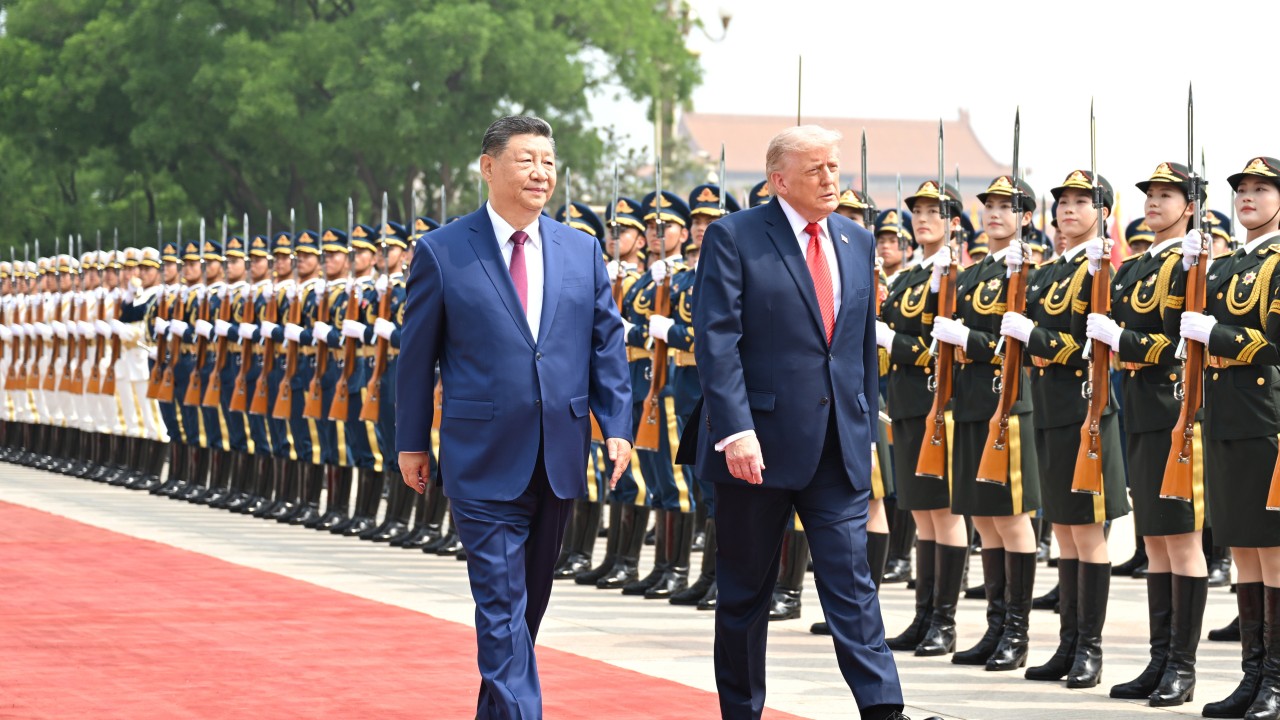
The headlines coming out of Beijing paint a picture of sweeping diplomatic victory. Following a highly choreographed two-day summit in the Great Hall of the People, Donald Trump and Xi Jinping emerged to announce the creation of new bilateral trade and investment councils. Trump boasted of fantastic deals, while Chinese Foreign Minister Wang Yi praised an agreement to implement all existing consensus. Do not be fooled by the optics. These councils are not a breakthrough. They are a structural holding action designed to mask a fundamental, unresolved economic conflict that both superpowers are merely delaying.
By looking past the state dinners and the military band covers of American pop songs, the reality becomes clear. The newly minted trade and investment councils are administrative pressure valves. They allow both leaders to claim a superficial victory for their domestic audiences while changing absolutely nothing about the underlying friction points. For Trump, the councils offer a narrative of engagement and a mechanism to boast about promised Chinese purchases of American airplanes and agricultural products. For Xi, they represent a bureaucratic buffer designed to stall aggressive American unilateralism and shield China from imminent economic shock.
The Mechanism of Deferral
To understand why these councils are an illusion of progress, one must look at what they actually do. They do not lower tariffs. They do not resolve the structural subsidies that power China's manufacturing engine. Instead, they establish a framework to segregate bilateral capital flows into artificial categories.
The investment council, for example, is being structured to identify non-sensitive sectors where Chinese capital can theoretically flow without triggering a full national security review by the Committee on Foreign Investment in the United States (CFIUS). This sounds practical on paper. In practice, it is an administrative nightmare. Defining what constitutes a non-strategic sector in an era where software, logistics, and basic manufacturing are deeply intertwined with data security is an impossible task. The council will likely become a bureaucratic swamp where investments go to die slow deaths of deliberation, rather than facing rapid political rejections.
Similarly, the trade council is designed to oversee the continuation of previous purchase agreements. Trump touted a commitment from Beijing to buy 200 Boeing aircraft. Wall Street, however, immediately noted that the markets had anticipated an order of twice that size to genuinely move the needle on the trade deficit. Beijing is doling out just enough commercial candy to keep Washington at the negotiating table, without committing to structural changes that would compromise its domestic industrial policy.
The Shadow of China Shock 2.0
The real crisis that these councils are avoiding is the massive wave of cheap Chinese industrial exports currently hitting global markets. American policymakers are privately terrified of what economist circle-rooms call China Shock 2.0. This refers to the tidal wave of low-cost electric vehicles, lithium batteries, and solar panels backed by massive state subsidies that threaten to wipe out domestic manufacturing before it can take root.
Trump claimed that the word tariff did not arise during his one-on-one sessions with Xi. That silence is telling. It does not mean the threat has vanished. It means both sides knew that bringing it up would shatter the fragile truce of the summit. The United States Trade Representative is currently finalizing sweeping investigations into Chinese unfair trade practices. New tariff packages are already scheduled for rollouts later this summer.
By creating these councils, Beijing has effectively bought itself a few months of predictability. Chinese officials are banking on the idea that as long as these councils are meeting and talking, the White House will find it politically difficult to unleash sudden, catastrophic escalations that would completely disrupt supply chains. It is a strategy of survival through institutionalization.
The Solitary Strongman Trap
A structural flaw in Washington's current approach is the deep-seated belief that complex macroeconomic imbalances can be settled through sheer force of personality. Trump approached the Beijing summit as an arena for two strongmen to strike a grand bargain. This bilateral myopia plays directly into China's hands.
Washington's true geopolitical leverage does not lie in unilateral threats, but in its vast network of global allies. Nations in Europe and Asia are facing the exact same industrial pressures from Chinese overcapacity. Yet, by focusing entirely on a personalized, one-on-one negotiation track, the American administration has effectively sidelined its partners. While the Office of the United States Trade Representative tries to quietly build a critical minerals club with allies to break China's stranglehold on raw materials, the headline-grabbing theater in Beijing undermines that collective leverage.
Xi understands that a fragmented West is much easier to manage than a unified trade bloc. By offering Trump personalized commercial concessions, Beijing successfully keeps the focus on bilateral dealmaking, preventing the formation of a broader, more formidable anti-subsidy coalition.
The September Deadline
This bureaucratic detente has a clear expiration date. The calendar for the remainder of the year reveals that this summit was merely the opening salvo in a grueling, multi-stage game of chicken. The two leaders are scheduled to meet again at a bilateral summit in Washington, followed by meetings at regional forums later in the winter.
This timeline perfectly mirrors the expiration of the temporary trade truces brokered last autumn. The hard choices have not been made; they have simply been rescheduled for the autumn. When the newly formed trade and investment councils inevitably fail to bridge the gap between American demands for structural reform and China's commitment to state-led capitalism, the theater will stop. The councils will not save the relationship from the structural forces dragging it toward deeper divergence. They have merely ensured that the collision will happen on a slight delay.