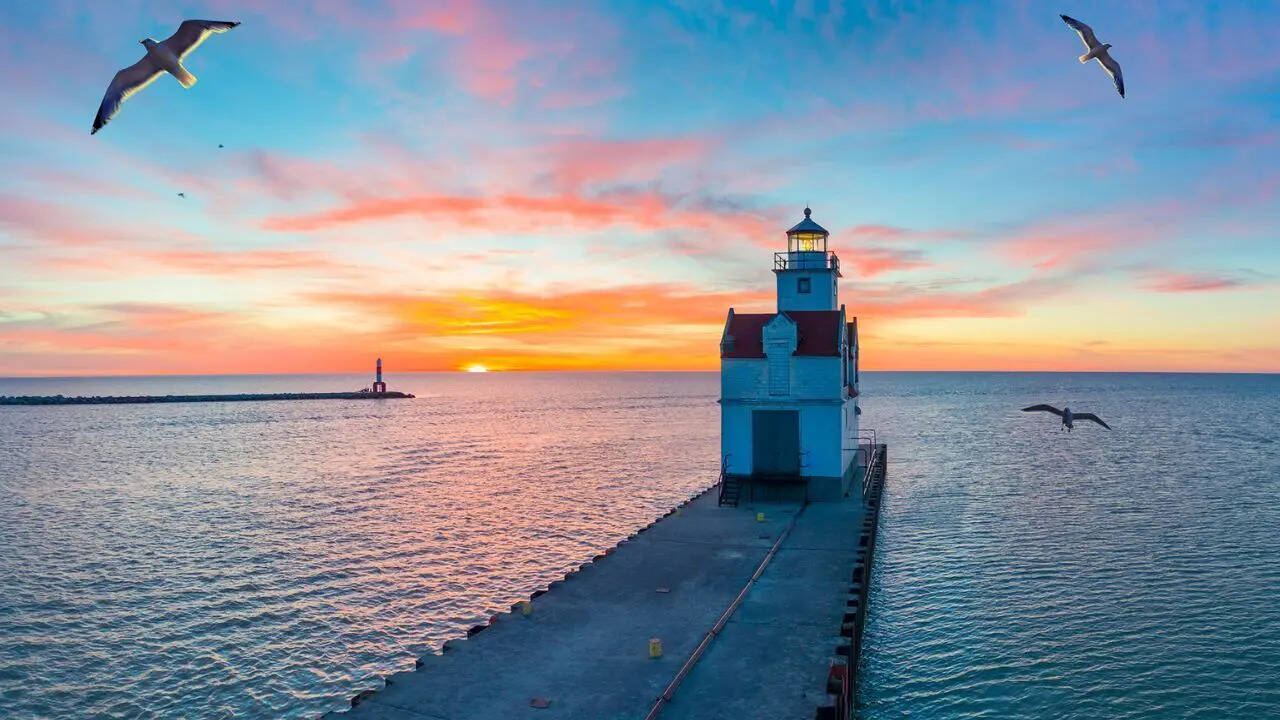
Rhode Island occupies a land area of approximately 1,034 square miles. While frequently used as a shorthand for insignificance in American geographic discourse, this unit of measurement reveals a startling lack of scale when applied to North American hydrology. Six distinct bodies of water within or bordering the United States possess surface areas that exceed this state’s footprint by factors ranging from double to nearly thirtyfold. This analysis deconstructs these massive hydrological systems through the lens of surface area displacement, volume-to-area ratios, and the economic utility of their vast littoral zones.
The Mathematical Supremacy of the Great Lakes System
The Great Lakes represent the most significant accumulation of liquid fresh water on the planet's surface by area. To understand the scale of these bodies, one must move beyond simple linear measurements and evaluate them as inland seas. The disparity between a state like Rhode Island and a body like Lake Superior is not merely a matter of more water; it is a fundamental shift in climate regulation, thermal inertia, and transport logistics. In similar developments, take a look at: The Morning the Sky Stood Still.
1. Lake Superior: The Continental Benchmark
Lake Superior is the largest freshwater lake in the world by surface area, covering roughly 31,700 square miles. In a direct comparison, Lake Superior could contain the entire landmass of Rhode Island approximately 30.6 times.
The lake’s scale creates a unique "maritime" environment in the center of the continent. Because of its massive volume—roughly 2,900 cubic miles—it possesses a thermal lag that dictates the agricultural cycles of the surrounding North Shore and Upper Peninsula. The depth of Superior (averaging 483 feet) means it holds more water than all the other Great Lakes combined, plus three extra Lake Eries. From an analytical perspective, Superior is less of a lake and more of a captured ocean, dictating its own weather patterns through "lake-effect" precipitation cycles that can dump feet of snow based solely on the fetch—the distance wind travels over open water. Lonely Planet has analyzed this important subject in great detail.
2. Lake Huron: The Hydraulic Twin
Lake Huron spans 23,000 square miles, making it approximately 22 times the size of Rhode Island. Geologically and hydrologically, Lake Huron and Lake Michigan are a single entity connected by the five-mile-wide Straits of Mackinac. They maintain the same surface elevation and technically constitute the largest lake in the world by surface area when measured as one.
Huron’s value is defined by its coastline. It boasts the longest shoreline of any Great Lake, largely due to the inclusion of Manitoulin Island—the largest freshwater island in the world. The complexity of Huron’s Georgian Bay and North Channel creates a high-density archipelago system that serves as a critical buffer for biodiversity. In terms of Rhode Island units, Huron’s surface area alone represents nearly the entire landmass of West Virginia.
3. Lake Michigan: The Singular Sovereign
At 22,404 square miles, Lake Michigan is the only Great Lake located entirely within United States borders. It is roughly 21.6 times the size of Rhode Island. The lake functions as a massive heat sink for the Chicago and Milwaukee metropolitan corridors, regulating extreme temperatures during summer months.
The bathymetry of Lake Michigan reveals a divided basin structure. The northern basin is deep and cold, while the southern basin is shallower and more industrial. This division creates a bottleneck for nutrient cycling, impacting the multi-billion dollar commercial and recreational fishing industries. The scale of Michigan is so vast that the "lake-effect" snow bands it generates can reach as far east as the Appalachian foothills under specific atmospheric conditions.
4. Lake Erie: The High-Production Basin
Lake Erie is the smallest of the Great Lakes by volume and the shallowest, yet its 9,910 square mile surface area still dwarfs Rhode Island by a factor of 9.5. Because Erie is shallow (averaging only 62 feet in depth), it warms more rapidly in the summer and freezes more consistently in the winter than its deeper counterparts.
This lack of depth creates a "low volume, high surface area" ratio that facilitates intense biological activity. Erie produces more consumable fish biomass than the other four Great Lakes combined. However, this same ratio makes the lake highly susceptible to nutrient runoff, leading to significant harmful algal blooms (HABs). The lake’s surface area is large enough to create dangerous "seiches"—wind-driven waves that can cause the water level to rise several feet on one end of the lake while dropping on the other, a phenomenon rarely seen in bodies of water smaller than this threshold.
5. Lake Ontario: The Downstream Threshold
Lake Ontario covers 7,340 square miles, roughly 7 times the size of Rhode Island. While it is the smallest of the Great Lakes in surface area, it exceeds Lake Erie in volume due to its significantly greater depth (averaging 283 feet).
Ontario serves as the final catchment for the entire Great Lakes system before the water exits via the St. Lawrence River to the Atlantic. The hydraulic pressure of the upstream lakes—Superior, Michigan, Huron, and Erie—all focus into this single basin. This creates a strategic bottleneck for the Saint Lawrence Seaway, where the scale of the lake must be balanced against the rigid constraints of the lock systems that facilitate global trade.
Beyond the Great Lakes: The Great Salt Lake Anomalies
The sixth body of water exceeding the Rhode Island benchmark is the Great Salt Lake in Utah. Unlike the Great Lakes, its surface area is highly volatile, fluctuating based on snowpack runoff and industrial water diversion.
6. The Great Salt Lake: A Variable Geometry
In a high-water year, the Great Salt Lake has reached surface areas of approximately 3,300 square miles, making it over 3 times the size of Rhode Island. In recent years of drought and systemic over-extraction, it has shrunk toward 950 square miles, occasionally falling below the Rhode Island threshold.
The lake represents a terminal basin; water enters but only leaves through evaporation. This creates a hypersaline environment that supports a massive brine shrimp industry and serves as a critical stopover for millions of migratory birds. The shrinkage of this lake poses a significant tectonic risk to the region: as the water recedes, the exposed lakebed releases toxic dust containing arsenic and lead into the Salt Lake City airshed. The scale of the lake is therefore not just a geographic curiosity but a biological and public health barometer for the Great Basin.
The Economic and Geopolitical Weight of Surface Area
The disparity in scale between these lakes and a US state is not merely a trivia point; it dictates the functional limits of regional economies. The Great Lakes system supports a regional GDP that would rank as the third-largest economy in the world if it were a stand-alone country.
- Logistics Efficiency: The surface area allows for the operation of "thousand-footers"—massive lake freighters that carry iron ore and grain. These vessels require a fetch and depth that are impossible in smaller bodies of water.
- Climate Regulation: The "lake effect" is a direct function of surface area. Smaller lakes do not have the surface-to-air interface necessary to significantly alter regional microclimates or extend growing seasons for specialized crops like cherries and grapes.
- Jurisdictional Complexity: Because these lakes span multiple states and two nations (with the exception of Michigan), they are governed by the Great Lakes Compact. This legal framework treats the water not as a commodity but as a shared natural asset, preventing the diversion of water to parched regions outside the basin.
The Failure of Small-Scale Perception
When observers compare Lake Michigan to Rhode Island, the error is often in treating the lake as a "resource" within a landmass. In reality, the Great Lakes are the dominant geographic features of the North American interior. They are the drivers of the landscape, not the inhabitants of it.
The hydraulic residence time—the measure of how long a drop of water stays in a lake—further emphasizes the scale. A drop of water entering Lake Superior stays for nearly 191 years. In Lake Michigan, the duration is roughly 99 years. This creates a massive "systemic memory" where pollutants or changes in water chemistry persist for generations, unlike the rapid turnover seen in smaller river-fed reservoirs.
Strategic Assessment of Freshwater Sovereignty
The six lakes larger than Rhode Island represent the primary freshwater strategic reserves of the United States. As western states face chronic water scarcity, the political pressure to "leverage" these massive surface areas will increase. However, the physical reality of the Great Lakes’ volume-to-recharge ratio suggests that they are less like a flowing tap and more like a massive, non-renewable gift from the last glacial retreat.
Current hydrological data suggests that while surface areas remain relatively stable, the quality and temperature of these "inland seas" are shifting. The strategic play for the next decade is not the expansion of water use, but the fortification of the Great Lakes Compact to ensure that the scale of these lakes remains a permanent feature of the North American continent rather than a dwindling resource. The sheer physical footprint of Lake Superior or Lake Michigan provides a buffer against rapid environmental change, but that buffer is finite. Protecting these 94,000 square miles of surface water is the most critical geopolitical imperative for the Great Lakes region.