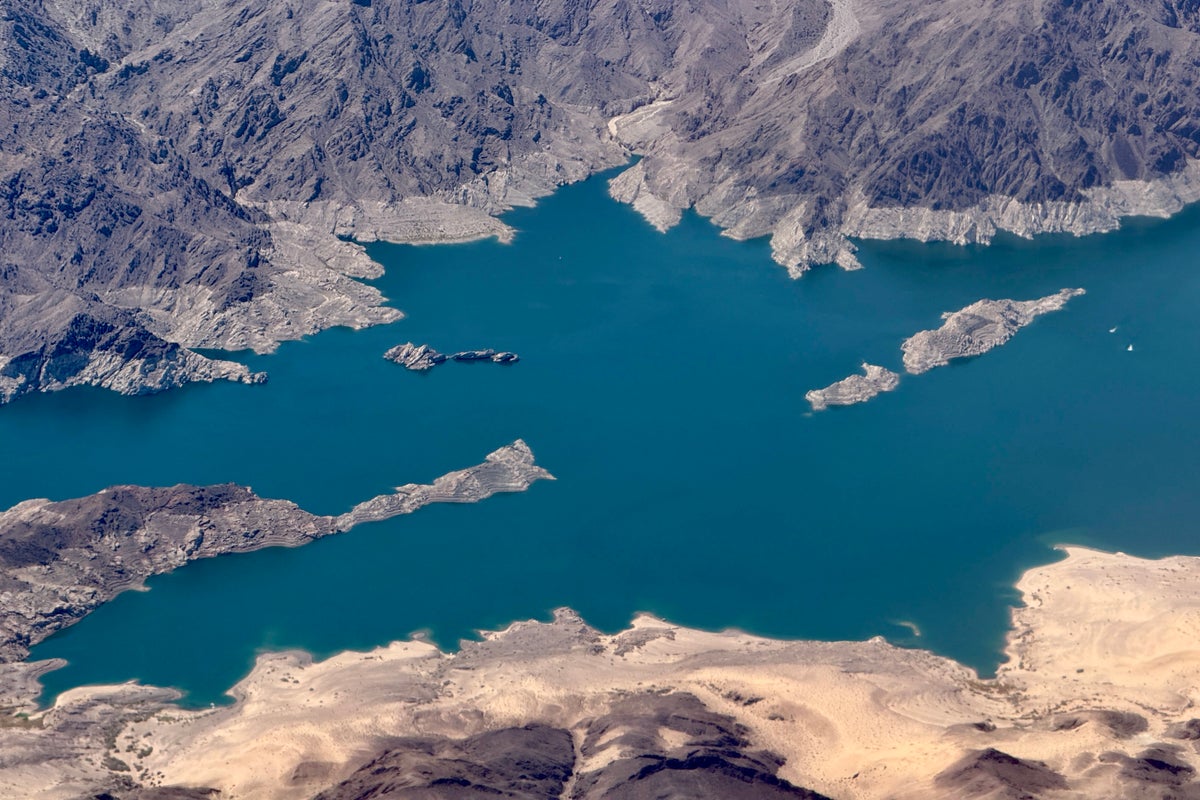
Lake Mead has reached a structural inflection point where marginal declines in water elevation yield exponential increases in systemic risk. The Colorado River infrastructure system, which supports 40 million people and billions of dollars in agricultural output across the American Southwest, is operating on an outdated allocations framework designed during an anomalously wet historical period. When water levels drop toward critical thresholds like power pool termination and dead pool, the crisis shifts from a resource scarcity issue to an irreversible operational failure. Resolving this requires shifting from temporary conservation agreements to a permanent, legally binding reduction in consumption that respects the hard physical realities of the basin's hydrology.
The Structural Mechanics of a System Crash
To evaluate the stability of Lake Mead, the system must be analyzed through three primary hydrological boundaries: normal operational capacity, minimum power pool, and dead pool. Each threshold represents a distinct phase shift in utility and engineering constraints.
- Normal Operational Capacity (Above 1,050 feet): At these elevations, water pressure is sufficient to drive the turbines at the Hoover Dam at peak efficiency. Water releases are dictated by downstream demand, legal allocations, and international treaties.
- Minimum Power Pool (1,050 to 950 feet): As the water surface drops below 1,050 feet, the hydraulic head—the physical height of the water column pressing down into the intake towers—diminishes. This reduction in pressure causes a non-linear drop in hydroelectric generation capacity. Turbines experience cavitation and structural strain, eventually forcing operators to halt power generation entirely at or near 950 feet to prevent catastrophic equipment failure. This eliminates a critical source of baseload electricity for Arizona, Nevada, and California.
- Dead Pool (895 feet): This is the ultimate physical barrier. At 895 feet, water falls below the lowest commercial release outlets of the Hoover Dam. The dam ceases to function as a controlled regulatory mechanism. Water can no longer flow downstream via gravity to the Lower Basin states or Mexico, trapping the remaining water in the reservoir pool.
This structural breakdown creates a cascading failure mechanism. The system does not degrade linearly; a five-foot drop at lower elevations carries far greater systemic consequences than a five-foot drop when the reservoir is near capacity due to the tapering V-shaped geometry of the canyon storage basin.
The Structural Deficit and Supply-Demand Asymmetry
The fundamental driver of Lake Mead’s depletion is a structural deficit: the volume of legal entitlements and systemic evaporation consistently exceeds the natural inflow of the Colorado River. This imbalance was codified by the 1922 Colorado River Compact.
The authors of the 1922 Compact calculated the river’s annual flow based on the preceding decades, estimating an average baseline of 15 million acre-feet (maf) per year. Modern tree-ring reconstructions and hydrological modeling have revealed that this period was one of the wettest intervals in the past 1,200 years. The true long-term historical average is closer to 12.5 to 13.5 maf, a figure that is shrinking further due to climate-driven aridification.
$$Allocations \ (16.5 \text{ maf}) > True \ Historical \ Inflow \ (13.5 \text{ maf}) > Contemporary \ Inflow \ (<12.0 \text{ maf})$$
The legal framework allocated 7.5 maf to the Upper Basin (Colorado, New Mexico, Utah, Wyoming), 7.5 maf to the Lower Basin (California, Arizona, Nevada), and a subsequent 1944 treaty allocated 1.5 maf to Mexico. This creates a fixed legal demand of 16.5 maf per year. When accounting for reservoir evaporation and transit losses—which can consume an additional 1 to 1.5 maf annually—the system is structurally designed to overspend its water budget.
The Downstream Allocation Hierarchy and the Seniority Bottleneck
The impact of a system crash is not distributed equally among users. It is governed by the Law of the River, a complex matrix of federal statutes, interstate compacts, and court decrees that establishes a rigid seniority system. Understanding who bears the initial losses requires analyzing this legal hierarchy.
California holds the most senior water rights in the Lower Basin. Under the 1968 Colorado River Basin Project Act, Arizona agreed to make its Central Arizona Project (CAP) water rights junior to California’s allocations in exchange for federal funding to build the CAP aqueduct system.
The structural consequence of this hierarchy is a severe vulnerability for Arizona and Nevada. When shortage conditions are declared by the federal government based on Lake Mead's elevation, the junior users must absorb the cuts first.
- Tier 1 Shortage (Elevation 1,075 to 1,050 feet): Arizona faces an approximate 18% reduction in its state allocation, primarily striking central Arizona agricultural users. Nevada faces a 7% reduction, which it mitigates through aggressive urban recycling infrastructure.
- Tier 2 Shortage (Elevation 1,050 to 1,025 feet): Cuts escalate. Arizona loses roughly 21% of its total allocation, moving beyond surplus agricultural water into municipal supply allocations.
- Tier 3 Shortage (Elevation 1,025 feet and below): The federal government gains broad discretionary authority to impose mandatory reductions across all Lower Basin users, including California, overriding historical seniority to protect the physical integrity of the dam infrastructure.
This creates an acute bottleneck for municipal planning. Cities like Phoenix, Tucson, and Las Vegas operate on multi-decade planning horizons, yet their foundational water supplies are tethered to a volatile reservoir subject to sudden, climate-driven drawdowns.
Soil Moisture Deficits and the Inflow Efficiency Penalty
A critical factor omitted from basic water accounting is the relationship between the mountain snowpack and reservoir inflow efficiency. A standard assumption is that a normal winter snowpack in the Rocky Mountains yields a normal spring runoff into the Colorado River system. This assumption is no longer hydrodynamically valid.
Rising average regional temperatures have decoupled snowpack volume from reservoir inflow through two primary mechanisms:
- Sublimation: Higher temperatures and lower relative humidity cause a greater percentage of the snowpack to transition directly from solid ice to water vapor, bypassing the liquid runoff phase entirely.
- Parched Soils: Successive years of drought bake the soil across the upper watershed, leaving it severely depleted of moisture. When the remaining snowpack melts in the spring, the dry soil acts as a sponge, absorbing the water before it can reach tributaries like the Green or San Juan rivers.
In recent years, watersheds that received 100% of their average winter snowpack have yielded as little as 50% to 60% of their historical average runoff into Lake Powell (which sits upstream from Lake Mead). This means that traditional snowpack tracking is a deceptive leading indicator; analysts must instead look at soil moisture anomalies in the late autumn to predict the efficiency of the following spring’s runoff.
Strategic Capital Realignment for the Lower Basin
Relying on temporary emergency releases from upstream reservoirs like Blue Mesa, Flaming Gorge, or Lake Powell is a failing strategy. These upstream reserves are finite and suffer from the same systemic aridification. A permanent stabilization of Lake Mead requires a fundamental re-engineering of demand management across two primary sectors.
Mandating Agricultural Decoupling and Crop Conversion
Agriculture consumes roughly 80% of the diverted water in the Colorado River basin, with a vast portion dedicated to water-intensive, low-margin forage crops like alfalfa and forage hay. Much of this production occurs in the Imperial Valley of California and Yuma, Arizona, where senior water rights permit flood irrigation in arid desert climates.
The most direct mechanism to prevent a system crash is to systematically retire flood-irrigation privileges for forage crops during critical summer months. Municipal water authorities must fund permanent agricultural transition programs. This involves shifting from flood irrigation to subsurface drip networks and swapping alfalfa for low-water cash crops or industrial hemp. If necessary, it requires direct, long-term leasing of agricultural water rights for municipal environmental stabilization use.
Implementation of Closed-Loop Urban Water Systems
Every municipality drawing from the Colorado River must transition to a closed-loop model modeled after Southern Nevada’s infrastructure. Las Vegas treats and returns nearly 100% of its indoor wastewater to Lake Mead via the Las Vegas Wash. Because the city receives "return-flow credits," every gallon of treated water returned allows them to pump an additional gallon out of the lake, effectively multiplying their net allocation efficiency.
Cities that consume water in a linear fashion—where wastewater is treated and discharged into ephemeral rivers or evaporated in containment ponds—must undergo rapid capital deployment to build advanced purification facilities. This water must either be directly injected back into local aquifers or plumbed back into the regional delivery infrastructure, neutralizing the urban growth factor as a variable in Lake Mead's depletion.
The structural deficit of the Colorado River cannot be engineered away through supply-side interventions. Weather modification, desalination plants along the Pacific coast, and cross-continental pipelines are cost-prohibitive and structurally inadequate at the scale required. Systemic equilibrium will only be achieved when total annual allocations are scaled down to match the true, climate-adjusted annual inflow of 11 million acre-feet, ending the reliance on drawing down the structural capital of Lake Mead.



:max_bytes(150000):strip_icc():focal(665x0:667x2)/gettyimages-50733149-2000-8b129a2475974982a915418ce92a73d8.jpg)