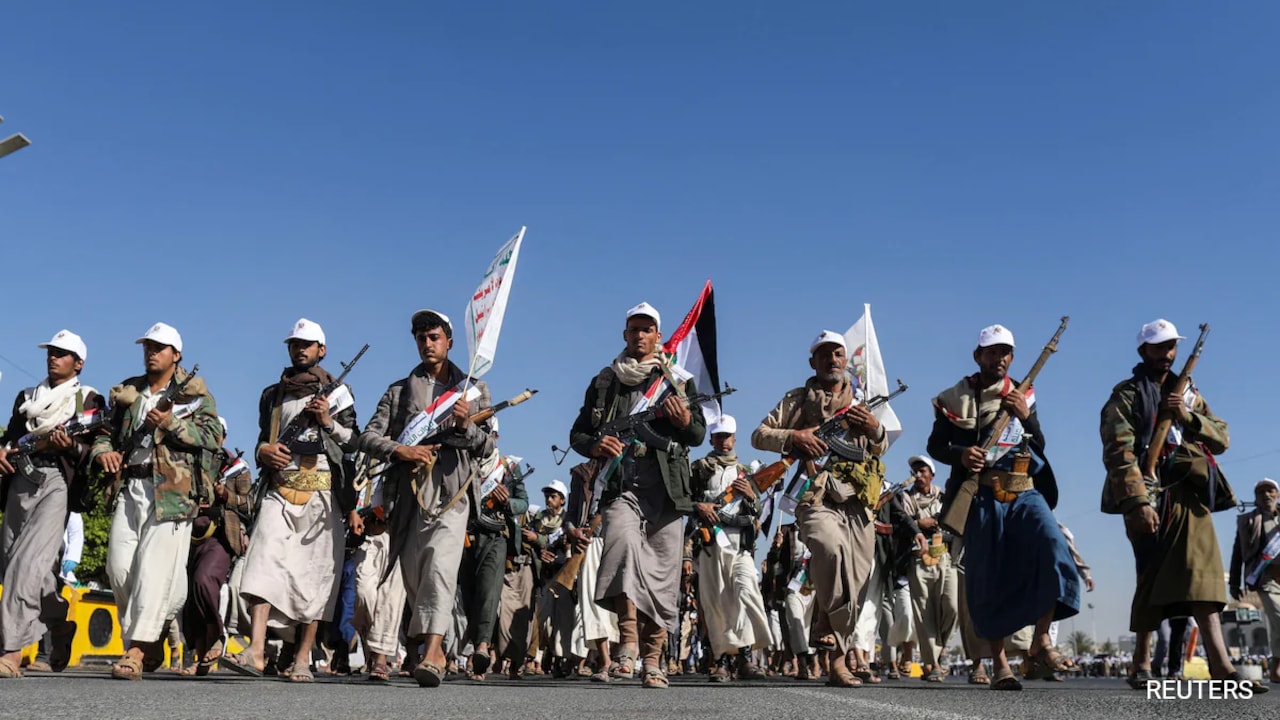
Yemen’s Houthi movement declared a full maritime blockade on Saudi shipping through the Bab al-Mandeb strait, turning the Red Sea into an immediate war zone for the Gulf kingdom's primary oil bypass. The declaration, issued under the banner of a "siege for a siege," effectively closes the trap on Saudi Arabia’s crude export network. With the Persian Gulf already choked off at the Strait of Hormuz, Riyadh had relied almost entirely on its East-West Pipeline to pump crude across the desert to its western port of Yanbu. That escape route now sits squarely in the target crosshairs of Houthi anti-ship missiles.
The strategic reality for global oil markets is stark and unforgiving. By declaring a maritime embargo on all Saudi-flagged and Saudi-bound vessels at the mouth of the Red Sea, the Iran-aligned group has engineered a simultaneous two-sided interdiction. Saudi Arabia now faces a reality where its primary export artery through Hormuz is severely restricted and its secondary emergency relief valves on the Red Sea are subject to missile strikes. The economic fallout will not stay isolated in the Gulf.
The Geography of a Strategic Trap
Saudi Arabia spent decades building infrastructure to insulate its economy against maritime blockades. The center of that effort is the 746-mile East-West Pipeline, designed to carry up to five million barrels of crude oil per day from eastern fields to the Red Sea terminal at Yanbu. When shipping traffic through the Strait of Hormuz ground down earlier this year during regional hostilities, Riyadh diverted record-setting volumes westward. Yanbu became the sole major outlet keeping Saudi oil flowing to global buyers in Europe and Asia.
That entire defensive posture depended on one major assumption. Riyadh assumed the Red Sea would remain a safe haven while the Persian Gulf burned.
That assumption collapsed when Houthi military spokesman Yahya Saree announced the embargo. The Bab al-Mandeb strait measures barely twenty miles across at its narrowest point, creating an ideal bottleneck for shore-based anti-ship cruise missiles, low-flying attack drones, and remote-controlled explosive boats. Ships exiting or entering the Red Sea through this corridor must pass within easy range of Houthi-controlled territory along the Yemeni coast.
For commercial tanker operators, insurance premiums for Red Sea transits were already sky-high. An explicit declaration targeting Saudi vessels pushes marine underwriters over the edge. War risk insurance rates for vessels attempting to dock at Yanbu or pass Bab al-Mandeb will spike past economic viability, forcing shipping firms to pull their tankers entirely.
+-----------------------------------------------------------------------+
|                 SAUDI ARABIA'S CRUDE EXPORT BOTTLENECKS               |
+-----------------------------------------------------------------------+
|  PERSIAN GULF (EAST)                  |  RED SEA (WEST)               |
|  Strait of Hormuz                     |  Bab al-Mandeb & Yanbu        |
|  Status: Severe Restrictions / Fire   |  Status: Declared Houthi      |
|  Impact: ~90% traffic disruption      |  Impact: Pipeline bypass in   |
|                                       |  direct crosshairs            |
+-----------------------------------------------------------------------+
The Chain Reaction Behind the Escalation
This crisis did not emerge in an operational vacuum. A fragile 2022 UN-backed truce between Saudi Arabia and the Houthi leadership held for years despite formal expiration, mainly because both sides found utility in a quiet border. Riyadh wanted to focus on trillion-dollar domestic development projects, while the Houthis focused on consolidating control over northern Yemen.
That fragile balance shattered over control of Yemeni airspace and transport hubs.
The Spark at Sanaa International Airport
The immediate trigger for the blockade traces back to a high-stakes intelligence clash at Sanaa International Airport. Houthi leadership attempted to establish direct, unvetted international flights into the capital without seeking authorization from the Saudi-led coalition. When an aircraft carrying a senior Houthi delegation returning from Tehran attempted to land, strikes hit the runway infrastructure, disabling the airport.
The Houthis blamed Riyadh directly for orchestrating the strike. Within hours, the group launched salvoes of ballistic missiles toward Abha International Airport in southern Saudi Arabia. The exchange marked the first direct reciprocal military strikes between the two entities in years, shattering the informal quiet that had prevailed along the border.
Tit for Tat Deterrence
For the Houthi command, the maritime embargo represents an asymmetric response intended to level the political playing field. Saudi Arabia has enforced naval and air restrictions on Houthi-controlled territory since 2015, controlling what goods enter the major Red Sea port of Hodeidah.
By invoking the concept of "an eye for an eye," Houthi commanders are explicitly pairing their military actions with the economic blockades imposed on them. They are asserting that if Sanaa cannot operate its airport and ports without Saudi interference, Riyadh will not be permitted to use its own Red Sea ports to pump crude oil to global markets.
The Flaws in the Saudi Red Sea Strategy
Riyadh’s strategic planners built their entire energy security model on geographic diversification. Pumping oil from the Eastern Province to the Red Sea was supposed to ensure that no single choke point could strangle the kingdom's fiscal lifeblood.
That strategy failed to account for the physical reach of modern asymmetric warfare.
A single mobile missile launcher hidden in the rugged coastal mountains of Yemen can threaten a supertanker worth tens of millions of dollars. The cost asymmetry is severe. Interceptor missiles used by naval coalition air defenses cost upwards of two million dollars each, while the anti-ship weapons employed by Houthi forces cost a fraction of that figure.
Operational Vulnerabilities at Yanbu
Yanbu is a vital terminal, but it was never constructed to serve as Saudi Arabia's permanent, exclusive export hub for the entirety of its production.
- Storage Capacity Limits: Onshore crude storage tanks at Yanbu cannot hold unlimited surplus production if tankers refuse to dock due to missile threats. Once storage fills, pipeline throughput must slow down.
- Refunded Freight Costs: Diverting crude around Africa's Cape of Good Hope adds nearly two weeks of travel time to Europe and Asia, adding massive fuel and chartering costs that erode margin profitability.
- Target Concentration: Pumping millions of barrels through a single pipeline corridor creates a static target. If regional strikes hit pumping stations along the East-West line inside Saudi territory, the Red Sea alternative vanishes entirely.
What Global Energy Markets Are Forcing Buyers to Do
Traders on international energy desks responded to the blockade announcement with immediate re-pricing of Brent crude futures. The prospect of losing simultaneous access to Hormuz and Bab al-Mandeb removes millions of daily barrels from global supply calculations.
Asian refiners in Japan, South Korea, and China are particularly exposed. These economies rely heavily on long-term supply contracts with Saudi Aramco. With Persian Gulf loadings already compromised, buyers had banked on receiving shipments loaded at Yanbu.
               [ Saudi Eastern Oil Fields ]
                            |
           +----------------+----------------+
           |                                 |
           v                                 v
   [ Strait of Hormuz ]             [ East-West Pipeline ]
   (Persian Gulf Exit)                       |
           |                                 v
  *RESTRICTED / BLOCKED* [ Yanbu Port / Red Sea ]
                                             |
                                     [ Bab al-Mandeb ]
                                             |
                                   *DECLARED EMBARGO*
Faced with the threat of delayed or canceled cargoes out of the Red Sea, buyers are turning to alternative suppliers in the Atlantic Basin, West Africa, and the United States. Freight rates for Aframax and Suezmax tankers outside the combat zone have surged as charterers scramble to secure tonnage that does not need to enter Middle Eastern waters.
The Military Options and Their Limitations
Saudi Arabia finds itself facing a tactical dilemma with no clean solution.
Launching a sweeping air campaign against Houthi coastal missile sites and radar installations would draw the kingdom back into a full-scale, exhausting war in Yemen. Past experience between 2015 and 2022 demonstrated that air power alone cannot destroy well-entrenched, mobile missile units hidden in complex terrain.
Relying on Western naval coalitions also carries distinct limitations. Escorting individual commercial tankers through the Bab al-Mandeb requires significant naval assets, and armed escorts cannot guarantee that a saturation strike of multiple drones and cruise missiles will not penetrate ship defenses. Furthermore, commercial tanker operators remain hesitant to enter designated combat zones regardless of military promises of protection.
The Houthis have effectively shifted the burden of escalation onto Riyadh. If Saudi Arabia retaliates with major offensive strikes, it risks direct attacks on its oil processing plants at Abqaiq and Khurais, duplicating the devastating air strikes of September 2019. If Riyadh remains passive, its Red Sea export strategy lies paralyzed.
The maritime embargo on Saudi Arabia fundamentally alters the geography of Gulf conflict. The safety cushion provided by Red Sea pipelines has evaporated, leaving the world's largest crude exporter pinned against a coastline it can no longer guarantee is safe.