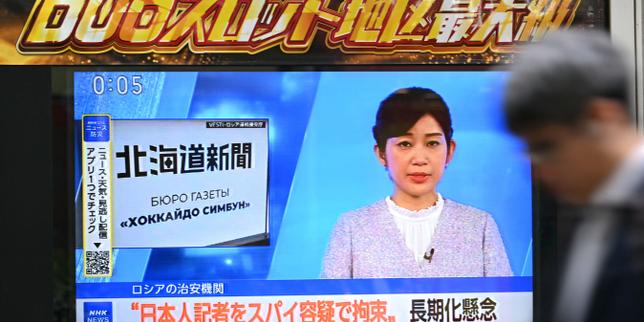
Detaining a foreign correspondent on espionage charges is rarely about counterintelligence; it is an exercise in coercive asymmetric leverage. When Russia's Federal Security Service (FSB) arrested Hokkaido Shimbun correspondent Yuki Imai on Sakhalin Island in October 2026, the move exposed a calculated escalation in how Moscow polices foreign reporting and applies pressure on Tokyo. Standard news coverage treats such arrests as isolated diplomatic incidents or predictable symptoms of bilateral friction. That framing misses the underlying operational mechanics: turning journalists into high-visibility detainees lowers the cost of deterrence, degrades external intelligence collection in contested border zones, and manufactures political leverage out of thin air.
This analysis breaks down the structural logic behind Moscow's crackdown on foreign correspondents using the Imai detention as a reference point. It separates verified facts from analytical hypotheses, models the incentive structure driving the Kremlin's behavior, and maps out tactical responses for newsrooms, corporate risk managers, and foreign policy teams operating in high-risk jurisdictions.
Separating Verified Facts from Analytical Hypotheses
Clear operational decisions require separating confirmed public facts from analytical inference. In cases involving state security services, official narratives are designed to shape diplomatic reactions as much as legal proceedings.
Known facts established by public reporting and official statements:
- In October 2026, the FSB announced the detention of Japanese journalist Yuki Imai on Sakhalin Island on suspicion of espionage, alleging he sought to gather defense-related information.
- The FSB accused Imai of collecting information regarding mobilized personnel and volunteers from the Kuril Islands involved in the war in Ukraine.
- Authorities transferred him to Moscow for pre-trial detention—initially ordered through December 12, 2026—under charges that carry up to a 20-year prison sentence.
- The arrest followed months of heightened friction between Tokyo and Moscow, including Russian President Vladimir Putin's August 2026 visit to the disputed Kuril Islands, Russian missile tests near the islands, Tokyo's continued sanctions and support for Ukraine, and Japanese security decisions such as hosting U.S. Typhon intermediate-range missiles.
- Japan's Ministry of Foreign Affairs protested the detention, summoned the Russian ambassador, and called for fair and impartial treatment.
Educated hypotheses derived from geopolitical and institutional patterns:
- Moscow is using provincial and border reporting—especially around Sakhalin and the Kuril Islands—as a pressure valve to signal displeasure over Japanese regional defense posture and alignment with Western sanctions.
- Because Japan holds few or no high-value Russian detainees that match a direct one-for-one swap, the Kremlin may be banking on long-term diplomatic pressure, quiet backchannel concessions, or future multilateral exchanges.
- State-amplified detention footage serves a dual audience: intimidating foreign reporters inside Russia while signaling domestic vigilance in the Russian Far East.
The Three Pillars of Moscow's Press Coercion Model
Conventional commentary describes Russia's treatment of foreign correspondents as "growing pressure," a phrase too vague to explain why certain reporters are targeted at specific moments. A more useful framework rests on three interlocking pillars: Information Denial, Sovereignty Signaling, and Asymmetric Bargaining.
Information Denial in Sensitive Peripheries
Authoritarian states treat information about troop mobilization, casualty patterns, defense infrastructure, and regional economic strain as strategic assets. In border regions like Sakhalin and the Kuril Islands, military logistics intersect with unresolved territorial disputes. A regional correspondent fluent in the local language and familiar with historical context—such as a reporter for Hokkaido Shimbun, which has long covered northern territories and bilateral ties—can spot anomalies that distant wire bureaus miss.
When security services detain a journalist for asking questions about mobilized locals or volunteers, the immediate effect is chilling. Local sources stop answering phone calls, regional officials refuse routine interviews, and remaining foreign correspondents self-censor or pull back from sensitive beats. Information denial does not require shutting down every newsroom; arresting one visible correspondent raises the perceived risk of routine reporting across the entire beat.
Sovereignty Signaling Over Contested Geography
Arresting a Japanese journalist on Sakhalin is not geographically neutral. The Kuril Islands—referred to in Japan as the Northern Territories—sit at the center of an unresolved territorial dispute between Moscow and Tokyo. Following Putin's August 2026 visit to the islands and regional missile activity, detaining a Japanese reporter there reinforces Moscow's claim of absolute administrative and security control over the Far East.
This creates a cause-and-effect dynamic that surface-level reporting often overlooks. Diplomatic protests by Tokyo are framed by state media not as defense of press freedom, but as proof of foreign interference in Russian sovereign territory. The arrest converts a journalistic inquiry into a test of territorial dominance.
Asymmetric Bargaining Without Direct Parity
In classic espionage or hostage diplomacy, leverage often relies on symmetrical assets—each side holds individuals the other wants back. Against Japan, Moscow faces a structural asymmetry: Tokyo does not operate an equivalent pool of detained Russian intelligence or political figures held on comparable terms.
Without direct parity, the Kremlin shifts from bilateral reciprocity to indirect and deferred leverage. A detained foreign national becomes a bargaining chip whose value can be cash-settled later through quiet diplomatic channels, regional negotiations, or broader multinational prisoner swaps. Even without an immediate demand attached to the arrest, holding a foreign citizen creates ongoing diplomatic friction that forces the target government to expend political capital just to secure consular access and fair treatment.
Why Standard Diplomatic Responses Face Diminishing Returns
Governments typically respond to the detention of a citizen abroad with a predictable sequence: summon the ambassador, issue a public protest, request consular access, and pursue quiet negotiations. While necessary for duty of care, these steps face steep diminishing returns when dealing with a state that views diplomatic friction as acceptable collateral.
The first bottleneck is asymmetric risk tolerance. A democratic government faces domestic accountability, legal constraints, and media scrutiny over a citizen's safety. A security-driven state apparatus faces minimal domestic penalty for prolonged pre-trial detention and can treat time itself as a lever.
The second limitation lies in the tension between public deterrence and private negotiation. Loud public condemnation signals resolve and protects press norms, yet some analysts argue that overly quiet, behind-the-scenes diplomacy can encourage further targeting if Moscow calculates that low-profile arrests carry manageable costs. Conversely, turning a detainee's case purely into a public megaphone battle can harden positions inside state security agencies, which rarely walk back an espionage accusation quickly once state television has broadcast the arrest.
A third constraint is legal capture. Once an espionage file is opened and pre-trial detention is extended in Moscow, domestic courts function as an instrument of executive security policy rather than an independent check. Legal appeals matter for documentation and consular records, but they rarely produce rapid release on their own.
Operational Playbook for Newsrooms, Risk Teams, and Policymakers
Managing exposure in high-risk environments requires treating correspondent safety and strategic communication as an integrated system rather than an afterthought. The following steps apply across editorial leadership, corporate security, and foreign policy practitioners.
- Map "Red-Line" Beats Before Deployment: Identify topics that security services treat as state secrets—such as mobilization figures, defense facilities, weapons transfers, and sensitive border movements—and conduct pre-trip threat assessments specific to the region rather than relying on capital-city risk ratings.
- Separate Routine Reporting from High-Risk Inquiries: Do not mix standard cultural, economic, or historical reporting with sensitive defense or mobilization questions on the same trip or device profile. A journalist with deep local ties and language skills can be an extraordinary asset, but familiarity can also create blind spots if threat models are not updated as geopolitical tensions spike.
- Harden Digital and Physical OpSec: Enforce strict device hygiene, compartmentalized communications, clear check-in cadences, and pre-agreed extraction or legal escalation triggers before a reporter enters a restricted or border zone.
- Coordinate Public Messaging and Backchannel Leverage: Align diplomatic statements, newsroom solidarity, and private negotiations around a single objective—securing safe conditions and release—while avoiding mixed signals that allow the detaining state to divide domestic and international pressure.
- Build Multilateral Coalitions: Because bilateral leverage against Moscow is often asymmetric, coordinating diplomatic pressure with allied capitals and international press freedom bodies raises the broader reputational and strategic cost of holding foreign journalists.
Limits of the Playbook
No risk-management framework eliminates danger in an environment where espionage accusations can be fabricated or stretched over routine journalism. Strict operational security reduces exposure and improves crisis response, yet it cannot guarantee immunity when a state decides to make an example of a foreign correspondent.
Over-reliance on defensive caution carries its own cost: information blindness. If newsrooms withdraw completely from every sensitive region, the public loses independent reporting precisely when accurate ground truth is hardest to obtain. The practical goal is calibrated risk management—protecting personnel through disciplined preparation while preserving credible, verifiable reporting where safe and feasible.
Strategic Recommendation
Foreign ministries, newsrooms, and regional analysts should stop treating the arrest of a correspondent like Imai as a standalone diplomatic hiccup and start pricing it as a structural feature of coercive statecraft. The most effective strategic move for Tokyo and allied partners is to pair firm, coordinated international condemnation with a dedicated crisis-response architecture—combining rapid consular and legal mobilization, strict source-and-data protection for field reporters, and clear refusal to trade core strategic or security policies for detainee releases. Rewarding hostage leverage with policy concessions only invites the next arrest; raising the diplomatic isolation and institutional cost of every detention is the only way to slow the cycle.



