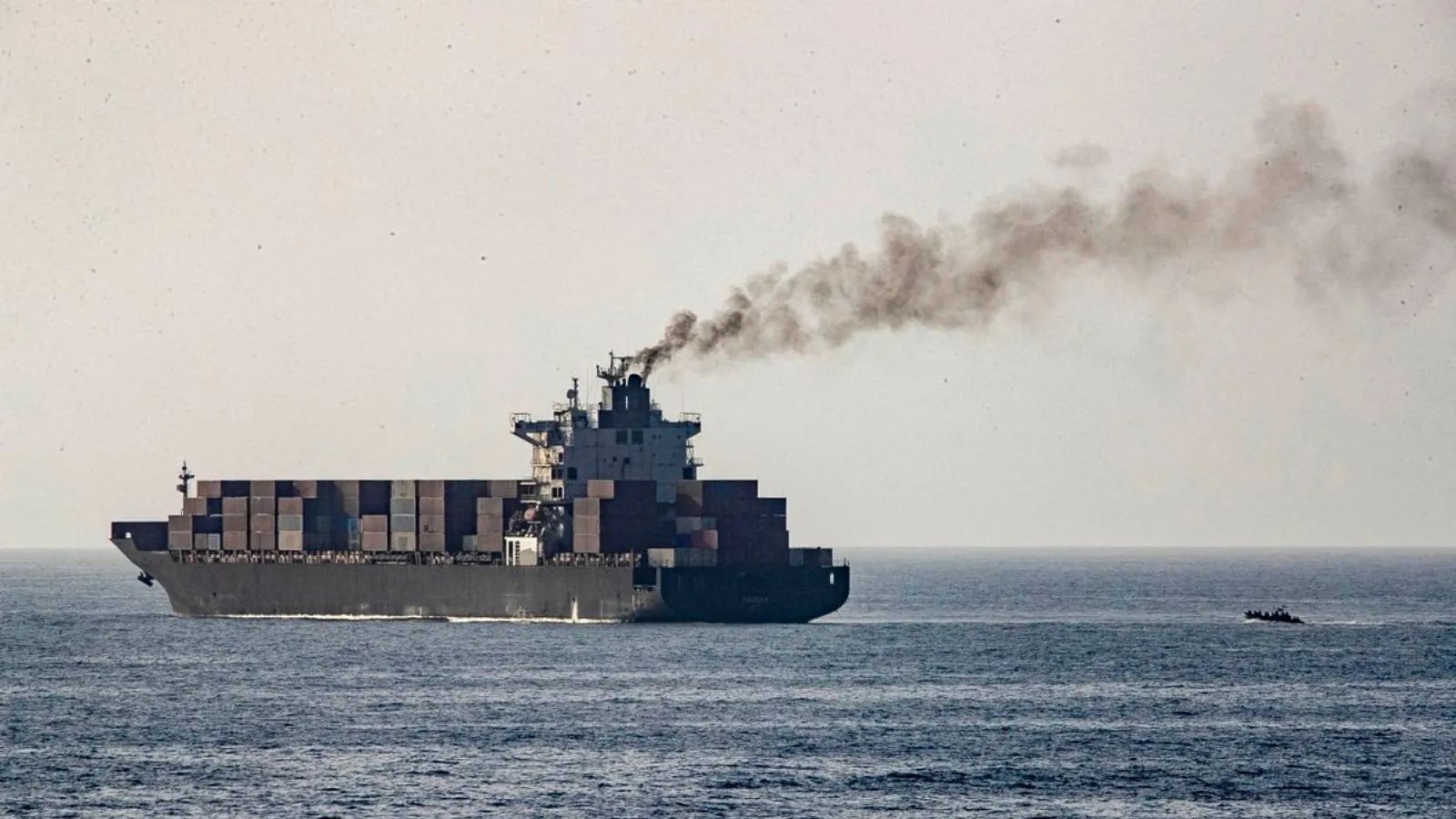
The headlines are panicking right on cue. "US-Iran War Live Updates." "Tehran attacks Bahrain." "Tanker hit in Strait of Hormuz."
Cable news anchors are dusted off their maps of the Persian Gulf, tracking the exact coordinates where the Singapore-flagged Ever Lovely took a drone hit to its upper deck. They are telling you the shaky interim ceasefire signed just last week by the Trump administration is dead. They are telling you the global economy is about to collapse under the weight of a $150 oil barrel because Iran launched a few drones at Bahrain and threatened coastal radars near Qeshm Island. Read more on a connected topic: this related article.
They are completely misreading the map.
What we are witnessing in the Persian Gulf is not the opening salvo of an uncontrollable global conflagration. It is something far more calculated, cynical, and ultimately contained. It is a highly scripted, theatrical negotiation by other means. More journalism by TIME delves into similar views on the subject.
If you are dumping your portfolio, buying oil futures at a premium, or preparing for a draft, you are falling for the theater. I have spent twenty years analyzing maritime chokepoints and Middle Eastern asymmetric warfare strategy. I have seen governments and trading desks blow hundreds of millions of dollars panicking over what amounts to geopolitical posturing.
Here is the data-driven reality of what is actually happening behind the smoke screens in the Gulf, and why the mainstream consensus has the entire situation backward.
The Myth of the Uncontrolled Escalation
The prevailing narrative says that because the US launched retaliatory airstrikes on Friday using six aircraft against four coastal targets, and Iran responded on Saturday morning by hitting Bahrain and another tanker, the conflict is "spinning out of control."
This is structurally impossible for one fundamental reason: neither side can afford the logical conclusion of a real war, and both sides know it.
Let us look at the mechanics of the strikes themselves. The US military’s Central Command targeted specific, isolated drone storage locations, missile sites, and coastal radar stations on Qeshm and Sirik Islands. These were precise, surgical extractions designed to degrade immediate tactical capabilities without targeting regime leadership or deep inland infrastructure.
Iran’s response? A drone salvo directed at Bahrain—the home of the US Navy’s 5th Fleet—and a non-lethal strike on a commercial vessel exiting the strait. Notice what didn’t happen. The crew on the tanker is entirely safe. There is zero environmental damage. The drones sent to Bahrain hit vague targets labeled by the Islamic Revolutionary Guard Corps (IRGC) as "locations of the U.S. terrorist army," causing minimal structural disruption.
This is symmetrical, calibrated proportional behavior. It is the language of a bloody, violent poker game, not total war.
[Mainstream Panic] -> "Ceasefire dead, imminent regional collapse, oil spike."
[Actual Strategy]   -> "Calibrated kinetic leverage to dictate terms of the final MOU."
The Real Battle: The Transit Fee Hustle
The media wants you to believe this is an ideological war of survival. In reality, it is a dispute over international maritime law and sovereign cash flow.
The core of the current breakdown is not religious or existential; it is financial. Under the 60-day window of the interim Memorandum of Understanding (MOU), the United Nations maritime agency (IMO) attempted to set up a dual-corridor evacuation framework. One route hugs the northern Iranian coast; the other runs south near Oman.
Iran’s domestic economy is suffocating under years of sanctions. Tehran looked at the southern route overseen by the U.S. Navy and realized its primary geopolitical leverage—control over 20% of the world's petroleum transit—was being bypassed.
Enter Ebrahim Azizi, head of Iran’s parliament national security commission, who explicitly laid out the real agenda on Friday: "The Strait of Hormuz is governed by Iran, so: Respect the rules."
What are those rules? Iran wants to levy transit fees on every single vessel passing through the international waterway. They are trying to turn the Strait of Hormuz into a sovereign toll road to fund their domestic deficit. The drone strikes on Thursday and Saturday were not attempts to permanently close the strait—which would destroy Iran's own remaining economic lifeblood through Chinese oil exports—but rather an enforcement mechanism to terrify commercial shipping into paying their protection money.
The Ever Lovely did its own private risk assessment and sailed down the southern passage without notifying regional authorities. Iran hit it to prove a point: No one transits for free.
The Oil Market Has Already Called the Bluff
If the global energy market truly believed the Strait of Hormuz was on the verge of a permanent, catastrophic closure, oil prices would be skyrocketing past $120 a barrel.
They aren't.
On Thursday, after the first drone strike, Brent crude actually hovered around $75 a barrel, briefly dipping to $72—flirting with its pre-war benchmarks. Even with Saturday's live updates of drone attacks in Bahrain, the market’s reaction has been remarkably muted.
Why? Because commodities traders are cold-blooded calculators, and they see the structural reality that talking heads miss:
- Sufficient Global Spare Capacity: Non-OPEC production, particularly from US shale and Latin American expansion, provides a massive cushion that did not exist during the oil shocks of the 20th century.
- The Chinese Shield: Iran relies almost exclusively on dark-fleet tankers selling discounted crude to independent refineries in China. If Tehran actually closed the strait, they would block their own economic lifeline and infuriate Beijing, their ultimate geopolitical patron.
- The Evacuation Velocity: While the IMO temporarily paused its coordinated vessel evacuations on Friday, 115 ships have already successfully exited the gulf. 43 transits were recorded immediately following the initial hostiles. The flow of commerce is slowing down to calculate insurance premiums, but it is not stopping.
The Flawed Premise of "Fixing" the Strait
The standard "People Also Ask" foreign policy questions all operate on a broken premise. People want to know: How can the US military permanently secure the Strait of Hormuz?
The brutal, unconventional truth is that it cannot.
The strait at its narrowest point is only 21 miles wide. The shipping lanes themselves are a mere two miles wide in either direction, separated by a two-mile buffer zone. This means any commercial vessel transiting the gulf is permanently within range of basic, low-tech anti-ship cruise missiles, asymmetric fast-attack craft, and $20,000 loitering munitions launched from truck beds hidden in the jagged cliffs of the Iranian coastline.
Short of a full-scale ground invasion and occupation of western Iran—an absolute strategic impossibility that would cost trillions and destabilize the hemisphere for a generation—there is no military solution that guarantees a 0% threat level to the shipping lanes.
The Trump administration's current posture, echoed by Vice President JD Vance’s statement that "violence will be met with violence," is designed to re-establish deterrence boundaries while the technical teams negotiate the fine print of the nuclear enrichment moratorium and the unfreezing of Iranian funds over the next 60 days.
The Hidden Risk: The Insurance Deadlock
If you want to look at the real vulnerability of this crisis, stop looking at the military hardware and look at the maritime insurance syndicates in London. This is the downside to my own contrarian view that the war won't explode: the conflict doesn't need to explode to cause severe economic friction.
A kinetic war won't stop the shipping; the underwriters will.
When the Joint Maritime Information Center warns that the threat to ships is "substantial," war risk premiums for the Persian Gulf skyrocket. If a hull insurance premium jumps from 0.05% to 5% of a vessel's total value per transit, the route becomes economically unviable for smaller, independent operators.
The true danger of the current US-Iran kinetic exchange is not a rain of missiles destroying fleets, but an invisible logistical chokehold where hundreds of civilian tankers remain anchored off the coast of Oman, completely unwilling to lift anchor because their corporate risk officers refuse to clear the voyage.
Stop Reading the Live Blogs
The competitor's live blog format is built to sell hyperventilating clicks. Every single drone launch is treated as the end of the world.
Do not buy into the hysteria.
What we are watching is a violent, high-stakes trade negotiation. Iran wants sanctions relief, cash visibility, and validation of its regional administrative influence over Gulf shipping. The US wants a verifiable cap on highly enriched uranium, international atomic inspections, and uninhibited commercial navigation. Both sides are using explosive ordinance to write clauses into a final treaty document that will likely be signed before the 60-day interim window closes.
Expect more headlines. Expect more dramatic footage of smoke over coastal islands. Expect more fiery statements from the IRGC and the White House.
But keep your eyes on the data. The strait remains operationally open, the oil markets are remaining disciplined, and the backchannel phone lines between Washington and Tehran are wide open.
The theater will continue until the checks clear.