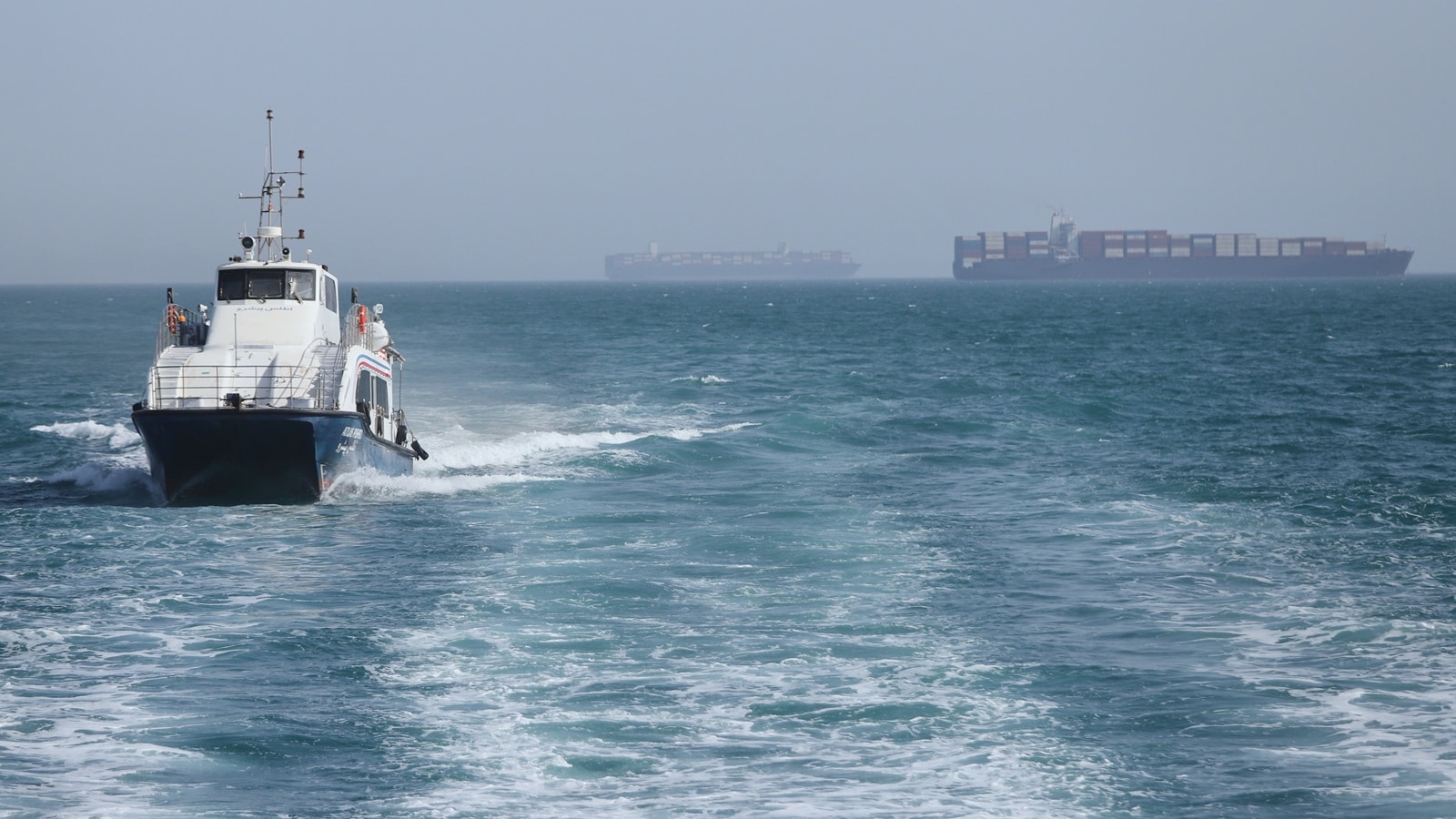
The coffee in a ship’s galley is never truly hot, and it always tastes faintly of salt and nerves. For Rajesh, a thirty-four-year-old boatswain from Kerala, that bitter brew was the only thing keeping the world from blurring into a gray smudge of exhaustion. He sat on a bolted stool, his boots vibrating with the low, rhythmic thrum of the vessel’s engines. Outside, the Strait of Hormuz was a black mirror. It is one of the most vital arteries of global commerce, a narrow choke point where the world’s energy flows like blood through a needle’s eye. But to the men on deck, it felt like a shooting gallery.
He didn't look at the radar. He didn't have to. He knew that somewhere in the darkness, eyes were watching the thermal signature of their hull.
When we talk about global supply chains, we use sterilized language. We speak of "bottlenecks," "maritime security," and "logistical disruptions." We track the price of crude oil as it ticks up by a percentage point on a glowing screen in London or New York. These are clean, mathematical abstractions. They do not account for the smell of ozone after an explosion. They do not capture the specific, high-pitched ringing in a sailor’s ears when a missile tears through the air mere hundreds of yards from the bridge.
The Midnight Watch
The attacks usually come when the human spirit is at its lowest. Between two and four in the morning, the silence of the sea becomes heavy. It presses against your eardrums. For the Indian sailors manned on tankers and cargo ships traversing these waters, the psychological toll is a debt that never stops accruing.
Consider the anatomy of a modern merchant ship. It is a gargantuan beast, often three football fields long, carrying millions of dollars in cargo. Yet, it is manned by a skeleton crew of perhaps twenty souls. These men are not soldiers. They are technicians, engineers, and cooks. They signed up for the steady paycheck and the chance to see the world, not to become collateral damage in a shadow war they barely understand.
The "dry" reports tell us that a drone struck a vessel or a missile was intercepted by a destroyer. They rarely mention the vibration.
When a projectile enters the immediate airspace of a ship, the hull acts like a massive tuning fork. The steel hums. It’s a sound that crawls up through the soles of your feet and settles in your teeth. Rajesh described it as a feeling of profound nakedness. You are trapped in a floating metal box with nowhere to run. The sea is deep, cold, and indifferent. The sky is suddenly hostile.
The Math of Fear
The statistics are sobering, though they often fail to convey the scale of the anxiety. Roughly 20% of the world's liquid petroleum gas and oil passes through this stretch of water. It is a geographical necessity. You cannot simply "go around" the Strait of Hormuz without adding weeks to a journey and millions to the fuel bill.
This creates a brutal economic pressure. Shipping companies calculate risk in cold dollars. They weigh the cost of insurance premiums against the necessity of delivery. But the men on the ships are not part of that calculation. They are the friction in the machine.
During the height of recent tensions, sailors reported staying awake for forty-eight hours straight. Sleep was not an option; the moment you closed your eyes, your mind would invent the sound of an approaching engine. Every whitecap on a wave looked like the wake of a fast-attack craft. Every blip on the radar was a potential threat.
This isn't just "stress." It is a systematic dismantling of the human nervous system. We often assume that because these ships are massive, they are safe. It’s a logical fallacy. A ship is a target, and a target is only as strong as its weakest point. In this case, the weakest point isn't the hull—it's the sleep-deprived mind of the man at the helm.
The Invisible Stakes
Why does this matter to someone sitting in a quiet suburb thousands of miles away?
Because the world is held together by these invisible threads of maritime labor. If the sailors stop sailing, the lights go out. The cars stop. The plastic for your medical devices, the grain for your bread, and the fuel for your heater all depend on a group of men from places like Mumbai, Kochi, and Chennai remaining calm while things explode around them.
The Indian government has dispatched warships to escort these vessels, a move that provides a thin layer of psychological comfort. But a destroyer cannot be everywhere at once. The ocean is too big. The threats are too small, often consisting of low-cost loitering munitions that cost less than a mid-range sedan but can cripple a multi-million-dollar tanker.
The disparity is jarring. You have a sailor who earns a modest wage to support a family back home, standing on the deck of a ship carrying a fortune, caught in the crosshairs of geopolitical actors who view him as an anonymous variable.
A Quiet Kind of Bravery
There is a specific type of courage required to walk back onto a ship after a near-miss. It isn't the cinematic bravado of a war movie. It’s a quiet, resigned persistence. It’s the act of checking the oil pressure and logging the coordinates even when your hands are shaking.
Rajesh told a story about a night when a flare lit up the horizon. It turned the night into a sickly, artificial day. For ten seconds, every man on the bridge saw each other’s faces clearly. He saw the sweat on the captain’s brow. He saw the youngest deckhand clutching a photo of his mother. They didn't speak. There was nothing to say. If the missile was coming, it was coming.
When the light faded, they simply went back to work.
The industry calls this "resilience." That’s a corporate word used to describe the capacity of a human being to endure trauma without breaking the equipment. A more honest word would be "survival."
We are currently witnessing a shift in the nature of global transit. The oceans, once seen as open highways, are reverting to contested territories. The "freedom of navigation" we took for granted for decades is now a fragile privilege maintained by constant vigilance and the nerves of merchant mariners.
The Cost of Silence
The psychological trauma doesn't end when the ship leaves the Strait. It follows the sailors home. They return to their villages, but they find they can no longer stand the sound of thunder. A door slamming in the wind sends them diving for cover.
We have failed to build a narrative that honors these men. We celebrate the "essential worker" on land, but we forget the ghosts on the water. We ignore the fact that our modern life is built upon the backs of people who have to decide, every single night, if the paycheck is worth the possibility of a watery grave.
The next time you fill your gas tank, or order a product that was manufactured across the globe, think of the vibration in the steel. Think of the man sitting in a dimly lit galley, drinking lukewarm coffee, listening to the silence of the Strait of Hormuz and praying that the darkness stays dark.
The world moves on, the prices fluctuate, and the headlines change. But for those on the water, the war isn't over when the news cycle ends. It continues every time the sun goes down and the radar starts to hum.
Rajesh eventually finished his contract and returned to the green hills of Kerala. He says the silence there is different. It’s a silence that lets you breathe. But sometimes, in the middle of the night, he still feels his bed vibrate, a phantom echo of a ship’s engine, waiting for a sound that never comes, but is always expected.


