Pine needles crunched underfoot in the crisp mountain air of Maryland, but inside the rustic timber-framed cabin at Camp David, the atmosphere was blistering.
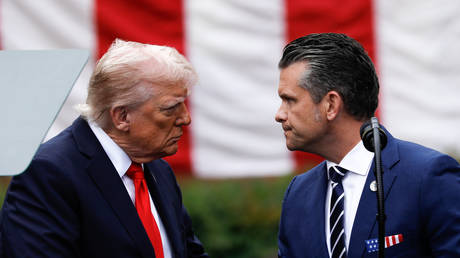
Maps spread across heavy wooden tables bore the greasy thumbprints of tired planners. Coffee cups went cold. Around the room, senior officials sat in tense stillness, acutely aware that the maps before them represented a ledger of choices rapidly evaporating into the atmosphere. At the center of the friction sat President Donald Trump and Defense Secretary Pete Hegseth. In similar developments, we also covered: Inside the Massive Price Tag of PM Modi Overseas Trips.
The friction was not about policy on a whiteboard. It was about math. Hard, unyielding, mechanical math.
Months of high-intensity operations against Iran—hundreds of Tomahawks launched from destroyers, thousands of tactical ballistic missiles arcing through the Middle Eastern night, and batteries of interceptors burning through reserves to swat down incoming drones—had left a silent void where a cushion used to be. Stockpiles do not empty all at once with a dramatic explosion. They drain quietly, receipt by receipt, until a commander reaches into the drawer for a crucial tool and finds only dust. Reuters has also covered this important subject in extensive detail.
Trump looked across the room and demanded answers. According to accounts from individuals familiar with the tense closed-door exchange, the President made it clear he believed the inventory deficit—specifically the dwindling numbers of long-range guided missiles and air-defense interceptors—had already been solved. He felt blindsided. He felt misled.
When the highest office in the nation plans what could be history-shaping military actions, the distance between perception and logistics can be measured in miles of empty airspace.
Consider what happens when a superpower runs low on its own shield.
The strategic cost echoes far beyond the immediate theater of operations in the Middle East. Think of a factory floor where raw materials stop arriving; soon, the assembly lines slow down, then stutter, then halt entirely. On a geopolitical scale, when the United States burns through roughly sixty-five percent of its Patriot interceptors and depletes its stocks of advanced tactical missile systems over a matter of months, the safety margins of global deterrence shrink. Allies watching from afar feel that chill. In Kyiv, air defense batteries look at empty skies and realize that the replenishment they hoped for has been quietly diverted to absorb shocks elsewhere.
Logistics rule nations. Generals talk strategy, but accountants and factory workers win protracted conflicts.
When pressed during the Camp David confrontation, Hegseth pointed downward in the chain of command, casting responsibility toward Deputy Defense Secretary Stephen Feinberg for failing to ensure the White House was fully apprised of the exact inventory figures. Finger-pointing in high-stakes environments is an old human reflex. When the architecture of power strains under pressure, the seams show.
Publicly, the machine moved swiftly to deny the friction. White House Press Secretary Karoline Leavitt dismissed reports of the confrontation as entirely fabricated, insisting the President retained absolute confidence in his defense chief. Pentagon spokesmen echoed those defenses, calling descriptions of depleted stockpiles and internal blame-shifting fictional. Yet behind the official statements, the underlying shadow remained: manufacturing advanced interceptor missiles like the Patriot or THAAD is not like turning on a kitchen faucet. It is an intricate, agonizingly slow industrial choreography that can take years to scale, even under emergency production agreements.
This logistical reality helps explain why a planned massive retaliation against Iran—what Trump himself described as a strike potentially eclipsing anything seen since the mid-twentieth century—was held back at the final hour. It is easy to point a finger at a map and draw a bold red arrow toward a target. It is entirely another matter to realize that after the arrow lands, the quiver is empty.
Power is finite. Even for a global hegemon, iron and titanium must be mined, shaped, wired, and tested before they can fly.
The confrontation at Camp David exposed the raw, pulsing nerve where political ambition meets industrial capacity. It serves as a stark reminder that modern sovereignty is bound by supply chains. As Washington pivots between the urge to strike and the necessity to negotiate, the real debate is not just about who gave the wrong briefing or who leaked the transcript to the press. It is about the uncomfortable realization that the nation's steel is finite, and the margin for error has grown dangerously thin.