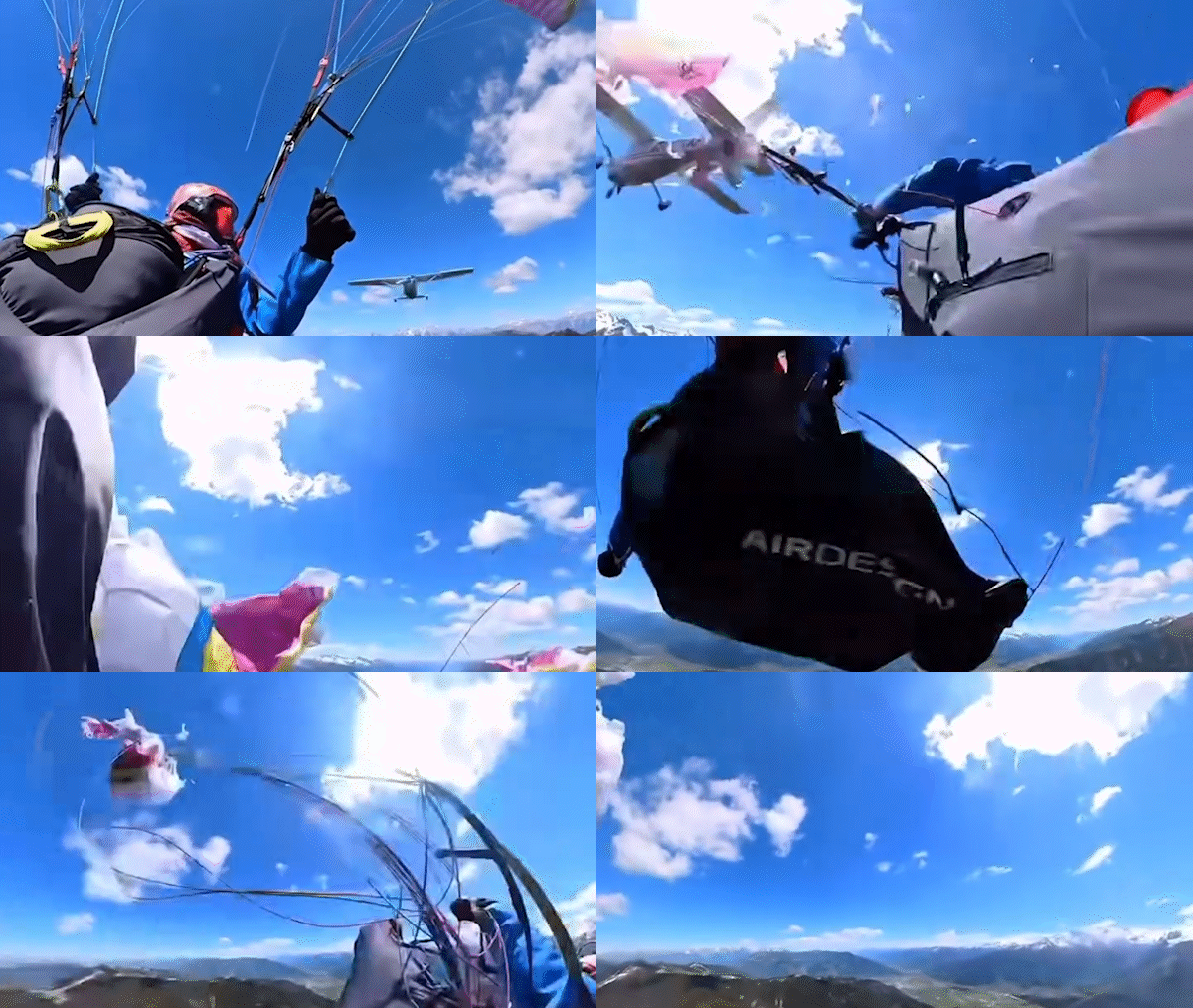
A recreational paraglider collides with a light aircraft, plummets toward the earth, and somehow survives. When footage of such an incident hits the internet, the public reaction follows a predictable pattern. Viewers marvel at the terrifying optics, praise the pilot’s quick deployment of a rescue parachute, and move on to the next viral video.
This surface-level shock misses the point entirely. The real crisis is not that a single fabric wing collapsed after hitting a plane, but that our heavily managed airspace routinely fails to prevent two completely different classes of aviation from occupying the exact same coordinate in space.
Midair collisions between powered aircraft and unpowered foot-launched gliders represent a systemic breakdown in visibility, technology, and outdated regulatory assumptions. Survival in these scenarios relies almost entirely on luck, rather than the failsafe engineering that defines modern commercial flight.
The Invisible Threat in Class G Airspace
Most midair collisions involving paragliders happen in uncontrolled airspace, known internationally as Class G. In this zone, the primary mechanism for avoiding disaster is a centuries-old rule. See and avoid.
The rule assumes that two pilots, traveling at wildly different velocities, can spot each other in a vast three-dimensional sky and take evasive action. It is a flawed premise. A standard paraglider moves at roughly 20 to 25 miles per hour. A light aircraft, such as a Cessna 172, cruises at over 120 miles per hour.
To a fixed-wing pilot tracking forward, a paraglider is a static dot on the windshield. It does not move across the horizon. It simply grows larger. Because of human visual physiology, an object on a collision course appears stationary until the final few seconds before impact, at which point it blooms rapidly in size. By then, the time required for a pilot to recognize the hazard, decide on an action, move the flight controls, and wait for the aircraft to respond exceeds the remaining time to collision.
Furthermore, aircraft design introduces significant blind spots. High-wing airplanes block the pilot’s view during turns, precisely when they need to see what is below them. Low-wing airplanes block the ground view during descent. A paraglider floating quietly beneath a descending plane is utterly invisible to the pilot above.
The Electronic Separation Myth
Aviation authorities frequently point to electronic conspicuity as the ultimate solution to airspace conflict. If every aircraft broadcasts its position, collisions become impossible.
The reality on the ground, or rather in the air, tells a different story. Commercial airliners rely on heavy, power-hungry TCAS systems, while general aviation increasingly uses ADS-B transponders. Paragliders cannot carry these units. A foot-launched pilot carries everything on their back and relies on compact, battery-operated flight instruments.
To bridge this gap, the light aviation community adopted FLARM, a low-power collision avoidance system, alongside smartphone applications that broadcast location via cellular networks. This created a fragmented ecosystem. A system only works if everyone uses it.
A pilot flying a light aircraft with a standard transponder will not see a paraglider broadcasting on a localized FLARM frequency. Conversely, a paraglider pilot tracking traffic on a mobile app receives no data if they fly into a valley with poor cellular coverage. The sky is divided by incompatible technologies, leaving the most vulnerable pilots invisible to the heaviest traffic.
The Physics of a Canopy Collapse and Reserve Deployment
When a collision occurs, the structural differences between the two craft dictate the outcome. A light airplane weighs over a ton and features a rigid aluminum or composite frame. A paraglider consists of nylon cells held open by internal air pressure and suspended by thin Kevlar or Dyneema lines.
The wake turbulence from a passing propeller alone can deflate a paraglider canopy. Direct contact with a fuselage or wing tip is catastrophic. The fabric shears, lines tangle, and the glider loses its aerodynamic shape instantly. The pilot enters a freefall, subjected to violent rotational forces that can cause disorientation within seconds.
At this stage, survival depends entirely on a mechanical backup system: the emergency reserve parachute.
[Paraglider Collision]
       │
       ▼
[Immediate Canopy Collapse]
       │
       ▼
[Rotational G-Forces / Disorientation]
       │
       ▼
[Manual Reserve Extraction & Throw]
       │
       ▼
[Airspeed Dependent Inflation (Requires ~100-150ft Vertical Drop)]
Deploying a reserve parachute is not an automated process. The pilot must manually locate a deployment handle, pull an inner bag from a harness container, and throw it forcefully into clear air away from the twisting wreckage of the main wing. If the throw is weak, or if the reserve catches on the spinning lines of the main glider, it will fail to open.
Even with a perfect deployment, a reserve parachute requires altitude to inflate. It typically takes between 100 to 150 feet of vertical drop for the canopy to catch enough air to slow the descent to a survivable impact speed. If the collision occurs low to the ground during a landing approach or ridge soaring session, the pilot simply runs out of sky.
The Friction Between Two Aviation Cultures
The technical vulnerabilities are worsened by a cultural divide between general aviation pilots and foot-launched aviators.
Fixed-wing pilots undergo rigorous training within a highly regulated framework. They operate from designated airfields, file flight plans, and communicate constantly on specific radio frequencies. They often view paragliders as unpredictable hazards, operating without licenses in areas where they do not belong.
Paraglider pilots view the sky through the lens of free flight. They utilize thermal updrafts and ridge lift to stay aloft, meaning their flight paths are dictated entirely by micrometeorology, not by straight lines between waypoints. A paraglider cannot simply maintain a specific altitude or heading to accommodate an approaching airplane; they are bound by the invisible currents of the air.
This misunderstanding leads to dangerous assumptions. A plane pilot might assume a paraglider will yield the right of way, unaware that the glider is currently trapped in a sink rate that prevents it from climbing or turning quickly.
Rebuilding the Airspace Architecture
Fixing this problem requires moving past the outdated reliance on human eyesight and fragmented tech. We need a unified approach to airspace management that acknowledges unpowered aviation as a permanent fixture, not an afterthought.
First, regulatory bodies must mandate dual-frequency or hybrid tracking devices for all users entering shared recreational airspace. Lightweight, solar-powered units capable of broadcasting both ADS-B and localized glider tracking signals exist, but adoption remains voluntary in many regions. Making these devices mandatory for anyone operating above a specific altitude would eliminate the electronic blind spots.
Second, flight training programs for powered aircraft must incorporate specific modules on free flight behavior. Pilots need to understand where paragliders congregate, such as thermal hotspots and windward ridges, and how to spot them against complex ground terrain.
Relying on the luck of a successful parachute deployment after a midair impact is an acceptance of policy failure. The sky is growing more crowded, and until the technology matches the reality of shared airspace, those flying without an engine will continue to bear the greatest risk.