The alarm rings at 5:15 AM in Lethbridge. It is freezing, the kind of Alberta cold that bites at the nose and turns breath into sudden, thick clouds. For Sarah, a single mother working a back-to-back shift at a local care facility, this hour is a precise mathematical equation. If she wakes up now, she can wake her son, bundle him up, and walk the three blocks to the nearest transit stop. The 5:45 AM bus is her lifeline. If that bus arrives, she stays employed. If that bus disappears, the equation collapses.
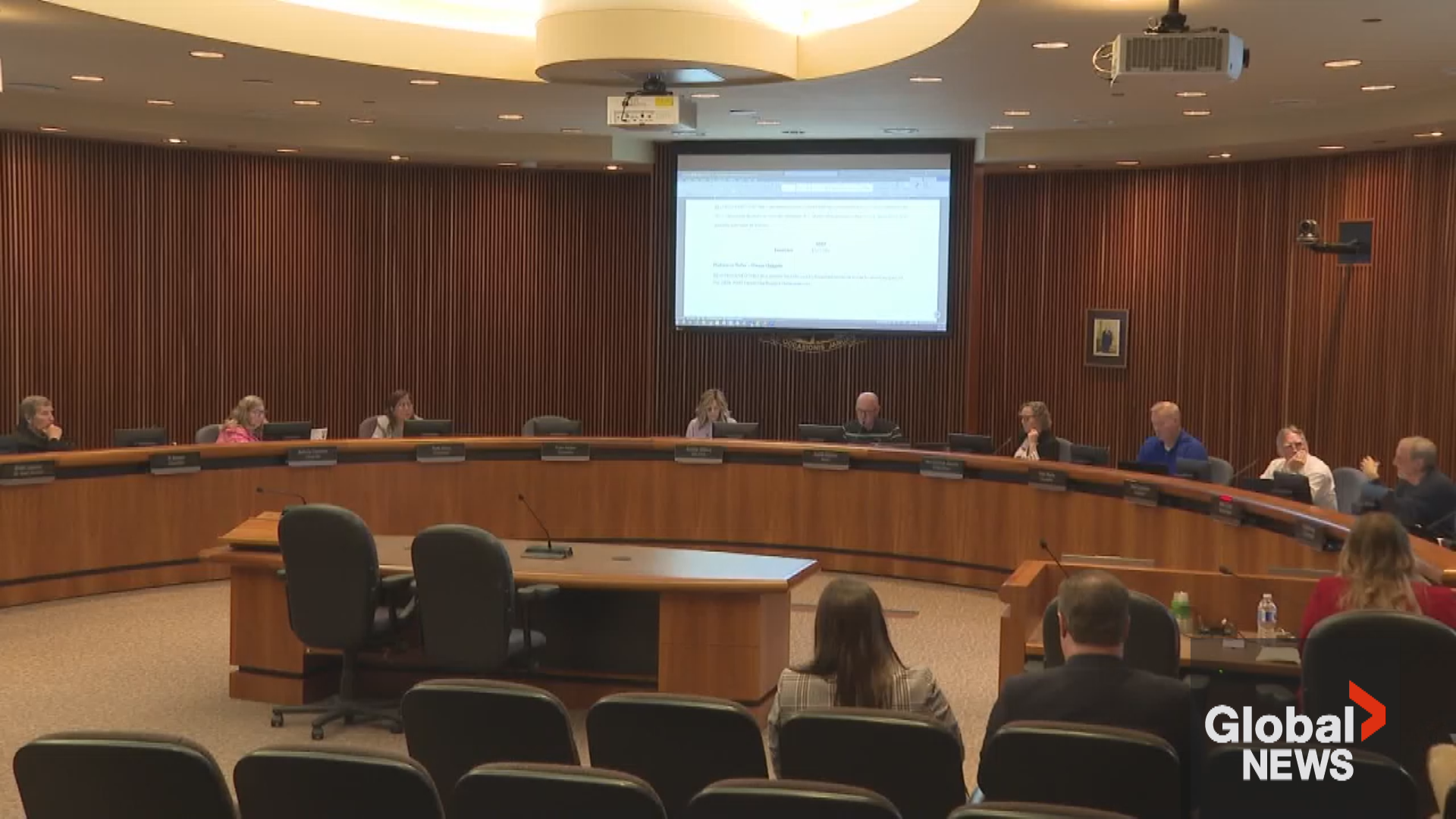
Miles away, in a brightly lit council chamber, a completely different kind of math is taking place.
City officials sit before glowing screens, staring at rows of numbers that refuse to balance. The problem is simple, cold, and structural. The city is facing an immense budgetary shortfall for the year 2027. To fix it, they have to cut. But you cannot cut air, and you cannot cut promises. You can only cut services.
When a city council decides to trim the fat, they rarely look at the grand, sweeping monuments. They look at the mundane machinery of daily life. They look at the buses. They look at the black bins sitting on the curb. They look at the invisible threads that hold a community together. What looks like a prudent, fiscally responsible line-item reduction on a spreadsheet in 2026 transforms into an existential crisis on a frozen sidewalk by 2027.
The Quiet Threat to the Curb
Waste management is something we only think about when it fails. We buy groceries, we consume, we toss the remnants into a plastic bin, and by some miracle of modern civilization, it vanishes before the sun comes up. It is a seamless illusion.
But the illusion is getting expensive.
Under the proposed cost-cutting measures for the 2027 fiscal cycle, Lethbridge is eyeing significant rollbacks in its environmental and waste operations. To the casual observer, an adjustment to waste service schedules sounds minor. Perhaps the trucks come every two weeks instead of every week. Perhaps certain recycling initiatives are paused. It sounds like a mild inconvenience.
The reality is far more visceral. Consider a bustling neighborhood filled with young families. Diapers pile up. Food scraps rot. In the heat of a July afternoon, a delayed waste pickup becomes a public health conversation, an invitation to local wildlife, and a psychological weight on a neighborhood. When a city slows down its cleanliness, the pride of its residents slows down with it.
The budget balancing act forces a strange trade-off. By saving a few hundred thousand dollars on diesel fuel, truck maintenance, and labor wages, the city shifts the burden directly onto the shoulders of its citizens. Suddenly, homeowners are forced to manage their own overflow, driving to regional landfills or watching their back alleys slowly degrade. The cost has not disappeared. It has merely changed addresses.
The Empty Bench on 4th Avenue
If the waste cuts threaten the cleanliness of the city, the proposed changes to the transit system threaten its pulse.
A transit system is the circulatory system of a working-class city. It bridges the gap between affordable housing on the periphery and the economic engines in the core. When a council looks at a bus route and sees low ridership numbers during off-peak hours, their instinct is to slash it. They see an empty 40-foot vehicle burning fuel and wonder why the taxpayer should foot the bill.
They do not see the teenager using that specific route to get to an after-school job that helps pay for groceries. They do not see the senior citizen whose only social interaction of the week is a trip to the downtown library.
Reducing transit frequency or cutting specific routes alters the geography of a city. It makes Lethbridge bigger, colder, and more isolated for those who do not own a vehicle. If the wait time for a bus stretches from fifteen minutes to forty-five, a commute is no longer a commute. It is an ordeal. People start missing doctor appointments. Job opportunities are turned down because the geography of the shift does not align with the diminished bus schedule.
The economic irony is profound. In an effort to save money, the city risks hamstringing the very people who generate local economic activity. A worker who cannot get to work cannot spend money at the local diner. A consumer stranded at home cannot support the downtown retail shops. The spreadsheet balance looks clean, but the local economy takes a quiet, bruising hit.
The Mirage of the Easy Fix
It is easy to cast the city council as the villain in this story. It is a satisfying narrative: wealthy politicians making detached decisions from high towers. But that caricature ignores the genuine agony of local governance.
Municipalities are caught in a brutal vice. Unlike federal or provincial governments, a city cannot print money, and it cannot run a structural deficit indefinitely. They are legally mandated to balance the books. When inflation drives up the cost of asphalt, electricity, concrete, and policing, the money must come from somewhere.
The options are brutally limited:
- Raise property taxes significantly, putting immense pressure on families already struggling with high mortgage rates and grocery bills.
- Dip into emergency reserves, effectively gambling with the city's financial stability against future disasters.
- Cut services, choosing which part of the city’s daily life can be sacrificed with the least amount of public outcry.
The council is essentially being asked to choose which limb to break to save the body. If they protect the buses, the roads crumble. If they protect the waste services, the community centers close their doors. Every decision is a compromise where someone, somewhere, loses.
The Unseen Momentum of Disinvestment
There is a psychological concept known as the broken windows theory, which suggests that visible signs of neglect create an environment that encourages further decline. When a community sees its services eroding, a subtle shift in collective confidence occurs.
If the parks are mowed less frequently, if the trash bins overflow, if the buses run late, a creeping sense of abandonment settles in. People stop looking out for their neighborhoods. The shared pride that makes a mid-sized city like Lethbridge thrive begins to fray at the edges.
This is the invisible stake of the 2027 budget debate. It is not just about dollars and cents, nor is it merely about the number of transit operators on the payroll. It is a question of what kind of city Lethbridge wants to be. Is it a community that protects its most vulnerable and maintains its shared spaces, or is it a city that manages decline through a series of tactical retreats?
The Concrete Reality
The debate will continue through smoke-filled committee rooms and tense public hearings. PowerPoint presentations will display colorful charts showing projected savings and optimized routes. Figures will be debated to the penny.
But the true metrics of these decisions will not be found in the minutes of the council meetings. They will be found on the street corners.
They will be measured by the length of the line at the transit terminal when the winter wind begins to howl. They will be measured by the smell of an alleyway in mid-August. They will be measured by the quiet frustration of a worker who realizes that their city has become just a little bit harder to live in.
As the sun comes up over the Oldman River, the first bus of the morning rolls out of the depot, its headlights cutting through the dark Alberta mist. For now, the wheels keep turning. But the clock is ticking toward 2027, and the margin for error is growing dangerously thin.