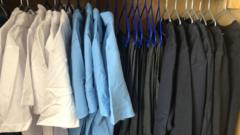
The fabric is stiff. It smells faintly of laundry detergent mixed with a stranger's house. To a casual observer, it is just a piece of dark polyester hanging from a temporary metal rack in a drafty community center. But to the teenager standing in front of the mirror, that blazer is either a shield or a target.
School uniforms were originally designed to be social equalizers. The theory made sense on paper: strip away the designer labels, enforce a singular dress code, and you eliminate the visible gap between the wealthy students and the poor ones. Everyone looks the same. Everyone starts on a level playing field.
It is a beautiful lie.
The reality plays out every September in school corridors across the country. Poverty does not disappear just because you put everyone in a navy blue sweater. It simply changes shape. It manifests in the frayed cuff that has been let down one too many times. It shows up in the trousers that stop two inches above the ankle because a growth spurt outpaced a parent’s bank balance. It is there in the panic of a mother realizing her child’s school has switched exclusive suppliers, making a single embroidered logo cost more than a week's worth of groceries.
Then comes prom season.
If the daily grind of school uniform compliance is a slow, steady drain on a family's dignity, prom is an acute financial crisis. It is an optional event that has become entirely mandatory in the eyes of teenage social survival. The dress, the suit, the shoes, the ticket. The price tag of a single night can easily rival a monthly rent payment.
So, what happens when you cannot pay?
The Hidden Penalty of the Playground
Consider Maya. She is a hypothetical compilation of three different girls who walked into a pop-up uniform stall on a rainy Tuesday afternoon, but her anxiety is entirely real. Maya is fifteen. She is smart, quick-witted, and terrified of assembly. Not because she fears public speaking, but because assembly requires everyone to stand up. When Maya stands up, the split seam under her left armpit becomes visible.
Her family is stuck in a classic modern trap. They earn too much to qualify for state-funded uniform grants, but far too little to cope with the soaring cost of living.
When a school demands a specific brand of trousers from a specific boutique vendor, it is not just enforcing discipline. It is levying a tax on education. According to data from children's advocacy groups, the average cost of a secondary school uniform can top £300 per child, per year. If you have three children, that is nearly a thousand pounds due all at once, right at the end of the summer holidays when utility bills are peaking.
Parents face impossible choices. Do you delay fixing the car brakes, or do you send your son to school in shoes that pinch his toes?
The punishment for making the wrong choice is swift. Schools regularly place children in isolation or send them home for dress code violations. The irony is bitter. A child is denied an education because their parents could not afford the correct shade of grey trousers. The psychological toll this takes on a teenager is immense. They learn early that their belonging is conditional on their wardrobe.
Inside the Pop-Up Revolution
But the real solution lies elsewhere, far away from corporate retail stores and punitive school board meetings. It is happening in church halls, empty shopfronts, and community centers.
The pop-up free uniform and prom dress stall is a deceptively simple concept. People donate clean, high-quality, pre-loved school gear and formal wear. Volunteers sort them by size. Families walk in, browse the racks, and take what they need. No vouchers required. No means-testing. No questions asked.
To understand why this works, you have to look past the financial transaction. The real magic is the environment.
When you walk into a traditional charity shop or a food bank, there is often an invisible weight in the air. A feeling of exposure. The pop-up stalls flip that script. They are designed to feel like boutiques. The dresses are organized by color. The suits are steamed. The school blazers are hung neatly with the crests facing outward.
"We don't want people to feel like they are receiving charity," says Sarah, a volunteer who has spent three weekends sorting through donations. "We want it to feel like a shopping trip. Every kid deserves that excitement of picking out an outfit for a big night, or feeling crisp on their first day of term."
The sheer volume of clothing that passes through these temporary spaces is staggering. Tons of textile waste are diverted from landfills, solving an environmental crisis while addressing a social one. But the metric that truly matters cannot be measured in kilograms. It is measured in the sudden relaxation of a father’s shoulders when he finds a pair of pristine football boots in his son’s size.
The Evening of the Great Equalizer
Let us look closer at the prom section of the stall. This is where the emotional stakes reach their peak.
Prom has evolved from a simple school dance into a high-stakes cultural ritual. It is a rite of passage, a marker of transition from childhood to whatever comes next. To be excluded from it because of money is a specific kind of heartbreak that a teenager does not easily forget. It leaves a scar. It tells them that the glossy, celebratory side of life is reserved for a tier of society they do not belong to.
Enter the racks of tulle, chiffon, and silk.
A vintage emerald green gown hangs between a sequined shift dress and a classic black tuxedo. These items are often worn exactly once before being relegated to the back of a wardrobe for a decade. By liberating them from the dark corners of affluent bedrooms, the pop-up stall does something radical. It redistributes joy.
Picture a boy trying on a tailored jacket. He looks in the mirror, adjusts his lapels, and for the first time in his life, he sees a young man who belongs in a ballroom. He does not see the financial stress that has kept his parents awake at night for six months. He sees potential.
This is not about vanity. It is about equity.
Rewriting the Code
The success of these community pop-ups exposes a fundamental flaw in how our institutions handle poverty. We tend to view financial hardship as an individual failure to be managed with bureaucracy, rather than a systemic issue that can be alleviated with collective empathy.
If a community can gather thousands of pieces of clothing, clean them, organize them, and distribute them to everyone who needs them without a single piece of red tape, why are we still allowing exclusive uniform monopolies to dictate terms to struggling families?
Some forward-thinking schools are starting to notice. They are relaxing their rules, banning expensive logos in favor of generic supermarket colors, and actively partnering with these local initiatives. But change is slow. Until the policy catches up with the reality on the ground, the pop-up stall remains the frontline defense against the erosion of teenage self-esteem.
The afternoon sun cuts through the high windows of the community hall, catching the sequins on a row of dresses. The room is noisy with the sound of zippers, the rustle of hangers, and the low hum of nervous, hopeful chatter.
Maya steps out from behind a makeshift curtain. She is wearing the emerald green gown. It fits perfectly. She looks at her reflection, then turns to her mother, who is biting her lip to keep from crying. For the next two months, Maya will not have to worry about how she will explain her absence from the biggest night of her school life. She will just be another teenager arguing with her friends about what song the DJ should play first.
The dress is just fabric and thread. But as Maya smiles at her reflection, it feels a lot like freedom.