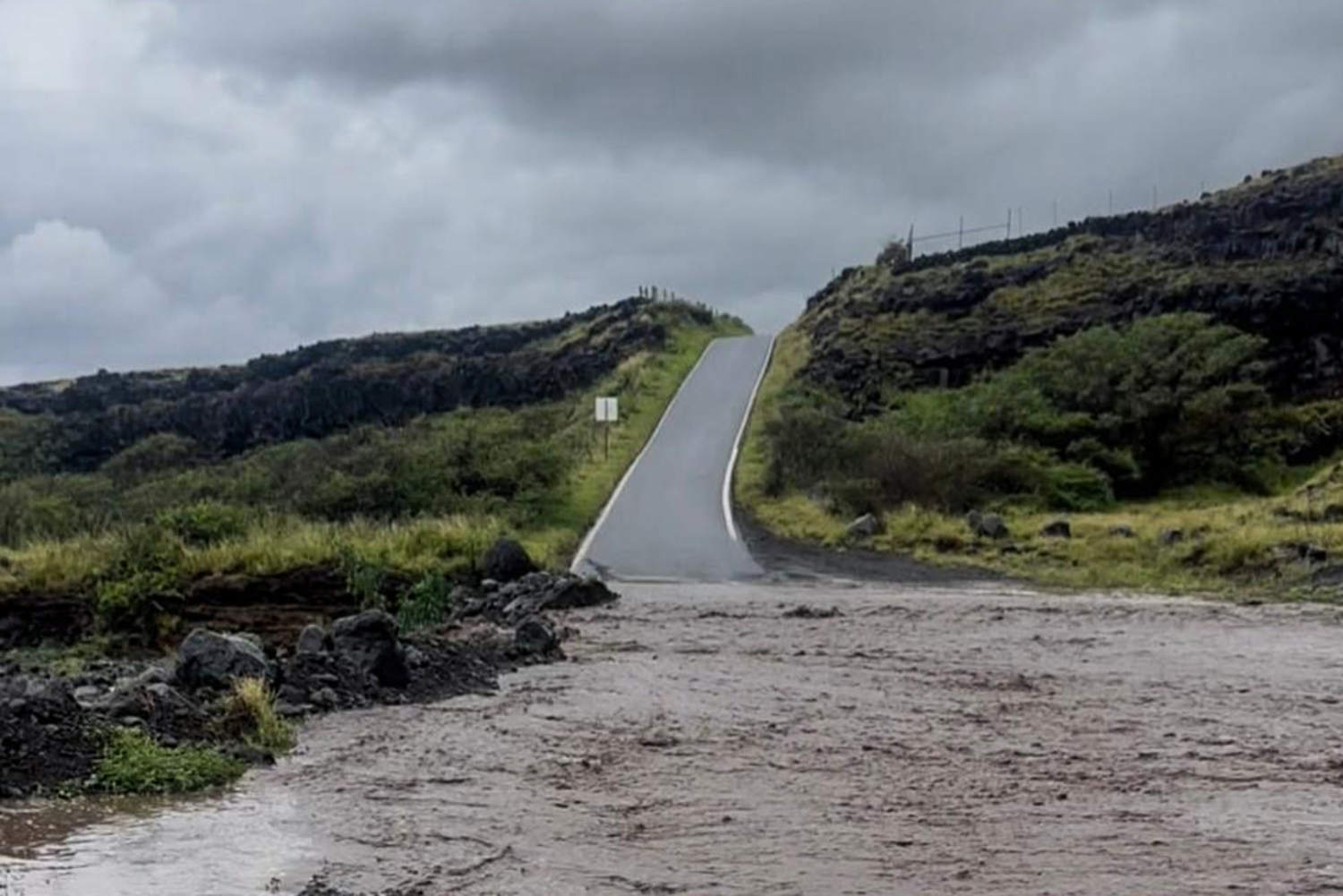
The ground in Maui and parts of the Big Island has become a hostile participant in the state's weather patterns. As heavy rains sweep across the Pacific, the immediate danger is no longer the flames that dominated the headlines last year, but the very earth those fires left behind. Burn scars—vast stretches of charred, hydrophobic soil—are essentially acting as paved chutes, funnelling rainwater into debris flows that threaten to bury communities and choke the ocean.
Hawaii is currently locked in a cycle where the trauma of the past is magnifying the volatility of the present. While the general public often views rain as a relief for drought-stricken islands, the reality on the ground is far more clinical and dangerous. Meanwhile, you can explore other stories here: The Cold Truth About Russias Crumbling Power Grid.
The Science of Repellent Earth
When a wildfire burns hot enough, it creates a chemical reaction in the soil. Organic compounds vaporize and then condense on the soil particles below the surface, creating a waxy, water-repellent layer. This is known as hydrophobicity. In a healthy ecosystem, the forest floor acts as a sponge, slowing down rainfall and allowing it to percolate into the aquifer. On a burn scar, that sponge is gone.
Instead of soaking in, the water sits on top. It gathers speed. Within minutes of a heavy downpour, a few inches of rain can transform into a wall of mud, ash, and uprooted vegetation. This isn't just theory. For residents in Lahaina and the Kula regions, this is a mathematical certainty that triggers every time the clouds darken. The infrastructure in these areas was never designed to handle the sheer volume of runoff that a flash flood on a burn scar produces. To explore the full picture, check out the excellent report by The Guardian.
The state’s drainage systems are often clogged with the very debris that the fires created. This creates a secondary crisis. When the water can't go through the pipes, it goes over the roads, undermining the pavement and cutting off the only exit routes for isolated communities.
The Infrastructure Gap and Legislative Inertia
The problem isn't just the weather; it is a legacy of land management and aging infrastructure that has failed to keep pace with a changing climate. Hawaii's topography is unique. You have steep volcanic slopes that drop thousands of feet into densely populated coastal plains. This creates a natural "flume" effect.
For decades, the focus was on fire prevention or coastal erosion. The middle ground—the literal slopes where the fires happened—was often overlooked until it became a graveyard. Now, the state is scrambling to install makeshift barriers and "Hesco" bastions to divert water. These are temporary fixes for a permanent shift in the environment.
There is a hard truth that officials are reluctant to say out loud. Some of these areas may be fundamentally unprotectable in their current state. Replanting native vegetation takes years. Breaking up the hydrophobic soil layer requires massive manual intervention that is often too expensive or logistically impossible on vertical terrain.
Atmospheric Rivers and the Kona Storm Factor
Hawaii is increasingly at the mercy of Kona storms and atmospheric rivers. These aren't your typical afternoon trade wind showers. They are deep, moisture-laden systems that can dump a month’s worth of rain in twenty-four hours. When these systems stall over a burn scar, the results are catastrophic.
The predictability of these storms is also wavering. Traditional meteorology relies on historical patterns that are being rewritten. The heat stored in the surrounding Pacific waters acts as fuel, supercharging these storms before they hit the islands. This means the window for evacuation is shrinking.
The Hidden Threat to the Reefs
The impact extends far beyond the shoreline. As these debris flows hit the ocean, they carry massive loads of sediment, ash, and potentially toxic runoff from burned structures. Hawaii's coral reefs are sensitive organisms. They need clear, sunlit water to survive.
When a "brownout" occurs—where the coastal waters turn a murky chocolate color from runoff—it smothers the reef. The sediment blocks the light and can introduce pathogens that lead to coral bleaching or death. This is an economic threat as much as an environmental one. The tourism industry depends on the health of these waters, and the fishing communities rely on the reefs as nurseries for the species that feed the islands.
A Failed Warning System
One of the most pressing issues identified by analysts is the failure of localized warning systems. While the National Weather Service provides broad alerts, the hyper-local nature of flash flooding on a burn scar requires sensors that simply aren't there in sufficient numbers.
A canyon three miles away might be bone dry while the next one over is experiencing a thousand-year flood event. Without real-time flow sensors in the upper elevations, people at the bottom of the hill are essentially flying blind. They are relying on the sound of the water—a roar often described as a freight train—which usually means it is too late to move.
The state has discussed "integrated monitoring," but the transition from discussion to installation has been sluggish. Budgetary constraints and the sheer difficulty of the terrain are the usual excuses. Meanwhile, every rainy season becomes a game of Russian roulette for those living in the shadow of the scars.
The Economic Aftershocks
Insurance companies are watching these weather patterns with predatory intensity. As the risk of "secondary perils"—the industry term for floods following fires—increases, the cost of living in Hawaii continues to spiral. Some homeowners are finding that their policies no longer cover mudflows, or that the premiums have reached a level that is effectively a soft eviction.
This creates a ghost-town effect. People who survived the fires are being forced out by the rain. If you cannot insure a home, you cannot get a mortgage. If you cannot get a mortgage, the property value craters, and the tax base that pays for the very infrastructure needed to fix the problem disappears. It is a feedback loop of decline that requires a massive infusion of federal capital to break.
The Biological Clock
Nature will eventually heal the scars, but not on a human timeline. It takes five to ten years for a forest canopy and the underlying root systems to recover enough to stabilize the soil. During those years, the risk remains at a peak.
The invasive grasses that contributed to the intensity of the fires are often the first things to grow back. They have shallow root systems that do almost nothing to stop erosion. In fact, they can make it worse by creating a slick "carpet" that helps water accelerate even faster. True restoration requires the reintroduction of deep-rooted native species like Koa and 'Ohi'a, which are struggling to survive in the altered soil chemistry.
Living in the Shadow of the Slope
For the people of Maui, the sound of rain on a tin roof has changed from a lullaby to a trigger. There is a psychological weight to this weather that data points can't capture. The anxiety is palpable in community meetings and on social media feeds.
The strategy of "shelter in place" is often dangerous when the ground itself is moving. However, with limited road networks, evacuation is equally risky. You don't want to be caught in a car when a culvert fails.
The path forward requires a brutal reassessment of where we build and how we manage the land between the peaks and the sea. It requires moving beyond the "emergency response" mindset and into a permanent state of "geological defense."
The rains will continue to come. The Pacific is not getting any calmer, and the scars on the hillsides are not healing fast enough to meet the next season's arrival. The state must decide if it will continue to chase the disaster or if it will finally get ahead of the water.
Clear out the culverts today because the mud is already moving.