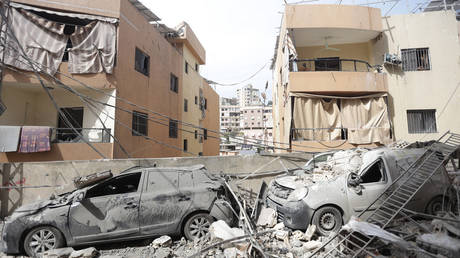
The Lebanese army just lost another soldier. On the ground in South Lebanon, the situation isn't just "tense"—it's becoming a meat grinder for a national institution that's trying to stay neutral while its sovereign territory is turned into a high-stakes chessboard. A recent Israeli strike hit a military center in the town of Sarafand, killing one soldier and wounding four others. This isn't an isolated incident. It's a pattern that's making the prospect of a ceasefire feel like a distant dream.
If you're watching the headlines, you've probably seen the back-and-forth between Israel and Hezbollah. But the Lebanese Armed Forces (LAF) are caught in a brutal middle ground. They aren't the primary combatants in this specific exchange, yet they're the ones buried under the rubble when precision strikes miss the mark or target positions they happen to occupy.
Why the LAF is taking hits despite not being at war
Let's be clear about something. The Lebanese army hasn't declared war on Israel. They aren't launching rockets. Their job, at least on paper and according to UN Resolution 1701, is to maintain stability in the south. But when Israeli jets and drones are hunting for Hezbollah infrastructure, the line between a "military target" and a "sovereign Lebanese army post" gets dangerously thin.
The strike in Sarafand happened on a Tuesday night. It wasn't in the middle of a pitched battle. It was a direct hit on a fixed military installation. When this happens, it sends a message that's louder than any diplomatic cable. It says that no one is safe in the south, not even the people tasked with keeping the peace.
The human toll on the ground
One dead. Four wounded. To a news ticker, those are just digits. To the Lebanese people, they represent the erosion of their last standing national pillar. The soldier killed in Sarafand adds to a growing list of LAF casualties since the escalation began last October.
I've talked to people in Beirut who see the army as the only thing keeping the country from a total internal collapse. When the army gets hit, the whole country feels the vibration. It isn't just about the hardware or the border security. It's about the psychological hit to a population that's already seen its currency fail, its port explode, and its political class vanish into a cloud of corruption.
The impossible math of UN Resolution 1701
Everyone loves to talk about 1701. Diplomats in suits at the UN mention it every five minutes. The idea is simple. Hezbollah moves north of the Litani River. The LAF and UNIFIL (the UN peacekeepers) take over the south. Israel stops its overflights and incursions.
But here's the reality. How do you expect the Lebanese army to move 15,000 troops into the south when their facilities are being leveled? You can't ask an institution to take control of a war zone while simultaneously being a casualty of that war. It's a logistical nightmare. The LAF is currently underfunded, under-equipped, and under-fed. Their soldiers often take second jobs just to buy groceries.
The irony of international support
The US and France keep saying they want to "strengthen" the LAF. They send humvees and ammunition. They talk about the army being the "sole legitimate defender" of Lebanon. Yet, when these strikes happen, the international response is usually a "deep concern" press release.
If the goal is truly to have the LAF replace non-state actors in the south, then killing their soldiers is the fastest way to undermine that plan. It creates a vacuum. It makes the "official" forces look weak and the "unofficial" forces look like the only ones actually fighting back.
Tactical shifts and the risk of miscalculation
The border isn't a straight line anymore. It's a chaotic mess of drone corridors and electronic warfare. In the Sarafand strike, the casualties were immediate. The Lebanese Red Cross had to scramble to reach the site.
This isn't just about "collateral damage." We're seeing a shift in how the conflict is being managed. Earlier this month, a Lebanese soldier was killed while on a joint patrol with the Red Cross to evacuate wounded people. That's a war crime in any other context. Here, it’s just another Tuesday in the Levant.
What the numbers tell us
If you look at the data from the Lebanese Ministry of Public Health and the LAF's own statements, the casualty rate for non-combatant military personnel is climbing.
- Over 3,500 people have been killed in Lebanon since the conflict flared.
- The vast majority are civilians and fighters, but the army's toll is now in the dozens.
- Infrastructure damage to LAF outposts is estimated in the millions of dollars.
For a military that relies on international donations for its very existence, these losses are catastrophic. You can't just "buy" a new experienced sergeant. You can't just "repair" the trust lost when a soldier dies in his sleep because of a missile.
The geopolitical fallout of a weakened LAF
If the Lebanese army breaks, Lebanon breaks. It’s that simple. The LAF is the only institution that cuts across sectarian lines. It’s got Sunnis, Shias, Christians, and Druze all wearing the same camo.
When Israel strikes an LAF position, it isn't just hitting a building. It's putting pressure on the delicate sectarian balance of the country. If the army can't protect its own, people start looking to their own sects for protection. That's how civil wars start. We've seen this movie before in Lebanon, and the ending is always a disaster.
The role of the US mediator
Amos Hochstein, the US envoy, has been flying back and forth between Beirut and Tel Aviv. He’s trying to bridge the gap. He talks about "windows of opportunity." But every time a Lebanese soldier is killed, that window slams shut a little harder.
The Lebanese government, represented by Prime Minister Najib Mikati and Speaker Nabih Berri, is in a tough spot. They’re trying to negotiate on behalf of a country that doesn't have a president and whose army is being picked off. They’ve signaled that Lebanon is ready to implement 1701, but they need a guarantee that the LAF won't be targeted while they do it.
Moving beyond the headlines
Stop thinking of this as just "Israel vs. Hezbollah." It's a three-way disaster where the most legitimate party—the one the world says it wants in charge—is the one being systematically weakened.
If you want to see a ceasefire that actually sticks, you have to look at the survival of the Lebanese Armed Forces. Without them, there's no one to hand the keys to. The strike in Sarafand is a reminder that while the diplomats argue over wording in a draft, the people meant to enforce that draft are being buried in the south.
Keep an eye on the LAF's response in the coming days. They won't retaliate with missiles—they don't have them—but watch the internal political shift. The more the army is targeted, the less likely the Lebanese government can sell a "peace deal" to a skeptical and grieving public. Check the local reports from Nabatieh and Tyre. The movement of LAF units away from the front lines isn't a retreat; it's a survival tactic. If they move back, the vacuum left behind will be filled by exactly the groups the world says it wants to move out.