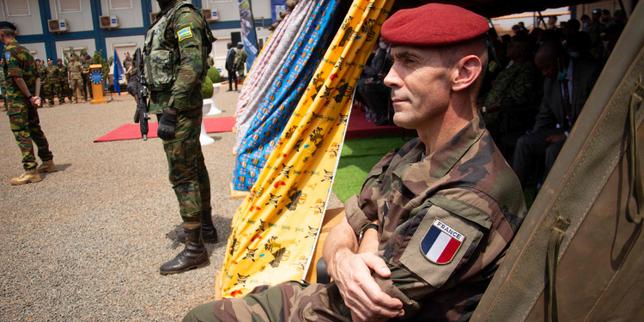
The Elysée Palace is quietly replacing the executioners of its military strategy. General Jacques Langlade de Montgros takes command of the French Army, while Admiral Christophe Cluzel assumes control of the French Navy. On the surface, the bureaucratic musical chairs look like routine institutional succession. The underlying reality is far more severe. This double appointment marks the definitive end of the post-Cold War era for the French Republic, signaling a forced transition from counter-insurgency operations in Africa toward preparation for a brutal, high-intensity state-on-state conflict in Europe and the Indo-Pacific.
For three decades, French military planning revolved around expeditionary interventions. Lightly armored columns chased insurgent groups across the Sahel, relying on total air superiority and asymmetrical advantages. Those days are gone. The war in Ukraine exposed the vulnerability of Western assumptions regarding ammunition consumption, electronic warfare, and attrition. By placing a seasoned intelligence mastermind at the head of the Army and an aggressive fleet commander at the helm of the Navy, Paris is acknowledging that its armed forces are structurally unready for a prolonged, industrial-scale war against a peer adversary.
The task before these two commanders is not to manage a peacetime transition. It is to overhaul an entire military apparatus before the clock runs out.
The Intelligence Fixer Inherits a Hollowed Army
General Jacques Langlade de Montgros is not a conventional infantry officer who climbed the ranks purely through field commands. His defining assignment came in 2022, when he was brought in to direct the Military Intelligence Directorate (DRM). His predecessor had been dismissed after failing to predict the Russian invasion of Ukraine, an intelligence failure that embarrassed Paris on the global stage. Montgros rebuilt the agency, forcing a culture shift toward objective, hard-nosed threat assessments that aligned more closely with Anglo-American intelligence models.
Now, he takes over an Army that faces a profound identity crisis.
The French Army is highly professionalized, combat-tested, and elite. It is also dangerously small. If a high-intensity conflict broke out on the eastern flank of Europe tomorrow, the French Army would struggle to sustain a single army corps in the field for more than a few weeks. The current ammunition stockpiles, while protected as state secrets, are widely understood by defense analysts to be insufficient for more than a handful of days of intense artillery duels.
Montgros must pivot the land forces away from the assumptions of the decade-long Operation Barkhane in Mali. In Africa, the threat was decentralized, lacking air support, anti-aircraft missiles, or heavy artillery. In a confrontation with a peer state, French forces will face electronic jamming that cuts off satellite communications, dense air defense umbrellas that deny air support, and thousands of loitering munitions targeting command posts.
The new chief of staff will have to make brutal decisions regarding procurement. The Scorpion program, designed to modernize French armored vehicles with advanced cooperative combat networks, was built on the assumption of digitized connectivity. If electronic warfare renders that connectivity useless on day one of a conflict, the Army needs a backup plan. Montgros must balance the drive for sophisticated technological platforms with the unglamorous necessity of mass. The military needs simple mass, meaning more artillery barrels, more unguided shells, and more men who can fight when the networks go dark.
The Carrier Commander Bracing for the Blue Water Fight
Simultaneously, Admiral Christophe Cluzel takes the helm of a Navy that is stretched to its absolute breaking point. Cluzel is a sailor who knows the exact weight of a carrier strike group, having commanded the task force centered around the Charles de Gaulle. He understands that the Mediterranean and the Red Sea have turned into highly contested environments where Western naval dominance is no longer guaranteed.
The French Navy likes to boast that it is one of the few global fleets capable of deploying a nuclear-powered aircraft carrier and a fleet of nuclear attack submarines. This projection of power rests on a remarkably fragile foundation. The Navy operates a single aircraft carrier. When the Charles de Gaulle undergoes maintenance or refueling, the entire French strike capability vanishes from the surface of the earth.
Cluzel faces a maritime arena where the rules of engagement are changing by the hour. In the Black Sea, asymmetric drone warfare effectively crippled the Russian Black Sea Fleet without the opposing force deploying a single traditional warship. In the Red Sea, Houthi rebels using cheap, Iranian-supplied anti-ship ballistic missiles forced Western navies, including France, to burn through multimillion-dollar air defense missiles to protect commercial shipping.
This equation is economically unsustainable. A French frigate firing an Aster 30 missile costing millions to down a drone worth twenty thousand dollars represents a mathematical certainty of defeat in a war of attrition. Cluzel must urgently solve the problem of close-in weapon systems and directed-energy weapons for the fleet. He must also prepare his sailors for the reality of the Indo-Pacific, where China is expanding its naval footprint at a velocity that dwarfs European shipyards. France claims millions of square kilometers of exclusive economic zones in the Pacific due to its overseas territories. Protecting those territories with the current number of first-rank frigates is mathematically impossible.
The Industrial Bottleneck That Money Cannot Quick Fix
The French political leadership points to the multi-year Military Programming Law (LPM) as the ultimate solution to these systemic deficiencies. The government promised hundreds of billions of euros to rebuild the apparatus. The civilian executive assumes that signing a check automatically translates into military readiness on the front line.
It does not. Money cannot buy time, and it cannot instantly conjure industrial capacity that was dismantled during the peace dividend era.
Consider the production of the Caesar self-propelled howitzer, one of the few pieces of French hardware that won universal acclaim on the battlefields of Ukraine. While manufacturers managed to accelerate production from two units a month to several, the supply chain remains highly vulnerable. A single shortage of specialized steel, a delay in gunpowder production, or a lack of skilled machinists can stall the entire assembly line.
Montgros and Cluzel are taking office at the exact moment when the friction between military necessity and industrial inertia becomes critical. They will have to argue with defense contractors who prefer long, lucrative, slow-paced production cycles over the messy, low-margin reality of rapid wartime manufacturing. The commanders will need to convince the political establishment that having twenty highly advanced, over-engineered fighter jets is worse than having sixty simpler aircraft that can be replaced when they are shot down.
Breaking the Gaullist Illusion of Strategic Autonomy
The deeper, unvarnished truth behind these appointments is that France can no longer maintain the illusion of total strategic autonomy. Ever since Charles de Gaulle withdrew France from the integrated military command of NATO in 1966, Paris has nurtured the myth that it can fight anywhere, anytime, completely alone. While France returned to the integrated command structure in 2009, the institutional mindset remained stubbornly independent.
The modern threat environment makes this isolationist pride dangerous. Neither the French Army under Montgros nor the Navy under Cluzel can fight a peer adversary without deep integration into allied networks. This creates an immediate friction point with the French political doctrine of European autonomy.
To survive a high-intensity confrontation, the French military must rely on American satellite reconnaissance, logistics, and heavy transport. It must coordinate its naval deployments in the Mediterranean and the Atlantic with the Royal Navy and the US Navy. Cluzel will have to ensure that French communication systems are completely interoperable with allied fleets, even if it means sacrificing some degree of sovereign control over data encryption.
Montgros faces a similar challenge on land. The French Army has long specialized in rapid, light deployment in Africa, a style of warfare that differs completely from the heavy, mechanized, layered defense required to hold territory against a massed armored assault in Eastern Europe. To become a credible force within NATO, the French Army must learn to operate as a component of a massive allied machine rather than acting as a self-contained boutique expeditionary force.
The Personnel Crisis Threatening the Ranks
Even if Montgros and Cluzel manage to secure the weapons, the ammunition, and the industrial backing, they face an even more stubborn obstacle. They are running out of people.
The French military is experiencing a quiet but devastating recruitment and retention crisis. The generation that joined the military after the 2015 terrorist attacks in Paris is reaching the end of their contracts, and they are leaving the service in numbers that outpace new recruits. The reasons are structural. The private sector offers better pay, predictable hours, and none of the hardships associated with prolonged overseas deployments or constant domestic patrols under Operation Sentinelle.
The technical branches are suffering the most. The Navy cannot retain its marine engineers, cyber specialists, or nuclear technicians because private civilian industries are willing to pay triple the salary for their expertise. A nuclear submarine cannot submerge without a highly qualified crew. If Cluzel cannot stem the tide of departures, his ships will remain tied to the piers of Toulon and Brest regardless of how many new vessels the shipyards deliver.
Montgros faces an Army where the physical standards of applicants are dropping while the psychological toll of service is rising. The modern infantryman is expected to carry heavier equipment, operate complex digital systems, and endure prolonged artillery barrages that cause severe traumatic brain injuries. Preparing civilian youth for this level of violence requires a training regimen that the current risk-averse institutional culture struggles to implement.
The Clock is Ticking
These appointments are not a reward for past achievements. They are a mandate to prepare for an existential struggle that most Western citizens still consider unthinkable.
The primary metric of success for General Montgros and Admiral Cluzel will not be the elegance of their strategic doctrines or the smoothness of their public relations campaigns. The single metric that matters is whether they can transform a small, highly specialized expeditionary force into a rugged, resilient, large-scale war machine capable of absorbing heavy casualties and fighting on through the chaos of a disrupted world. They must strip away the bureaucratic complacency that accumulated over decades of fighting poorly equipped insurgents. The transition must be fast, it must be ruthless, and it must happen before the next major crisis erupts on the global stage.