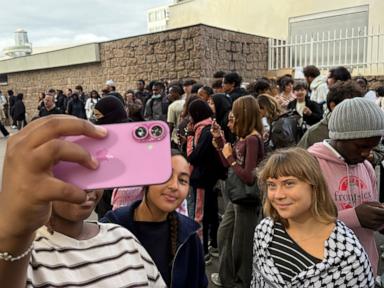
Greta Thunberg showed up outside Paul Éluard High School in Saint-Denis, handed teenagers a microphone of global validation, and told the world they were watching with awe. Standard wire coverage framed the moment as a tidy moral binary. Plucky youth. Crumbling classrooms. Absent adults. A familiar activist star lending weight to a righteous uprising.
That framing is lazy consensus. It makes great copy and terrible analysis.
When Greta Thunberg backs French high school protests over run-down schools, she treats a complex institutional and fiscal breakdown as a morality play about generational betrayal. Calling for more money and more defiance feels electric on a street corner north of Paris. It does almost nothing to explain why a school in one neighborhood has leaky ceilings and unreplaced teachers while another operates smoothly, why budgets are locked in a vise, or why blocking school gates costs the very students demanding a future.
The Lazy Consensus Around Run-Down Schools
Conventional coverage treats public school decay like a simple math problem with a villain at the chalkboard. More grievances, bigger marches, louder slogans—and eventually, the state must cough up cash.
I have watched public institutions and private organizations alike burn millions chasing symptoms while ignoring incentives and constraints. Throwing money at an unexamined operating model rarely fixes broken execution. If a building leaks, a teacher goes unreplaced for weeks, and scheduling forces teenagers into erratic blocks of downtime, simply announcing a bigger budget check does not automatically repair roofs, train substitutes, or fix timetable design.
Worse, celebrity solidarity turns local structural failures into a single ideological war. Thunberg links French school grievances to a global struggle against "the same system". That sounds sweeping. It also flattens real differences between local maintenance, national staffing rules, university admissions bottlenecks, and sovereign debt realities. A teenager in a cramped suburban classroom dealing with missing staff is not fighting an abstract villain in a speech. They are dealing with concrete administrative and fiscal bottlenecks.
What "Run-Down" Actually Means in French Education
To talk seriously about French high schools (lycées), we have to separate three things media reports routinely mash together: physical maintenance, instructional continuity, and selection pressure.
- Physical maintenance involves building upkeep, heating, sanitation, and safety equipment. Responsibilities across French school tiers are split across levels of government, which creates friction when budgets tighten and priorities collide.
- Instructional continuity is about whether a warm body who actually knows the subject stands in front of a class every day, especially ahead of high-stakes exams like the baccalauréat. Missing hours here hurt exam readiness directly.
- Selection pressure comes from university admissions anxiety and curriculum reforms that leave students feeling squeezed between rigid pathways and uncertain outcomes.
A common misunderstanding is assuming that every visibly worn building means total educational collapse, or that every protest is purely about leaky pipes. Deteriorating facilities are real and demoralizing. Yet instructional gaps—unfilled teaching posts, abrupt absences, and lost classroom hours—hit learning outcomes far faster than scuffed paint.
Imagine a scenario where two high schools sit twenty miles apart. School A gets a shiny coat of paint and new projectors after a headline-grabbing demonstration, while three math and science posts remain unfilled all semester. School B keeps an older, plainer building clean, safe, and fully staffed from September to June. Which students walk into exam season better prepared? The answer is obvious, yet the loudest protests often focus on visible symbols rather than quiet operational failures.
The Fiscal Vise Nobody Wants to Name
Here is the uncomfortable reality that street chants rarely answer: where does the extra money come from when a government is already squeezed from every direction?
Public finance is a zero-sum game in the short run. Higher debt service, competing public priorities, defense commitments, and resistance to higher taxes all press on the same treasury. You cannot simply declare that education is priceless and pretend sovereign balance sheets are optional. Every euro routed to one line item without offsetting savings or growth comes from somewhere else—higher borrowing costs, cuts elsewhere, or heavier burdens on working households.
Even when money is allocated, bureaucracy eats a chunk of it. Public procurement rules, union negotiations, regional administration, and slow capital projects mean a budget line announced in autumn can take years to turn into a renovated science lab or a full roster of substitute teachers.
Economists and public-policy scholars such as Thomas Piketty and Dani Rodrik have spent years examining how modern states balance redistribution, fiscal capacity, and democratic legitimacy. Their work underscores a sobering rule of governance: grand promises collide hard with institutional capacity and political trade-offs. Applause from an international activist does not expand fiscal space or speed up a municipal maintenance contract.
Are Students Asking the Wrong Question?
When people search for news on Greta Thunberg backing French high school protests over run-down schools, they usually ask a predictable set of questions:
- "Why are French high school students protesting?" Mostly because daily friction—frayed facilities, staffing gaps, and pressure around schooling and admissions—has boiled over into sustained frustration.
- "Is Greta Thunberg right to support them?" Emotionally, teenagers voicing real frustrations deserve to be heard. Strategically, importing a global protest brand can bring cameras while obscuring local fixes.
- "Will protesting fix run-down schools?" Protests force attention. They rarely solve procurement delays, teacher recruitment shortages, or math on a stretched budget by themselves.
The better question is not whether the protesters are angry enough. They are clearly angry enough. The better question is which specific failures in a school can be fixed fast with existing rules, and which ones require structural reform rather than slogans.
Blocking gates, burning property, or trading clashes with police can shut down classes for days or weeks. Every missed instructional block steals time back from the students themselves—especially those without private tutors or safety nets at home. Disrupting the system to demand a better system is a high-wire act where the students often pay the steepest tuition.
Where My Contrarian Take Has Blind Spots
Let's be honest about the downside of taking a hard-nosed, operational view of student protests.
First, cold pragmatism can sound dismissive to people living in genuinely unsafe or neglected spaces. If a teenager is freezing in a classroom or dealing with broken facilities week after week, telling them to "be patient with institutional mechanics" feels tone-deaf. Legitimate anger often needs noise just to break through political inertia.
Second, my approach prioritizes measurable execution—staffing, maintenance schedules, exam hours—over symbolic solidarity. That can undervalue the role of collective morale and political pressure in forcing leaders who were ignoring a problem to finally look up. Sometimes a shock to the system is the only thing that moves a stagnant administration.
What Actually Works Instead of Performative Outrage
If you care about fixing run-down schools rather than just winning a news cycle, skip the grand speeches and focus on leverage that sticks.
- Audit the exact failure points. Separate building defects from teacher vacancies and schedule dead zones. Publish a plain, school-by-school ledger of what is broken, who owns the fix, and how long it has been delayed. Vague outrage is easy to ignore; specific public scorecards are harder to dodge.
- Target bottlenecks, not just budgets. Pushing for "more funding" in the abstract invites endless arguments over deficits. Pushing to streamline substitute hiring, reallocate unused space, or fast-track urgent safety repairs targets concrete choke points.
- Protect instructional time during leverage. Disruptions that wipe out weeks of core classes hurt the most vulnerable students first. Walkouts, petitions, press briefings, and coordinated boycotts of non-essential events can apply pressure without torching a student's own academic calendar.
- Follow the local implementation. The real test of any protest isn't the day a famous activist poses outside the gates. It is six months later, when cameras are gone, checking whether the boiler works, the roof stays dry, and the teacher actually shows up.
A microphone and a crowd make a striking photograph. A dry ceiling and a full classroom do the actual work.



