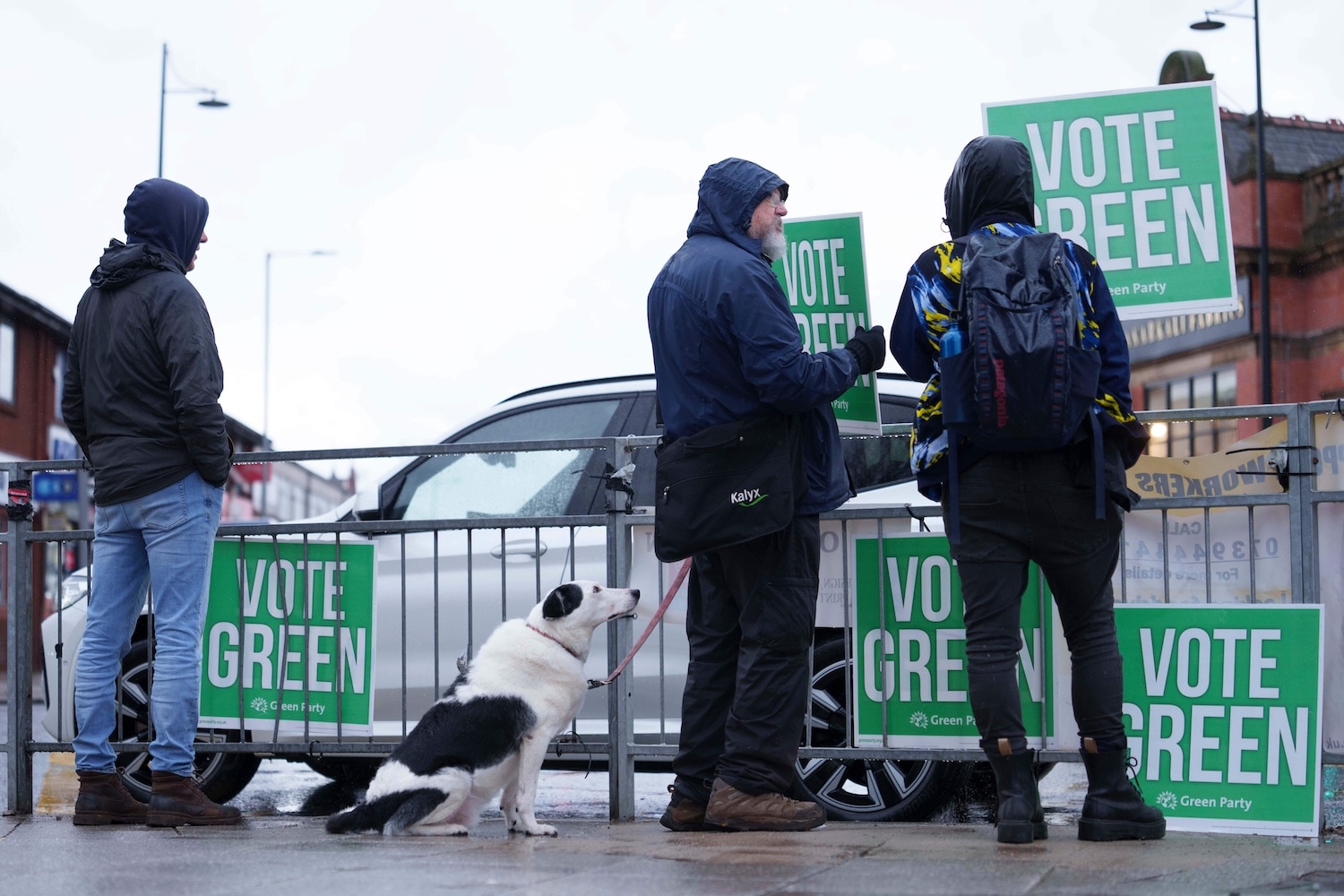
The victory of the Green Party in a recent special election is not a localized anomaly but a clinical demonstration of the "Squeezed Centre" phenomenon affecting the Labour Party's current governing coalition. While traditional political analysis frames such losses as "blows" to leadership, a more rigorous assessment identifies a systemic realignment where the Green Party has transitioned from a fringe protest group into a specialized vehicle for capturing high-density, urban-progressive voters. This shift exposes a specific structural weakness in Prime Minister Keir Starmer’s electoral efficiency: the inability to maintain a broad-tent coalition when the policy requirements of rural-industrial swing seats directly conflict with the ideological demands of the metropolitan core.
The Triangulation Trap and Vote Dispersion
Labour’s current governing strategy relies on a principle of political triangulation—moving toward the center to capture former Conservative voters while assuming the progressive base has "nowhere else to go." This special election result falsifies that assumption. The Green Party’s success is predicated on three distinct pillars of voter migration:
- Policy Vacuum Exploitation: By adopting positions on international conflict and aggressive climate timelines that the Labour leadership has sidelined to maintain centrist credibility, the Greens offer a high-contrast alternative.
- The Incumbency Tax: Governing parties almost always experience a contraction in support during special elections as the electorate uses the vote to signal dissatisfaction with the pace of change rather than a desire for a change in government.
- Efficiency of Concentrated Activism: In low-turnout special elections, the Green Party’s ability to concentrate human capital and door-knocking resources into a single constituency creates a temporary parity with the much larger Labour machine.
The Green Party has successfully rebranded its platform from a single-issue environmental focus to a "Universal Progressive" alternative. This allows them to capture the protest vote from multiple demographics, including younger voters concerned with housing costs and traditional left-wing voters who feel alienated by the current administration's fiscal conservatism.
The Cost Function of Electoral Dominance
To understand why this seat flipped, one must analyze the cost-benefit ratio of Labour's policy platform. To win a general election, Labour optimized for "Red Wall" seats—working-class areas that prioritize economic security and controlled immigration. However, the policy concessions required to hold those seats create a "Progressive Deficit" in urban centers.
The Mechanics of the Progressive Deficit
The Green Party operates with a lower "overhead" of political compromise. Because they do not expect to form a national government in the immediate term, they can propose un-costed or radical policies that resonate emotionally with specific sub-sections of the electorate. Labour, as the party of government, is bound by the Treasury’s fiscal rules and the need for diplomatic consistency. This creates a functional imbalance:
- Labour's Constraint: Must provide a "feasible" path to net zero that does not collapse industrial employment or spike energy prices.
- Green Opportunity: Can demand an "immediate" cessation of fossil fuel licensing, capturing the moral high ground without the immediate burden of managing the grid's stability.
This creates a bottleneck for Starmer. If he moves left to reclaim these Green-leaning voters, he risks a flanking maneuver from the right. If he stays the course, he risks a "death by a thousand cuts" where high-concentration urban seats become competitive, forcing the party to divert precious resources away from national battlegrounds to defend "safe" seats.
Demographic Realignment and the Urban-Rural Divide
The special election result highlights a deepening geographic stratification in British politics. The Green Party's growth is statistically correlated with university towns and "gentrified" urban hubs. These areas possess a high density of "High-Education, Low-Equity" voters—individuals with degrees and professional jobs who are nonetheless priced out of the housing market and feel the current economic system is failing them.
Labour’s difficulty lies in the fact that its traditional 20th-century identity—the party of the industrial worker—does not naturally map onto this 21st-century demographic. The Green Party has filled this void by framing environmentalism as a broader critique of "extractive" capitalism, which appeals directly to the demographic reality of the modern city.
Strategic Resource Misallocation
A critical failure in the Labour campaign during this special election was the underestimation of the "Localist Advantage." In special elections, voters often prioritize immediate, localized grievances over national narratives. The Green Party utilized a "Hyper-Local" strategy, focusing on specific community infrastructure and local environmental concerns, which they then tied to a broader critique of the Starmer administration’s perceived inertia.
The mechanism at play is a feedback loop:
- Local dissatisfaction provides the initial spark.
- National policy caution from the governing party prevents an effective counter-narrative.
- The Green Party provides a ready-made vessel for that dissatisfaction.
- A win then validates the Green Party as a "viable" choice, lowering the psychological barrier for future voters in similar constituencies.
The Mathematical Challenge of the First-Past-The-Post System
Under the UK’s First-Past-The-Post (FPTP) system, a third party winning a seat is an outlier event that requires a "perfect storm" of high local popularity and a split in the opposition. In this instance, the Green victory indicates that the threshold for "viability" has been crossed.
Once a party wins a seat, the "wasted vote" argument—which Labour uses to keep its left wing in line—loses its potency. The Green Party can now point to this victory as empirical evidence that they can win, which fundamentally alters the tactical voting calculus for the next general election. If 15-20% of the Labour vote in urban seats begins to view the Greens as a viable alternative, Labour’s projected 100-plus seat majorities could rapidly shrink to much narrower margins, making the government vulnerable to internal rebellions from its own backbenchers.
Strategic Forecast for Governing Dynamics
The emergence of a credible Green threat on the left flank forces the Starmer administration into a defensive posture. The primary risk is not the loss of many seats to the Greens—the FPTP system still heavily favors the two largest parties—but the loss of "Policy Sovereignty."
To mitigate the Green surge, the government will likely be forced to adopt one of two strategies:
- The Co-option Strategy: Accelerating specific environmental or social justice milestones to "starve" the Greens of their primary talking points. This carries the risk of alienating the centrist and right-leaning voters Labour worked hard to win back.
- The Structural Marginalization Strategy: Doubling down on the "responsibility" narrative, framing Green policies as dangerous or unworkable, and banking on the hope that the electorate will prioritize stability over ideology during a general election cycle.
The current evidence suggests the government is leaning toward the latter. However, this creates a persistent "low-grade fever" in the party's base. The Green victory in this special election proves that the progressive wing of the electorate is willing to defect if they perceive the governing party as indistinguishable from its predecessor on key ethical or environmental axes.
The strategic play for the Labour leadership is to re-engineer the national conversation toward "Deliverables" (housing starts, NHS waiting lists, and tangible wage growth) rather than "Values." By grounding the political debate in material outcomes, they can bridge the gap between their industrial and urban voters. If they fail to show rapid material improvement, the Green Party will continue to serve as the primary beneficiary of metropolitan disillusionment, turning safe Labour heartlands into expensive, multi-front battlegrounds.