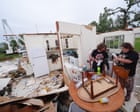
The central United States is currently enduring a relentless atmospheric siege that has transitioned from a standard spring storm season into a multibillion-dollar catastrophe. While social media feeds are saturated with shaky footage of funnel clouds, the real story lies in the sheer physics of "giant" hail and the unsettling return of high-intensity EF4 tornadoes to populated corridors. This is not just a run of bad luck; it is a manifestation of a highly primed "hail machine" fueled by a volatile mix of Gulf moisture and steep lapse rates that are rewriting the insurance books for 2026.
As of May 1, 2026, the preliminary damage estimates for the late April outbreaks alone are climbing toward the $10 billion mark. The headline-grabber was the EF4 monster that tore through Enid, Oklahoma, on April 25, packing winds that leveled reinforced structures and scarred Vance Air Force Base. But while tornadoes claim the headlines, the "giant" hail—defined as stones exceeding 2 inches in diameter—is causing a more pervasive, slow-motion economic collapse across the Midwest and Southern Plains.
The Physics of the Hail Machine
To understand why 2026 has been so violent, you have to look at the updraft. A standard thunderstorm might have an updraft of 40 mph. The supercells we saw over Illinois and Wisconsin in mid-April, however, featured "mesocyclones" with vertical velocities exceeding 100 mph.
When an updraft is that powerful, it acts as a suspension chamber. Raindrops are lofted into the sub-freezing layers of the atmosphere, where they encounter supercooled water. These droplets don't just freeze; they coat the ice nucleus in layers, much like an onion. In a weaker storm, the stone falls once it hits the size of a marble. In the 2026 "hail machine" environment, these stones stayed suspended for tens of minutes, growing into 3-inch and 4-inch jagged ice boulders before gravity finally won the tug-of-war.
The result is a kinetic bombardment. A 3-inch hailstone falls at roughly 80 mph. When that hits a residential roof or a field of budding corn, it isn't just "weather"—it’s a terminal ballistics event.
Why Oklahoma and Texas Are Losing the Shield
For decades, the "Tornado Alley" narrative focused on rural plywood houses being swept away. The 2026 reality is different. We are seeing these high-intensity events shift or expand into more densely populated zones.
The Enid EF4 was a sobering reminder that our engineering limits are being tested. When a tornado reaches that intensity, the pressure differential alone can cause structures to fail before the debris even hits. Investigative looks at the damage in Wise County, Texas, and Rochester, Minnesota, show a recurring theme: building codes are designed for "average" severe weather, not the 140+ mph sustained vortices that defined the April 17 and April 25 outbreaks.
- The Enid Event: An EF4 with 170+ mph winds that fundamentally altered the landscape of a major regional hub.
- The Wisconsin Surge: An unexpected EF3 in Ringle, Wisconsin, proving that the "traditional" boundaries of Tornado Alley are increasingly irrelevant in a warming atmosphere.
- The California Anomaly: Four tornadoes in the Central Valley on April 21, a "black swan" event that suggests the entire US moisture conveyor belt is out of alignment.
The Invisible Crisis of Insurability
While the National Weather Service tracks the rotation, the insurance industry is tracking the "total loss." We are approaching a tipping point where the "Single-Digit Billion" loss events are becoming monthly occurrences rather than annual outliers.
The economic fallout is not just about rebuilding; it’s about the cost of risk. In states like Oklahoma and Kansas, the surge in giant hail events is making private homeowners insurance a luxury. When a single storm cell can drop 3-inch ice across a 100-mile "hail swath," as seen in the April 17 outbreak from Iowa into Illinois, the actuarial tables are rendered useless.
We are witnessing a shift where "Total Cost of Ownership" for a home in the Central US must now include the high probability of a total roof and vehicle replacement every five to seven years. That is an unsustainable model for the middle class.
The Overlooked Factor of Low-Level Shear
Meteorologists are pointing to an unusually strong Low-Level Jet (LLJ) this season. This stream of fast-moving air, just a few thousand feet above the ground, provides the "spin" necessary to turn a garden-variety thunderstorm into a rotating supercell.
In the April 27 "Wake Low" event across the Midwest, this shear was so intense that it caused widespread 70 mph wind damage even in areas that didn't see a drop of rain. This "dry" severe weather is often more dangerous because the public doesn't perceive the threat in the absence of a dark, looming cloud. It is a invisible predator that downs power lines and uproots trees, further straining an already taxed emergency response infrastructure.
Hard Truths for the Heartland
The 2026 season has stripped away the illusion that we can simply "weather the storm." The sheer scale of the April outbreaks—85 confirmed tornadoes in just 48 hours during the mid-month peak—suggests a higher frequency of "cluster" events.
These clusters prevent recovery. Before a town can clear the debris from an EF2, another cell with 3-inch hail moves in, ruining the temporary tarps and exposing the interior of homes to further water damage. It is a compounding disaster.
We must stop treating these as isolated "acts of God" and start treating them as a structural challenge to American infrastructure. If the "hail machine" continues to operate at this capacity, the very map of where it is "safe" and "affordable" to live in the United States will have to be redrawn. The wind and ice don't care about your zip code; they only care about the energy in the air, and right now, the atmosphere has more energy than it knows what to do with.
The immediate action step for those in the path is a move toward "hardened" structures—impact-rated roofing and reinforced safe rooms. The days of relying on a basement and a prayer are being buried under 4 inches of ice and the wreckage of EF4 winds.


