Silence.
That is the first thing you notice when you spend enough time analyzing satellite telemetry of the Iranian desert—not the roar of jet engines, not the static of encrypted radio chatter, just the vast, blinding stillness of white dust and jagged limestone stretching toward the Zagros Mountains. I have spent the better part of fifteen years staring at high-resolution imagery of hardened military sites across the Middle East, watching earthmovers crawl like yellow beetles across dry riverbeds, and I can tell you that nothing unnerves a military planner quite like a hole that refuses to stop going down.
For two decades, the world’s intelligence agencies played a predictable game of cat and mouse with Tehran’s nuclear program. Iran would build a facility, bury it under reinforced concrete, and Western or Israeli analysts would immediately begin calculating the exact tonnage of high explosives required to crack it open. It was a grim, mathematical certainty. Every bunker had a ceiling, and every ceiling had a price.
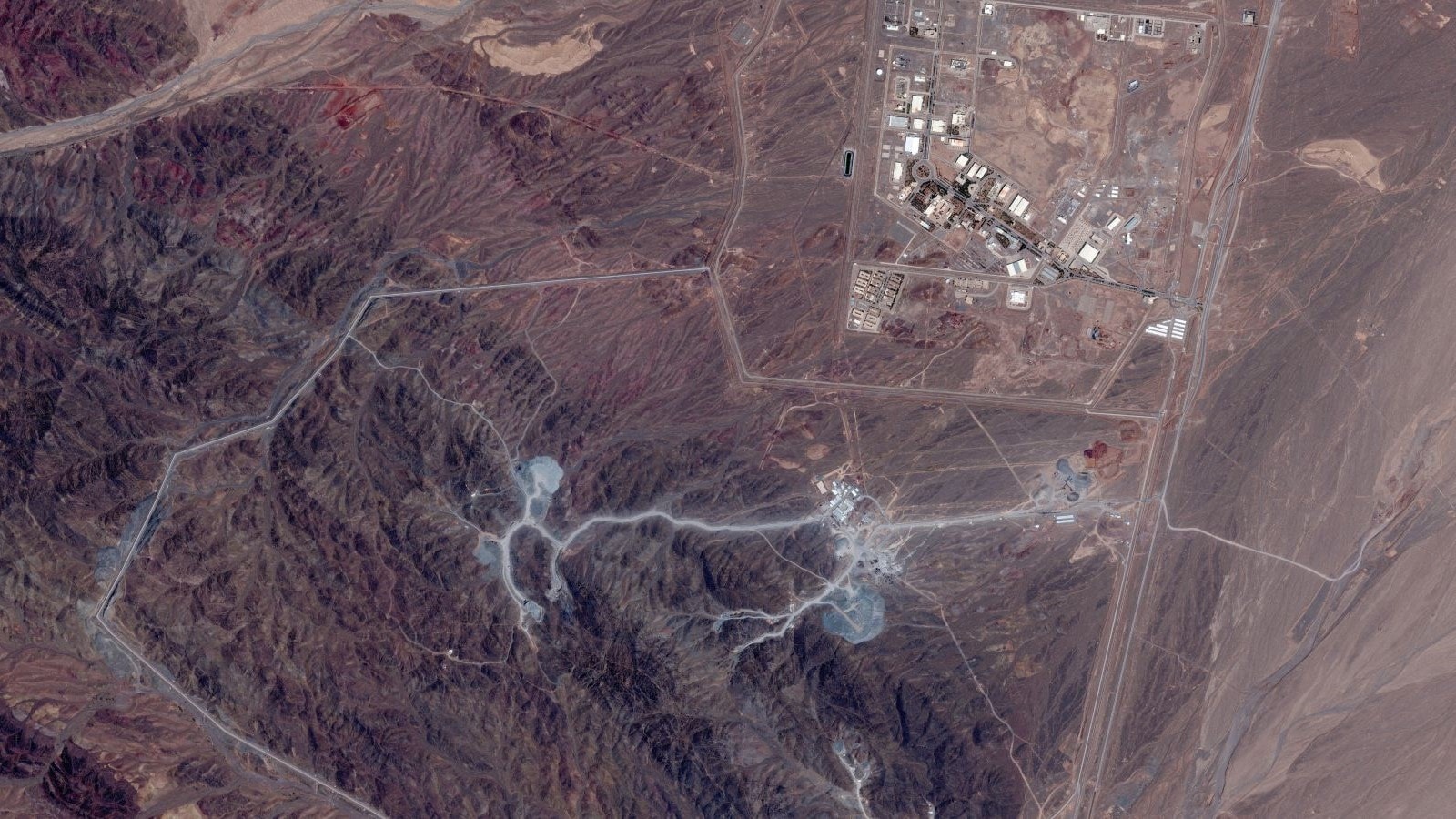
Then came Kūh-e Kolang Gaz Lā. Western intelligence analysts call it Pickaxe Mountain.
Situated just south of the sprawling Natanz nuclear complex in central Iran, this jagged, twin-peaked ridge has quietly rewritten the rules of modern warfare, rendering the most sophisticated conventional arsenals on earth nearly obsolete before a single plane even leaves the runway.
The Architecture of Impunity
To understand why Pickaxe Mountain keeps generals awake in Washington and Tel Aviv, you have to stop thinking about buildings and start thinking about geology.
Consider a hypothetical scenario inside a reinforced concrete command room at the Pentagon, three miles beneath the surface of normal political chatter. Picture an Air Force targeteer—let’s call her Major Miller—staring at a three-dimensional topographic render of Natanz. In 2020 and 2021, sabotage ripped through Natanz’s above-ground and shallow-buried centrifuge halls. Explosions sheared through power grids and shattered delicate spinning machines. Iran learned a brutal lesson from those attacks: concrete is an invitation, not a shield.
So, Tehran moved south, right into the base of Pickaxe Mountain.
Satellite imagery captured between 2020 and 2024 revealed four massive tunnel entrances bored directly into the eastern and western flanks of the mountain. By measuring the colossal spoil piles—the mountains of crushed rock hauled out by dump trucks and dumped across the desert floor—commercial imagery analysts and nuclear experts at the James Martin Center for Nonproliferation Studies calculated something staggering. The main halls beneath Pickaxe Mountain are buried between 80 and 100 meters (roughly 260 to 330 feet) below the surface.
To put that number into visceral terms, imagine standing at the base of the Statue of Liberty, looking all the way up to the tip of her torch, and then burying that entire monument beneath solid, unbroken granite.
That is deeper than Fordow, Iran’s notoriously fortified uranium enrichment site dug into a mountain near Qom, which sits roughly 80 to 90 meters down. And unlike Fordow, which was built into a relatively narrow ridge with limited internal square footage, the subterranean footprint beneath Pickaxe Mountain appears massive—wide enough to house thousands of advanced IR-6 centrifuges, assembly lines, and hardened command centers.
The Physics of a Broken Sword
Why can’t the United States or Israel simply bomb it?
The answer lies in the unforgiving laws of physics and the limits of metallurgy. When a fighter jet drops a bomb, gravity and rocket boosters can only push steel so fast before the casing itself vaporizes on impact.
Take the crown jewel of the American conventional bunker-busting arsenal: the GBU-57A/B Massive Ordnance Penetrator, or MOP. It is a thirty-thousand-pound monster, twenty feet long, packed with over five thousand pounds of high explosives inside a specialized, ultra-hardened steel alloy shell. Only one aircraft in the world is large enough to carry it—the B-2 Spirit stealth bomber (and soon, its successor, the B-21 Raider).
Under ideal conditions, the Massive Ordnance Penetrator can punch through roughly 60 meters (about 200 feet) of standard reinforced concrete before detonating. Against solid, dense mountain rock, that penetration depth drops sharply. Even if a B-2 bomber drops one MOP directly onto the summit of Pickaxe Mountain, and then drops a second, a third, and a fourth into the exact same crater—a tactic known as "weaponeering" or sequential burrowing—the physics begin to turn against the attacker.
Think of it like trying to hammer a steel nail into a block of solid oak using a wooden mallet. On the first strike, the nail goes in an inch. On the second, half an inch. By the third strike, the oak fibers have compressed so tightly around the shaft, and the heat of friction has warped the metal so badly, that the nail simply stops moving. Every subsequent blow just shatters the mallet.
Inside the granite core of Pickaxe Mountain, pulverized rock turns into a dense, shock-absorbing cushion. Worse still, Iranian engineers haven't just relied on raw rock; they have lined the interior caverns with ultra-high-performance concrete, blast doors set at ninety-degree angles to deflect pressure waves, and shock-mounted floors designed to absorb seismic jolts without knocking delicate centrifuges off their magnetic bearings.
For Israel, the military math is even harsher. Israel does not possess the B-2 stealth bomber, nor does it own the thirty-thousand-pound MOP. Its heaviest bunker busters, such as the American-made GBU-28 or domestic equivalents, weigh around five thousand pounds—designed to crack shallow command bunkers, not hundreds of feet of solid mountain. To destroy Pickaxe Mountain from the air without direct American intervention, Israeli pilots would have to fly over a thousand miles, refuel mid-air through contested airspace, and execute dozens of suicidal, low-altitude runs against the tunnel entrances, hoping merely to collapse the doorways rather than destroy the rooms inside.
The Blind Spot of International Oversight
Yet the physical depth of Pickaxe Mountain is only half the story. The invisible danger—the part that turns a military headache into a geopolitical nightmare—is what happens when a facility disappears from the world’s eyes.
For decades, the fragile peace surrounding Iran’s nuclear ambitions rested on a single, unglamorous pillar: verification. Inspectors from the International Atomic Energy Agency (IAEA) walked the floors of Natanz, bolted tamper-evident seals onto enrichment cascades, and installed continuous surveillance cameras. Even when diplomatic talks soured, the world could see what Iran was doing.
Pickaxe Mountain sits outside that window.
Because the facility is officially classified by Tehran as a centrifuge assembly plant rather than an active enrichment site, Iran has flatly refused to grant IAEA inspectors access to the tunnels, citing security concerns following the 2021 sabotage at Natanz. In 2023, IAEA Director General Rafael Grossi publicly acknowledged that the agency had no visibility into what was happening beneath the mountain, warning that the world was flying blind into a critical blind spot.
Consider what happens next when a state possesses an unbombable, unmonitored cavern.
You no longer need a sprawling industrial complex to build a nuclear weapon. With modern, high-efficiency centrifuges—machines that spin at supersonic speeds and take up a fraction of the space of older models—a small cascade hidden inside a mountain hall can enrich enough weapons-grade uranium for a bomb in a matter of weeks. If Tehran ever decides to make a "dash" for a nuclear weapon, they wouldn't do it at Natanz, where satellites watch every truck and inspectors check every seal. They would load cylinders of enriched gas onto flatbeds, drive them ten minutes south through the desert dust, and disappear behind the steel blast doors of Pickaxe Mountain.
By the time intelligence agencies realized the doors had closed, the breakout would already be over.
The Human Element in the Dark
It is easy to talk about centrifuges, blast radii, and enrichment percentages as if they were moves on a sterile chessboard. They aren't. They are the direct result of human fear, stubbornness, and survival instinct colliding in the dark.
Imagine a young Iranian structural engineer—let’s call him Reza—who spent three years working twelve-hour shifts inside the dust-choked tunnels of Pickaxe Mountain. To Western analysts, Reza is a cog in a proliferation machine. To himself, he is a man who watched Israeli and American intelligence assassinate his country’s top scientists on the streets of Tehran, who saw his colleagues killed in explosions at Natanz, and who believes with every fiber of his being that digging deeper into the earth is the only way his nation will ever be safe from regime change.
Now flip the lens. Picture an Israeli intelligence officer in Tel Aviv—let’s call her Maya—who grew up hearing the vows of Iranian leaders to wipe her country off the map. Every morning, Maya reviews high-resolution radar passes over Pickaxe Mountain, measuring the tiny thermal signatures coming from the ventilation shafts. For her, those vents aren't engineering marvels; they are a ticking clock. Every ton of rock Iran leaves untouched above those caverns shrinks the window of time her country has to prevent an existential threat.
Both Reza and Maya are trapped by the exact same piece of geography. The deeper Reza digs, the more desperate Maya’s superiors become to strike before the vault is sealed forever. And the louder Maya’s superiors threaten military action, the faster Reza’s crews pour concrete.
When Airpower Hits a Wall
History has a way of humbling generals who believe that superior technology guarantees victory.
During the Vietnam War, American bombers dropped millions of tons of explosives on the Ho Chi Minh Trail, convinced that enough firepower could sever a supply line carved through jungle and limestone. It didn't. During the Cold War, the United States itself built the Cheyenne Mountain Complex beneath two thousand feet of Colorado granite for the exact same reason Iran built Pickaxe Mountain: because when the sky becomes lethal, survival belongs to whoever owns the earth.
Today, military planners in Washington and Tel Aviv are forced to confront an uncomfortable truth: airpower has hit a geological wall.
If conventional bombs cannot collapse the roof of Pickaxe Mountain, the remaining options on the table carry terrifying price tags. One option is sealing the four tunnel entrances with repeated airstrikes—burying the facility alive. Yet history shows that collapsed tunnels can be dug out in months with heavy excavators, turning a multi-billion-dollar military operation into a temporary construction delay.
Another option is a covert ground raid—sending elite special forces deep into hostile territory, fighting through heavily armed perimeter guards, breaching hardened blast doors, and manually planting demolition charges inside the centrifuge halls. It is the stuff of Hollywood thrillers, and in reality, a logistical gamble where a single mechanical failure or blown cover means dozens of soldiers trapped hundreds of miles behind enemy lines.
The final option is cyber sabotage—slipping digital poison into the industrial control systems that regulate the centrifuges' spin speeds, repeating the Stuxnet worm that crippled Natanz in 2010. Yet Iran has spent fifteen years air-gapping its critical networks from the open internet, building domestic operating systems, and hardening its digital walls just as thoroughly as its stone ones.
The Dust Over Natanz
I often think back to the first satellite images I ever saw of Pickaxe Mountain, back in late 2020. Back then, it was barely a smudge—a faint gray scratch at the base of a brown hill, indistinguishable from a dozen small mining operations scattered across the Iranian plateau.
Over the years, I watched that scratch widen into a scar, and that scar deepen into a fortress. Every few months, the satellite would pass overhead, snapping another frame in the harsh afternoon light. The spoil piles grew taller. The access roads were paved. Perimeter fences ringed the ridge, punctuated by anti-aircraft batteries and radar domes pointing steadily at the sky.
The sky is where the United States and Israel hold absolute, unchallenged dominance. In the air, their jets are invisible, their sensors can read a license plate from fifty thousand feet, and their missiles can fly through a specific window from a hundred miles away.
But beneath Pickaxe Mountain, none of that matters. Under three hundred feet of silent, indifferent stone, the laws of modern warfare simply cease to function, leaving the world’s most powerful militaries staring at a solid mountain wall, waiting for a door to open that may never be unlocked from the outside.


