The dust in Beijing does not settle; it hangs. On a stifling afternoon, if you stand outside the towering, meridian-red walls of the world’s largest palatial complex, the air feels heavy with the weight of twenty-four ghosts.
Most travel guides treat the Forbidden City as an architectural checklist. They tell you it spans 180 acres. They tell you it contains roughly 9,000 rooms. They marvel at the symmetry, the preservation of the Ming and Qing dynasty timber, and the sheer scale of a fortress that anchored the Middle Kingdom for half a millennium.
But scale is an anesthesia. It numbs the human reality of what happened inside.
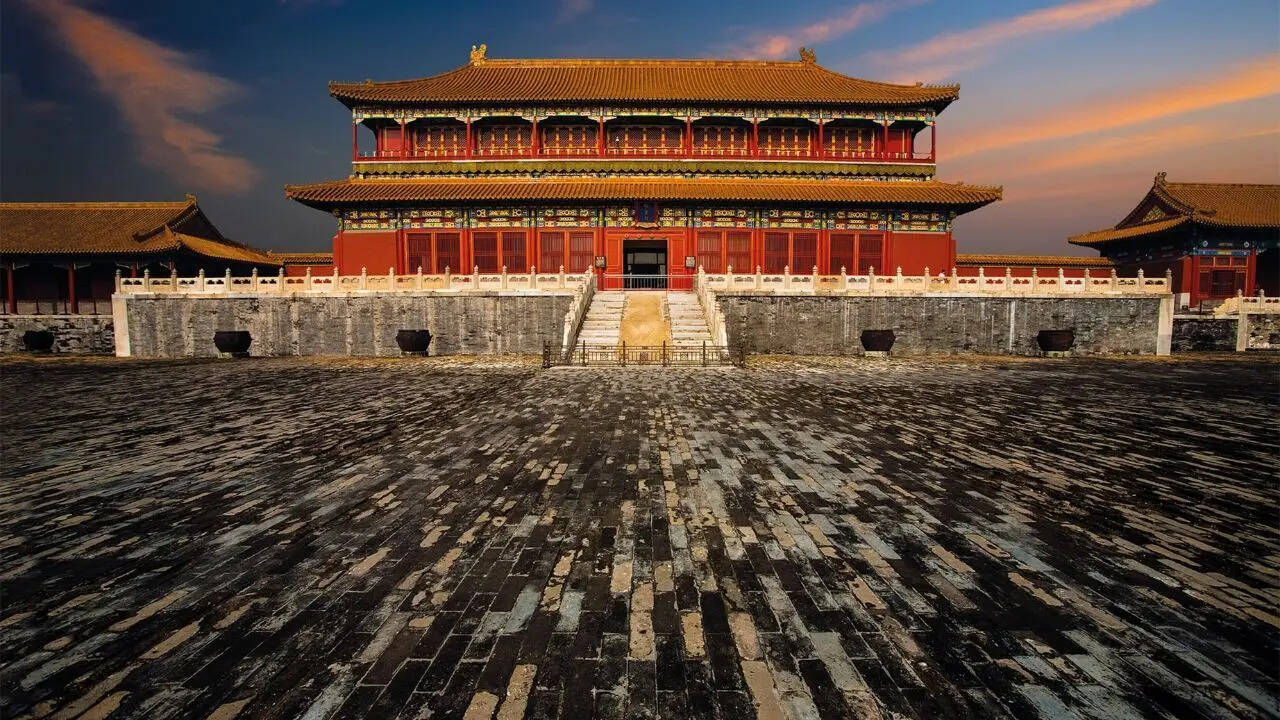
To understand the Forbidden City, you have to stop looking at the rooftops and start looking at the flagstones. Walk into the outer courtyards. Notice how the stone beneath your boots is uneven, deeply grooved, and oddly sterile. There are no trees here. No gardens in the grand plazas. For centuries, the emperors demanded absolute visibility. A tree was a hiding place for an assassin. The vast, empty expanses were designed to make an individual feel microscopic, entirely swallowed by the state.
This was not a palace. It was a beautifully gilded machine designed to manufacture absolute obedience, and its first casualty was always the human spirit.
The Architect Who Never Saw His Masterpiece
To build a prison that could contain the psyche of an entire nation, you first had to break the men who built it.
Consider Nguyen An. He was a young man from Vietnam, taken as a eunuch tribute during the Ming dynasty’s expansionist wars. In the early 1400s, the Yongle Emperor decided to move the capital from Nanjing to Beijing, demanding a cosmic center that would legitimize his bloody usurpation of the throne. He chose Nguyen An to oversee the design.
An possessed a genius for geometry and hydraulics, but his reality was brutal. He was a foreigner, castrated, enslaved, and tasked with fulfilling the megalomaniacal vision of a tyrant. If a single column cracked, if the alignment of the Hall of Supreme Harmony deviated by an inch from the true north-south axis of the world, his life was forfeit.
For over a decade, hundreds of thousands of workers dragged massive logs of nanmu wood from the southwestern jungles, thousands of miles away. They quarried giant blocks of marble, moving them in the dead of winter by digging wells every quarter-mile, pouring water on the roads to create artificial ice sheets, and sliding the stones into the city.
When the project was completed in 1420, Nguyen An did not receive a monument. He remained a shadow in the halls he created. The emperor sat on the Dragon Throne, a solitary figure trapped at the center of a cosmic maze, while the man who drafted the walls walked back to his quarters in the dark. The system swallowed the creator whole.
The Anatomy of the Great Disconnect
The Forbidden City was split by an invisible, lethal line.
The Outer Court was the stage of politics. Here, the emperor was a god. He sat facing south, bathed in light, while thousands of officials knelt on the freezing stones, their foreheads pressed against the floor. The architecture worked as a megaphone for power; the massive courtyards amplified the heralds' voices, making the emperor's decrees sound like thunder from the heavens.
But step past the Gate of Heavenly Purity into the Inner Court, and the atmosphere shifts from terrifying to suffocating.
This was the domestic quarters, where the emperor lived with his empress, his concubines, and an army of eunuchs. It was a labyrinth of narrow alleys, high walls, and small, interconnected courtyards. If the Outer Court was built for a god, the Inner Court was built for a prisoner.
Imagine being a young woman selected as a low-ranking concubine. You entered through the northern gate, and the heavy timber doors slammed shut behind you. You would likely never see your family again. Your entire existence was reduced to a desperate, hyper-politicized game of survival.
Every word was monitored. Every glance was analyzed by rival factions. To bear a son was to secure survival; to fail was to fade into obscurity in the cold corners of the Western Palaces, forgotten by history. The luxury was immense—silks from Suzhou, jade from Xinjiang—but the walls were fifteen feet high and packed with earth to deaden sound. No one could hear you scream.
The Cost of the Invisible Wall
The true tragedy of this hidden empire was not the cruelty inside, but the profound ignorance it generated outside.
By the time the Qing dynasty reached its twilight in the 19th century, the Forbidden City had become an echo chamber. The rulers had spent centuries cut off from the mud, the sweat, and the realities of the common people. They believed their own mythology. They truly believed that the world ended at the moat, and that everything beyond was a landscape of barbarians.
When foreign emissaries arrived with steam engine models, repeating rifles, and modern globes, the imperial court looked at them as cheap toys. The bureaucracy was too bloated, too choked by ritual, to adapt. An emperor could not simply change a law; he had to consult centuries of precedents, appease a court of conservative eunuchs, and perform hours of daily rituals to keep the universe in balance.
While the industrial revolution reshaped the globe, the last emperors of China were learning how to walk in shoes with three-inch platforms and writing poetry about the winter snow on the palace eaves.
The disconnect was fatal. When the Western powers and Japan finally breached the gates during the Opium Wars and subsequent conflicts, the palace could not defend itself. The sacred halls were looted, the ancient bronzes scraped of their gold leaf by bayonets, and the divine rulers forced to flee in the night, disguised as peasants.
Walking the Axis of Ghostly Silence
Today, if you visit late in the afternoon as the crowds begin to thin toward the exit, the true nature of the space reveals itself.
The red paint on the pillars is thick, layered over centuries of maintenance. But if you get close enough, you can see the grain of the wood underneath, still breathing, still straining under the weight of the massive yellow-tiled roofs.
The tourists carry smartphones and selfie sticks, their laughter echoing off the same stones where officials once trembled for their lives. It is easy to view it all as an exotic theme park, a relic of a time so distant it feels like fiction.
But the architecture tells a different story. It reminds us of what happens when power isolates itself completely, when leaders build walls so thick that they can no longer hear the whispers of the street.
The sun drops behind the western hills, casting long, bloody shadows across the Meridian Gate. The guards begin to clear the courtyards, their voices echoing in the vast emptiness. You walk out through the massive northern exit, crossing the moat where the water is dark and still.
You take a deep breath of the polluted, vibrant, chaotic Beijing air outside. For the first time in hours, you can see trees. You can hear traffic. You see people arguing over fruit prices and children running after dogs.
You look back at the high, silent walls of the fortress. The gold roofs are still catching the last rays of light, glowing like embers. It is magnificent. It is breathtaking. And you are deeply, profoundly glad to be on the outside.