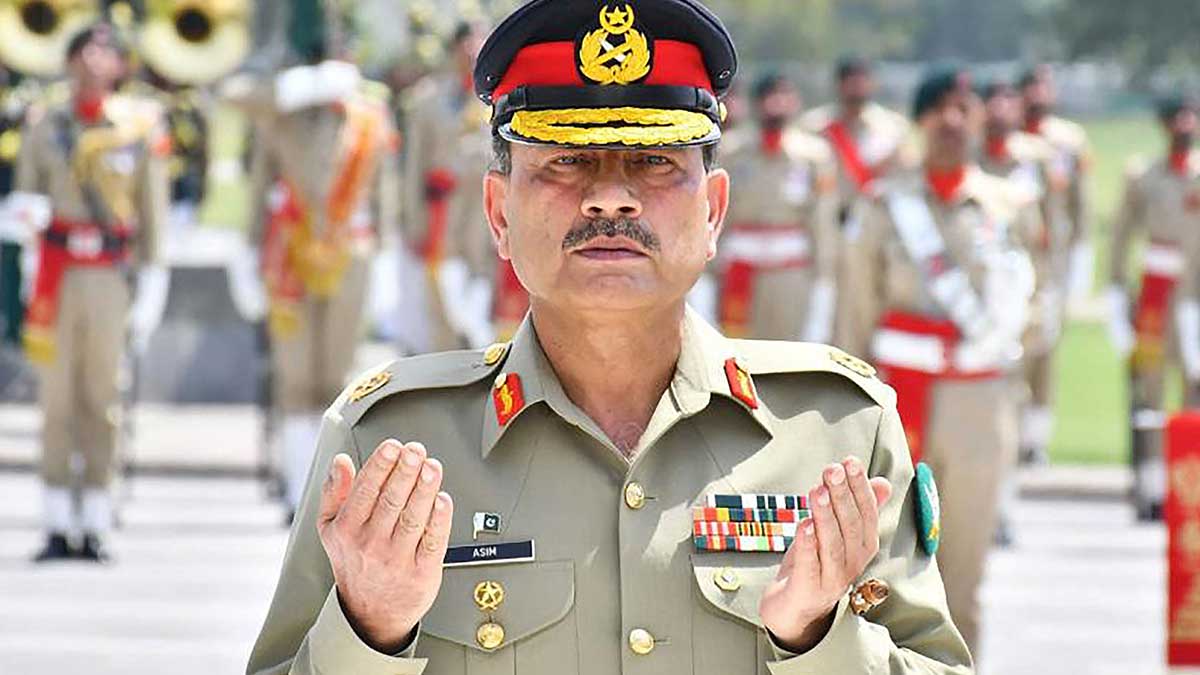
The comfortable consensus among regional analysts is that General Asim Munir is playing a weak hand with loud rhetoric. Mainstream commentary insists that Washington and Beijing hold a permanent veto over Pakistan’s nuclear posture. The prevailing narrative argues that economic dependency—manifested through IMF bailouts and Chinese debt—renders Islamabad’s strategic deterrence a paper tiger.
This view is dangerously naive. It misjudges the mechanics of modern geopolitical blackmail. You might also find this related article insightful: Why the US and Iran Are Letting Pakistan Hold the Mirror.
The idea that external superpowers can simply turn off Pakistan’s strategic leverage ignores thirty years of non-proliferation failures. Islamabad does not possess nuclear weapons despite its economic vulnerabilities; it possesses them because of them. General Munir understands what Western think tanks refuse to admit: a collapsing state with an expanding arsenal yields more diplomatic leverage than a stable, predictable partner ever could.
The Illusion of the Financial Veto
Conventional wisdom says money buys obedience. The argument goes that because Pakistan relies on Western-backed financial institutions and Chinese infrastructure capital, its military leadership must ultimately bow to foreign dictates regarding its strategic assets. As highlighted in recent coverage by Associated Press, the implications are notable.
This assumes leverage works in only one direction.
When a nation owes billions to global creditors and holds the keys to the world’s fastest-growing nuclear stockpile, the creditor carries the risk. The international community does not bail out Islamabad to reward its economic policies; it funds the state to keep the security apparatus intact. The nuclear program is not a luxury funded by a dysfunctional economy; it is the insurance policy that guarantees the economy is never allowed to fully collapse.
- The Debt-Security Paradox: Financial vulnerability increases, rather than decreases, the utility of strategic posturing. If Pakistan were economically stable like India, its nuclear arsenal would be viewed through a standard deterrence framework. Because it is teetering on the edge, the arsenal becomes an existential warning system for global markets and regional stability.
- The Beijing Dilemma: China’s multi-billion-dollar investments in the China-Pakistan Economic Corridor (CPEC) are often cited as a leash. In reality, these investments are hostages to fortune. Beijing cannot afford a chaotic, fractured neighbor on its western border. Munir knows that China’s deep pockets ensure a baseline of support, regardless of how aggressively Islamabad signals its strategic readiness.
Tactical Nuclear Weapons and the Breakdown of Control
The lazy critique of Pakistan’s current posture labels it as vanity-driven grandstanding. This completely misses the structural shift in regional military doctrine, specifically the development of low-yield, tactical nuclear weapons like the Nasr missile system.
This is not about ego. It is about a calculated response to India’s Cold Start doctrine.
Conventional Threat (India's Cold Start)
       └──> Tactical Nuclear Development (Nasr System)
               └──> Lowering the Nuclear Threshold
                       └──> Neutralizing Conventional Superiority
By introducing battlefield nuclear weapons, Pakistan deliberately decentralized its command-and-control structure. This was a brilliant, if terrifying, strategic move. It undercuts the exact argument that Washington or Beijing can intervene during a crisis to freeze the escalation ladder.
When authority over low-yield weapons is delegated to field commanders to ensure a credible response to a rapid conventional incursion, foreign capitals lose their leverage points. You cannot negotiate a de-escalation with a central command structure if that structure has intentionally given up absolute control to ensure deterrence validity. The United States discovered this limitation during the 2019 Balakot crisis, where external diplomatic pressure was lagging far behind the speed of operational deployments on the ground.
Dismantling the People Also Ask Fallacies
Public discourse around South Asian security is clogged with fundamentally flawed assumptions. Let us dismantle the most prominent ones.
Can the US Seize or Secure Pakistan's Nuclear Assets?
This is a favorite scenario of Washington policymakers and fiction writers. The short answer is no.
The Pentagon has spent decades studying contingency plans for securing loose nukes in unstable environments. I have spoken with strategic planners who admit the logistics are an absolute nightmare. Pakistan's strategic assets are highly mobile, deeply buried, and heavily defended by the Strategic Plans Division (SPD).
Any unilateral attempt by an external power to secure these weapons would immediately trigger the very conflict it seeks to avoid. The assets are not sitting in a centralized warehouse waiting for a special forces operation. They are integrated into the state’s survival mechanism.
Will China Intervene to Disarm Islamabad If Rhetoric Escalates?
Beijing is a status quo power that detests unpredictability, but it detests a dominant, unaligned India even more.
China views Pakistan as a low-cost balancer against New Delhi's regional ambitions. Disarming or severely weakening Islamabad’s strategic capabilities would force China to commit significantly more conventional military resources to its southwestern front. Beijing will issue stern, behind-the-scenes warnings about rhetoric, but it will never actively dismantle the one mechanism that keeps India perpetually distracted on two fronts.
| Strategic Variable | Mainstream Assumption | Operational Reality |
|---|---|---|
| Economic Aid | Used as a lever to force non-proliferation compliance. | Used as emergency life support to prevent state collapse and asset insecurity. |
| Command & Control | Centrally managed and susceptible to superpower pressure. | Intentionally decentralized via tactical systems to resist external vetoes. |
| Sino-Pak Alliance | China controls Islamabad's strategic choices. | Pakistan utilizes China's regional anxieties to maintain its autonomy. |
The Flaw in the Contrarian Approach
To be absolutely fair, this strategy of leveraging instability carries an immense internal cost. It requires a permanent state of domestic austerity to fund the security apparatus while the civilian infrastructure decays.
The risk is not that Washington or Beijing will step in and stop Munir. The risk is that the internal mechanics of the Pakistani state become so brittle that the military command loses its grip on the domestic population. Strategic deterrence works against foreign adversaries; it does nothing to resolve a collapsing balance of payments, systemic inflation, or internal political alienation.
But from the perspective of raw power dynamics, Munir’s calculation remains sound. The international community is trapped in a cycle of its own making. It cannot punish Pakistan’s strategic assertiveness without risking the stability of the state, and it cannot allow the state to fail without risking the security of the arsenal.
Stop looking for a secret agreement between the US and China to defuse this dynamic. They lack the leverage, they lack the willpower, and they are both fundamentally constrained by the reality that Islamabad has successfully weaponized its own fragility.