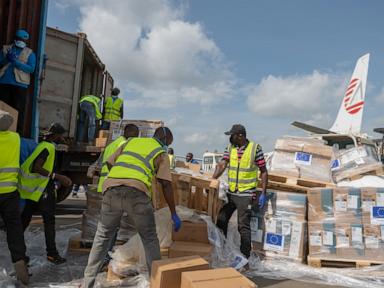
Sending a cargo plane full of masks and boots into a war zone doesn't stop a virus. It just means the people dying now have boxes sitting on a runway.
On Thursday, a European Union aid flight landed in Bunia, a northeastern town in the Democratic Republic of Congo. The plane brought in gloves, medication, and protective gear. On paper, it looks like a win. In reality, it highlights a massive, ongoing failure in how the international community handles severe health emergencies.
This isn't a standard outbreak. We are looking at the Bundibugyo strain of Ebola. This specific version of the virus has no approved vaccine. It has no approved treatment. You can't just deploy the highly effective Ervebo vaccine used in past outbreaks. Frontline workers are fighting a deadly hemorrhagic fever with nothing but basic supportive care and sheer willpower.
To make matters worse, World Health Organization Director-General Tedros Adhanom Ghebreyesus just arrived in Kinshasa. He plans to head directly to the epicenter in Ituri province. It's a high-profile move, but it shows just how desperate the situation has become. The response is weeks, maybe months, behind the curve.
The Broken Logistics of a Hot Zone
Humanitarian agencies love to talk about supply lines. They don't talk enough about the bureaucratic nightmare that kills people before the supplies even arrive.
Congo's health ministry has struggled with customs delays and logistical bottlenecks. Right now, flight restrictions in and out of Bunia are crippling the operations of humanitarian groups on the ground. The ministry of transport reportedly promised ad hoc exemptions for aid workers, but those exemptions are sitting on desks, unprocessed.
Then there's the geography. Eastern Congo is a landscape of terrible roads and spotty telecommunications. You can't coordinate contact tracing when your teams don't have cell service. You can't transport sick patients when roads turn into mud pits.
Look at the raw data from the latest health ministry situation reports. We have already surpassed 1,000 suspected cases and more than 230 deaths. Experts on the ground will tell you flat out that these numbers are a massive undercount. Because of the insecurity, dozens of communities are completely cut off from surveillance teams. People are dying in their homes, completely unrecorded.
War and Disease Make a Fatal Mix
You can't isolate patients while bombs are falling. Tedros explicitly called for an immediate ceasefire among the armed groups operating in Ituri and the Kivus, but don't hold your breath.
Eastern Congo is home to over 100 active rebel groups, including the Rwanda-backed M23 rebels. The ongoing conflict has displaced roughly 7 million people. When millions of people live in overcrowded, unsanitary displacement camps, an Ebola outbreak transforms from a localized crisis into a ticking bomb.
Worse, the presence of these armed groups creates a climate of absolute terror. Health workers aren't just dodging a virus; they're dodging bullets. Doctors in remote clinics are wearing expired medical masks because the safe gear can't reach them through the rebel blockades.
The Trust Gap That Kills
If you think the biggest obstacle is a lack of medicine, you're missing the point entirely. The real battle is trust.
At least three health centers in Ituri province have been attacked by local residents recently. Why? Because international health protocols clash violently with deeply ingrained local burial traditions. When a loved one dies of Ebola, their body is highly infectious. Safe burial teams come in wearing terrifying yellow hazmat suits, take the body away, and bury it in a plastic bag. To the local community, this looks like desecration, not healthcare.
Congolese Health Minister Samuel Roger Kamba noted that remote communities quickly feel overwhelmed by the sudden influx of outsiders and aggressive medical information. When people get scared, they resist. They hide their sick relatives. They avoid the treatment centers. That resistance drives the virus deeper underground, making it impossible to map the chains of transmission.
Panic at the Borders
While the WHO tries to scale up testing alongside local Congolese research organizations, western nations are panicking. The United States has already slapped travel restrictions on anyone who has visited Congo, Uganda, or South Sudan in the previous 21 days.
This is a terrible strategy. Tedros openly criticized these travel bans upon his arrival in Kinshasa, and he's completely right. Travel bans don't stop viruses; they just delay them by a few days while destroying the local economy.
More importantly, punitive travel bans create a toxic incentive structure. When a country gets penalized for being transparent about a health crisis, future governments will think twice before reporting the next outbreak. We need cooperation, not isolation.
What Needs to Happen Right Now
Dropping off aid packages in Bunia is a drop in the bucket. If the international community actually wants to contain the Bundibugyo strain before it spills across borders into Uganda or South Sudan, the playbook has to change today.
- Force the logistics open. The Congolese government must immediately lift all domestic flight restrictions for humanitarian personnel and clear the customs backlog for diagnostic equipment.
- Shift the messaging. Stop sending teams to lecture communities. Hire local leaders, elders, and religious figures to run the risk communication. If the community doesn't own the response, the response fails.
- Fund localized research. Since there's no vaccine for this strain, real-time clinical trials for therapeutics must be fast-tracked on the ground in partnership with Congo's national medical research organization.
The global health apparatus knows how to print press releases. It knows how to send high-ranking officials on solidarity visits. But until it solves the basic issues of local trust, bureaucratic red tape, and physical security, the virus will keep winning.
/i.s3.glbimg.com/v1/AUTH_5dfbcf92c1a84b20a5da5024d398ff2f/internal_photos/bs/2022/7/q/6M5eaAQBGuPVBPz0xKuQ/whatsapp-image-2022-12-24-at-17.52.03.jpeg)