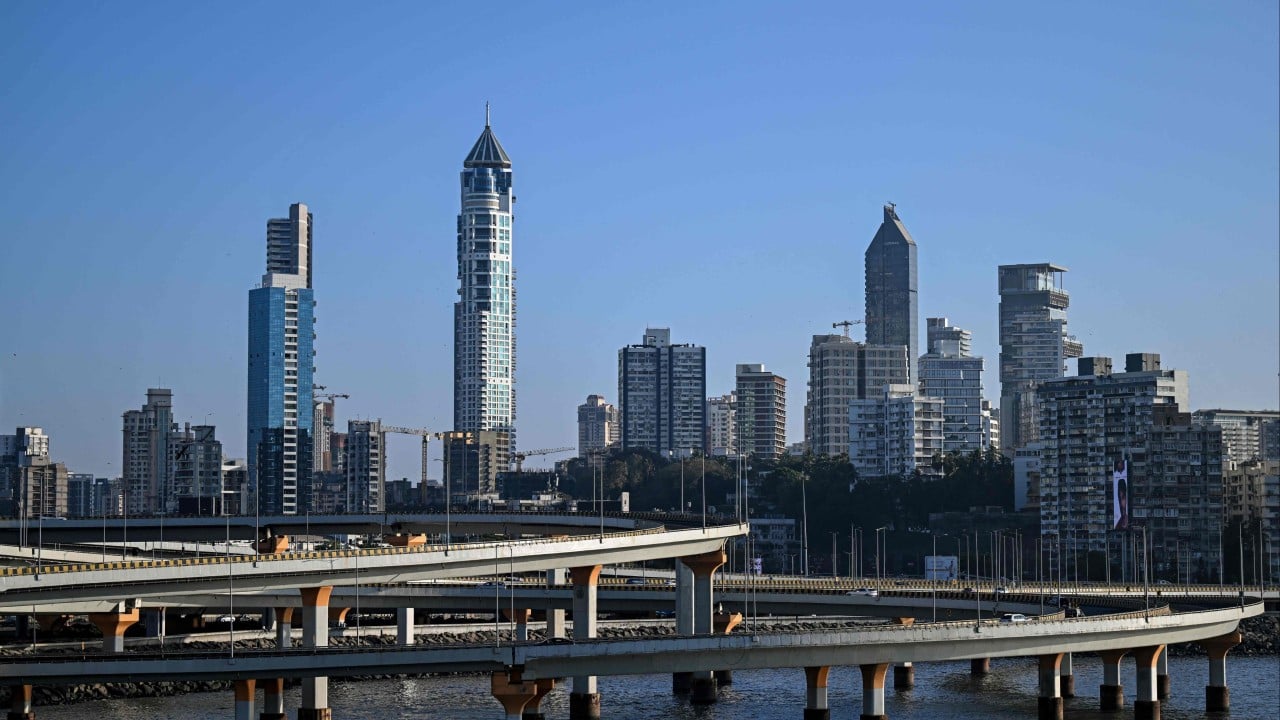
The air in the boardroom on the 42nd floor of a Mumbai skyscraper is thin, filtered, and smells faintly of expensive sandalwood. Through the floor-to-ceiling glass, the Arabian Sea looks like a sheet of hammered silver. Below, the city is a blur of motion. On the mahogany table lies a report bound in leather. It says India is the world’s fastest-growing major economy. It talks about a 7% GDP surge. It uses words like "juggernaut" and "unstoppable."
Three hundred miles away, in a village where the red earth of the Deccan Plateau cracks under a relentless sun, a man named Ramesh sits on a plastic chair. He is twenty-four. He has a degree in civil engineering from a college that cost his father three years of crop yields. Ramesh is not looking at a leather-bound report. He is looking at his phone, scrolling through job portals that offer him nothing but "delivery partner" roles or data entry gigs that pay less than the interest on his student loan.
These two realities are not merely different. They are moving in opposite directions.
The story of India’s current economic ascent is often told through the lens of the "K-shaped" recovery. It is a mathematical term that sounds clinical, but it feels like a fracture. Imagine a wooden plank snapping in half. The top piece—the tech moguls, the luxury real estate developers, the stock market investors—is angling toward the stratosphere. The bottom piece—the rural laborers, the small-shop owners, the millions of "Rameshes"—is pointing toward the dirt.
The Luxury of Velocity
In the glitzy malls of Gurgaon and Bangalore, the "boom" is visceral. You can hear it in the pop of champagne corks and the silent whirr of electric SUVs. India’s upper-middle class is spending with a vengeance. After years of suppressed demand, the top 10% of the population is driving a consumption engine that looks invincible.
Apple is opening flagship stores. High-end watch brands are reporting record sales. If you look only at the sales of premium goods, you would think the country had already arrived at its destination as a global superpower. This is the "top" of the K. It is fueled by white-collar salary hikes in the IT sector, a booming services industry, and a stock market that seems to ignore gravity. For this demographic, the economy is a high-speed elevator.
But elevators have weight limits.
The problem with a growth model that relies almost exclusively on the top tier is that it eventually runs out of oxygen. When a small fraction of the population does all the heavy lifting for the national GDP, the foundation becomes brittle. A country of 1.4 billion people cannot be sustained by the purchasing power of 100 million.
The Quiet Crisis of the Middle
Consider the "missing middle." In a healthy, maturing economy, the middle class acts as a stabilizer. They are the people who buy the mid-range cars, the branded soaps, and the sturdy furniture. They are the buffer against volatility.
Currently, that buffer is thinning. While luxury car sales are at an all-time high, the sale of entry-level motorcycles—the literal wheels of the Indian economy—has stagnated. When a farmer or a small-town teacher decides they can’t afford a new 100cc bike, the economy isn't just slowing down. It is signaling a loss of hope.
The statistics hide this because they average everything out. If one person eats two chickens and another eats zero, the statistician says both had one chicken for dinner. The 7% growth rate is an average that masks a profound silence in the rural heartlands.
The invisible stake here is social stability. When young men like Ramesh see the glittering lights of the "New India" on their screens but find the doors to that world locked, the frustration doesn't stay quiet for long. It manifests in migration patterns, where cities are choked by people fleeing rural stagnation, only to find themselves living in shanties beneath the very skyscrapers they helped build.
The Manufacturing Mirage
For decades, the consensus was that India would follow the "East Asian Miracle" path: move people from low-productivity farming into factory jobs, then into services.
It hasn't happened.
Instead, India skipped a step. We went straight from the plow to the laptop. While this created a world-class software industry, it left hundreds of millions of people behind. You cannot turn a person with a primary school education into a software coder overnight. You can, however, turn them into a factory worker.
But the factories are not appearing fast enough. Automation is eating the low-skill jobs that used to be the ladder to the middle class. A robotic arm in a Chennai automotive plant doesn't need a lunch break or a pension. It also doesn't buy groceries in the local market, which means the "multiplier effect" of manufacturing is being strangled in the cradle.
The Education Trap
Ramesh’s degree is a piece of paper that promised him a life he cannot touch. He is a victim of "degree inflation." In an attempt to capitalize on the boom, thousands of private colleges sprouted across the country like weeds after a monsoon. They promised skills. They delivered certificates.
The industry now complains that Indian graduates are "unemployable." This is a polite way of saying the education system sold a generation a dream without providing the tools to build it. It is a cruel irony: we have a massive labor shortage in high-end tech and a massive labor surplus everywhere else.
The gap is widening because the "New Economy" rewards specialized talent and punishes everyone else. If you know how to train a Large Language Model, the world is your oyster. If you only know how to mix concrete or manage a small warehouse, you are competing with millions of others for a wage that hasn't kept pace with the price of cooking oil.
The Cost of the Divide
We often talk about economic inequality as a moral issue. It is. But it is also a structural defect.
When wealth is concentrated at the top, it tends to flow into assets—real estate, gold, foreign stocks. It doesn't necessarily circulate back into the local economy where it can create jobs. When wealth is distributed, it is spent on clothes, food, and education. It moves. It breathes.
The current "boom" feels like a frantic party in a penthouse while the floors below are under renovation. The music is loud enough to drown out the sound of the hammers, but the building is still shaking.
To bridge this, the focus must shift from "how much" we grow to "how" we grow. It isn't enough to have the most billionaires in the world if we also have the most people stuck in "informal" labor—jobs with no contracts, no benefits, and no future.
The invisible stake is the "demographic dividend." India has the youngest population in the world. This is our greatest strength, but it is also a ticking clock. If we cannot provide meaningful work for the millions of young people entering the workforce every year, that dividend becomes a demographic disaster.
The Human Bottom Line
Back in the village, Ramesh puts his phone away. He goes to help his father in the fields. The sun is hot, and the work is backbreaking. He wonders if he should move to Dubai or Singapore to work as a construction laborer. He would be building someone else's skyscraper in someone else's country, but at least he would be sending money home.
This is the hidden cost of uneven growth: the export of our best and most desperate talent.
The Mumbai boardroom is still celebrating. The reports are still glowing. The stock market is still climbing. But outside the window, the haze over the city is thickening. It is the dust of a million feet moving toward a promise that hasn't been kept yet.
Growth is a magnificent thing, but it is not a destination. It is a vehicle. And right now, too many people are standing on the side of the road, watching it roar past.
The true measure of the Indian economy won't be found in the height of the Mumbai skyline or the valuation of a tech unicorn. It will be found in whether Ramesh ever gets to use that civil engineering degree to build something in his own town. Until then, the boom is just a loud noise in a very quiet room.
Imagine the moment the music stops. The silence that follows is where the real story begins.