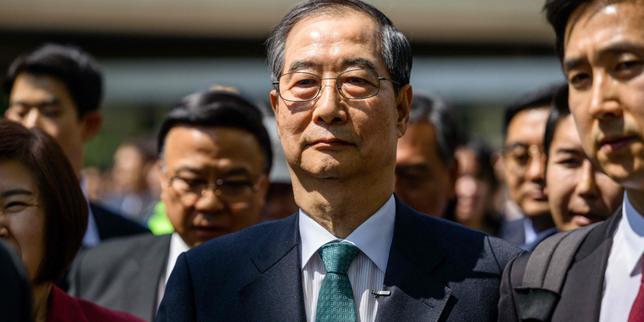
The air inside the Seoul High Court doesn't circulate. It settles, heavy with the scent of old paper and the quiet, crushing weight of institutional history. When Han Duck-soo stood to hear his fate, he wasn't just a man in a suit. He was a symbol of a decades-old friction between the lightning-fast ascent of South Korean industry and the slow, grinding gears of its judicial system.
The verdict was a number: fifteen.
Fifteen years. For a man of his stature, a former Prime Minister who once navigated the high-stakes corridors of international trade and domestic policy, the sentence reduction from an initial eighteen years felt less like a victory and more like a slightly more comfortable suffocation. The courtroom was silent, but the implications screamed. This wasn't just about one man’s corruption; it was about the crumbling architecture of the chaebol era.
The Architect and the Abyss
To understand Han Duck-soo, you have to understand the pressure cooker of Seoul. Imagine a city that rebuilt itself from ash to neon in a single generation. That kind of speed requires shortcuts. It requires "favors." In the West, we call it lobbying. In the shadow of the Blue House, it often morphs into something far more intimate and far more dangerous.
Han was an architect of the system. He knew where the levers were hidden. The prosecution's case painted a picture of a man who didn't just walk the line between public service and private gain—he erased it. The core of the scandal involved millions in bribes, funneled through layers of corporate shell games, all designed to ensure that certain industrial titans kept their grip on the nation’s pulse.
But facts are cold. The reality for the average citizen in the Myeong-dong district, watching the news on a giant LED screen while clutching a coffee, is much warmer and more painful. Every won diverted into a politician’s pocket is a won taken from the social safety net of a country with the world's lowest birth rate and a skyrocketing cost of living.
The Cost of a Handshake
Consider a hypothetical shop owner in Busan named Min-jun. Min-jun works sixteen hours a day. He pays his taxes. He follows the rules. To him, fifteen years or eighteen years for a Prime Minister is an abstraction. What isn't abstract is the feeling that the game is rigged. When the people at the top trade policy for profit, the gravity of that corruption pulls hardest on the people at the bottom.
The defense argued for leniency based on Han's "contributions to the nation." It is a classic refrain in South Korean legal battles. It suggests that a lifetime of building the economy should act as a shield against the consequences of breaking the law. The court, however, chose a middle path. By reducing the sentence to fifteen years, the judges acknowledged his age and his service, but they refused to let him walk.
This tension defines the modern Korean soul. There is an immense pride in the global dominance of Samsung, LG, and Hyundai. Yet, there is a growing, burning resentment toward the "Golden Spoon" culture that allows the elite to bypass the hardships the rest of the population endures.
The Paper Trail of a Fallen Star
The evidence wasn't just a collection of bank statements. It was a diary of entitlement. The court pored over records of lavish "consulting" fees that were, in reality, payments for access. The trial revealed how deeply the rot had settled into the foundation.
The reduction of the sentence was a calculated move. In the South Korean judicial landscape, judges often face immense pressure to balance the "national interest" with the letter of the law. If they are too harsh, they risk destabilizing the corporate confidence that keeps the economy afloat. If they are too light, they risk a popular uprising.
Fifteen years is a lifetime when you are already in the winter of your career. It is a sentence that says: We remember what you did for us, but we cannot ignore what you did to us.
A Culture in Transition
We often think of justice as a blindfolded goddess, but in Seoul, she has her eyes wide open, watching the stock tickers and the protest banners. The Han Duck-soo case is a mirror reflecting a society in the middle of a painful metamorphosis. The old guard, those who believe that economic growth justifies moral flexibility, is dying out. A younger generation is demanding a transparency that the system wasn't built to provide.
The tragedy of Han Duck-soo isn't the loss of his freedom. The tragedy is the betrayal of the promise of the Republic. Every time a leader of his caliber falls, a little bit of the public’s faith in the future dissolves. It’s the feeling of a glass vase shattering on a marble floor—you can glue the pieces back together, but the cracks will always show.
The bribe-takers and the power-brokers often convince themselves they are doing what is necessary for the "greater good." They see themselves as the grease that keeps the engine of the state from seizing up. They forget that grease, when left too long, turns into sludge.
The Shadow in the Cell
As Han is escorted back to his cell, the city of Seoul continues its relentless march. The neon lights of the Gangnam district flicker with the same intensity. The subways remain punctual to the second. But the silence in the wake of the verdict speaks volumes.
There is no "clean" way to end a story like this. There is only the lingering question of who will fill the vacuum. If the system only swaps one corrupt architect for another, then the fifteen years Han Duck-soo spends behind bars will be nothing more than a temporary pause in a long, downward slide.
The real verdict isn't written in the court transcripts. It’s written in the eyes of the students studying for the civil service exam, hoping against hope that the meritocracy they were promised actually exists. They are the ones who will ultimately decide if fifteen years was enough to pay for a stolen legacy.
The cell door closes with a finality that no legal appeal can soften. Outside, the world moves on, indifferent to the man who once thought he held the sun in his hands, only to find he was holding a handful of cooling coals.